
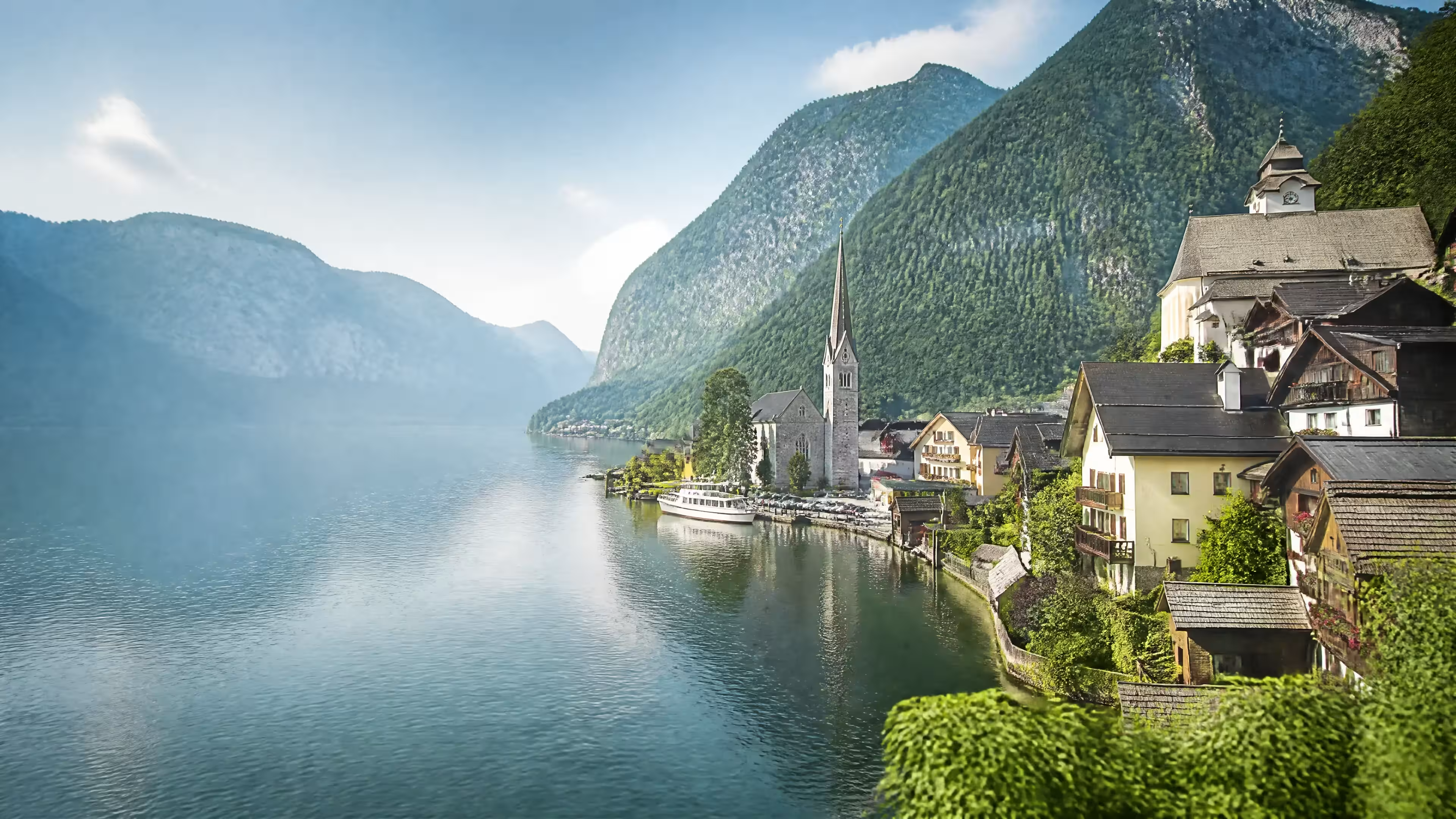
Tours to Austria from Ust-Kamenogorsk: prices
Instalments up to 24 months on any tour A manager replies within 15 minutes
Tours to Austria
Resorts of the country
No data yet
We have no supplier prices for this destination yet. Leave a request and a manager will quote a price and check availability.
Leave a requestLow-price calendar for tours to Austria
The lowest price by month for the chosen destination.
Tour collections for Austria

How to buy a tour to Austria
- 01
Find a tour
Departure city, destination, dates, nights and who is travelling — five fields in one row.
- 02
Choose and book
Compare the price for two, the board and the beach line, then hold your choice with a request.
- 03
Pay
By card, in instalments through a bank, by bank transfer or in cash at the office.
- 04
Get the documents
The contract, the voucher, the insurance policy and the itinerary receipts arrive by e-mail.
Tours to Austria: facts for the traveller
Ready to travel?
Leave a request and a manager will suggest options for your budget, dates and party.
Tours to Austria: what to know
Austria attracts tourists all year round: in winter — with the ski resorts of Innsbruck and thermal complexes, in summer — with festivals in Vienna and Salzburg and walks through Alpine meadows. The journey from Ust-Kamenogorsk begins with a flight to Almaty, from where direct flights and convenient connections lead to Vienna, Salzburg and Innsbruck. The optimal duration of the trip is from a week, and it is better to book hotels and tickets several months before departure.
Flight and trip preparation
The journey to Austria begins with a flight to Almaty, and from there tours to Austria from Ust-Kamenogorsk lead to Vienna, Salzburg or Innsbruck. Preparation should begin in advance.
Routes and connections via Almaty
Daily flights operate from Ust-Kamenogorsk to Almaty, the journey takes about two hours. The Istanbul connection is usually the shortest, the airport is large, but the transfer takes place without changing terminals. The Austrian side welcomes guests at the airports of Vienna, Salzburg and Innsbruck.
| Corridor | Feature | To Vienna and Salzburg |
|---|---|---|
| Istanbul | Shortest connection | Transfer without changing terminals |
| Dubai | Longer flight | Night departures, day in the city |
| Frankfurt | Direct trains | Direct trains to Vienna and Salzburg |
Insurance and preparations for the journey
An insurance policy with coverage from thirty thousand euros is a mandatory condition for a trip to Austria. It should be arranged for the entire duration of the holiday in Austria and the printout kept at hand. Medical insurance covers treatment, hospitalization and repatriation of the body, while the extended version includes active sports. For ski tours to Austria a separate option for injuries is needed. The policy is purchased in advance, often together with the hotel booking. Confirmation of accommodation booking and return tickets are kept in a folder in hand luggage. Copies are sent to yourself by email. Insurance is arranged for each traveler, including children.
When is the best time to go to Austria
Austria is good all year round, but the character of a holiday in Austria strongly depends on the month. Below is how the high season and the calm shoulder season look.
High season and school holidays
Peak demand falls on July, August and the Christmas weeks. At this time hotels in Vienna and Salzburg become noticeably more expensive, and rooms are booked several months in advance. In summer music and opera festivals take place in Austria, tickets for them should be bought in advance. In winter the country attracts skiers, but besides skiing thermal resorts and Christmas markets are popular. Holidays in Kazakhstan partially coincide with European ones, so the end of December and the first days of January are the busiest dates. The Austrian railway operates under increased load on these days, seats on trains are snapped up quickly. A holiday in Austria in high season requires planning six months ahead. Those who travel for tranquility should shift the dates by a couple of weeks.
| Season | Features | Recommendations |
|---|---|---|
| July, August | Music and opera festivals | Buy tickets in advance |
| Christmas weeks | Christmas markets, thermal resorts | Rooms are booked several months in advance |
| End of December, first days of January | Coincidence of holidays in Kazakhstan and Europe | The busiest dates |
| Winter | Skiers, increased load on the railway | Seats on trains are snapped up quickly |
| High season | Hotels in Vienna and Salzburg become more expensive | Planning six months ahead |
| Calm holiday | Less load | Shift the dates by a couple of weeks |
Shoulder season: prices and number of tourists
In spring and autumn Austria empties out, and accommodation prices fall by a third. April and May delight with blooming Alpine meadows, but high-altitude trails are still closed. September and October are a velvet period for Vienna and Salzburg: warm, dry, museums without queues. Rains in the shoulder season are more frequent, so an umbrella and a waterproof jacket are essential. A holiday in Austria at this time is chosen by those who want to stroll calmly through the old quarters. Excursions in Innsbruck and Salzburg are conducted without crowds, guides are freer. Austrian autumn is good for wine cellars and thermal springs. Prices for flights via Almaty in October are also lower than in July. Such a holiday in Austria suits couples and older travelers.
How to get around the country
Within Austria it is easy to manage without a car: the country is compact, and transport is linked into a single network. Let's look at what to use between cities and within them.
Trains and buses between cities
Trains run between Vienna, Salzburg and Innsbruck, the journey takes several hours and does not require renting a car. The Austrian railway offers tickets for a specific train and day passes. From Vienna to Salzburg the train takes about two and a half hours, from Salzburg to Innsbruck — about two hours. Buses are cheaper than trains, but take longer and often get stuck in traffic jams on highways. Tickets are bought at a machine at the station or in the carrier's app. Early booking gives a discount of up to half the price. The Austrian network also covers small towns where trains do not go. For long journeys a night train with sleeper seats is convenient. Vienna remains the main hub from which all directions radiate.
Urban transport and car rental
Public transport in Austrian cities runs on a single travel pass, and tickets are conveniently bought from machines or in an app. In Vienna, the metro, trams and buses cover the entire center, and a day ticket pays for itself after three rides. In Salzburg and Innsbruck, a tram and walking are enough. Renting a car will require an international driver's license and payment for parking. In the center of Vienna, parking is paid and expensive, and many streets are closed to traffic. Austrian roads are excellent, but in winter you need chains and winter tires. A car is taken by those who plan to travel around villages and thermal resorts. For a short holiday in Austria, a rental is often not needed.
What to consider on a trip?
Household details decide how comfortable the holiday will be. Money, food and local habits are what you should know in advance.
Euros, cards and cash
The country's currency is the euro, cards are accepted almost everywhere, but a small supply of cash will come in handy for markets and small cafes. The Austrian habit of paying by card even for coffee has long been the norm. ATMs in Vienna and Salzburg are common, but withdrawals outside the issuing bank incur a commission. It is more profitable to withdraw a large amount once than to withdraw a little every day. In Innsbruck and mountain villages, not all shops have terminals. Cash is kept in two different places so as not to lose everything at once. Austrian sellers calmly accept small banknotes. Tips and small purchases are more conveniently paid with coins. The exchange rate at the airport is always worse than in the city.
Cafes, restaurants and tips
Lunch in the tourist center costs more than in residential areas where locals have lunch. Austrian cuisine is known for Wiener schnitzel, Tafelspitz, strudel and coffee houses where it is customary to sit for a long time. In Vienna, coffee is served with a glass of water, and no one rushes the guest. During the day it is more profitable to take a set menu; in the evening prices are higher. Tips in Austria are usually left at about five to ten percent of the bill if the service suited you. In Salzburg and Innsbruck, portions are generous, and one is often enough for two. Austrian coffee houses work from morning until late evening. Vegetarian dishes are on almost any menu. Tap water in Austria is drinkable and free.
How to put together a route and not overpay?
The logic of the route and early booking save more than any discounts on the spot. Here is how to connect the cities and when to buy tickets.
Combinations of Vienna, Salzburg and Innsbruck
The classic triangle Vienna — Salzburg — Innsbruck is done in a week without haste. From Vienna to Salzburg they go by train, then descend to Innsbruck and return to the capital. The Austrian railway connects all three cities with direct trains. It is reasonable to leave three days for Vienna, two for Salzburg, and two for Innsbruck. Between them it is convenient to squeeze in Hallstatt or the Salzkammergut. The return journey from Innsbruck to Vienna takes about four hours. Such a route is suitable both in winter and in summer. The Austrian side offers single tickets for several journeys. A holiday in Austria along such a ring comes out cheaper than three separate trips.
Booking hotels and tickets in advance
Early booking in Austria noticeably lowers the price of a room, especially in Vienna and Salzburg. Hotels in the center are taken first, and the remaining places are only expensive. Train tickets are more profitable to buy a month in advance: then a discounted fare applies. Austrian museums and palaces also sell entrance tickets online without a queue. Summer festivals and winter fairs require booking several months ahead. Insurance and transfer are arranged together with the hotel so that everything is in one place. Flexible fares with free cancellation cost more, but save you when plans change. Austrian practice is this: the earlier, the cheaper.
Briefly
- From Ust-Kamenogorsk they fly via Almaty, with a connection in Istanbul, Dubai or Frankfurt.
- Insurance with coverage from thirty thousand euros is needed for the entire duration of the trip.
- In summer and during the Christmas weeks it is more expensive; in April and October it is calmer and cheaper.
- Vienna, Salzburg and Innsbruck are connected by direct trains; a car is not always needed.
- Hotels, train tickets and museums are booked in advance — that way it comes out cheaper.
Tours by destination and departure city
Turkey
Tours to Turkey from Almaty Tours to Turkey from Astana Tours to Turkey from Shymkent Tours to Turkey from Kostanay Tours to Turkey from Aktobe Tours to Turkey from AktauEgypt
Tours to Egypt from Almaty Tours to Egypt from Astana Tours to Egypt from Shymkent Tours to Egypt from Kostanay Tours to Egypt from Aktobe Tours to Egypt from AktauUAE
Tours to UAE from Almaty Tours to UAE from Astana Tours to UAE from Shymkent Tours to UAE from Kostanay Tours to UAE from Aktobe Tours to UAE from AktauFrequent questions about tours to Austria
For ski holidays choose the period from December to March. For sightseeing in cities, May, June and September are suitable.
There are no direct flights, so tours include a transfer. Usually the journey takes from ten hours.
Vienna, Salzburg and Innsbruck are considered the main points of the route. Each city reveals its own side of Austria.
Yes, there are calm resorts and convenient slopes for beginners. Holidays in Austria will suit both children and adults.
In the mountains it is frosty and snowy, in cities it is milder. Austrian winter delights snow lovers.
For mountain slopes you need skis, a helmet and warm clothing. All of this can be rented at the resort.
In summer, hiking routes, lakes and bicycle rides are popular. Tours in this season are calmer and cheaper.
People often buy chocolate, coffee and wool products. In Vienna and Salzburg there are many craft shops.
A week is enough to get acquainted with two cities. Tours for ten days allow you to add the mountains.
Austrian cuisine and accommodation are not cheap. The budget can be reduced in the shoulder season.
Convenient trains run between Vienna, Salzburg and Innsbruck. It is better to buy tickets in advance.
It is worth ordering schnitzel, strudel and Viennese coffee. In Salzburg local desserts are served.
Reviews of tours to Austria
What travellers write afterwards: the hotel, the dates and what is worth knowing in advance.
No data yet
No one has left a review yet. Yours would be the first.
Write a review
The review appears on the site after a moderator checks it.
Destination guide
Short guides: season, hotels, money and documents.
Are international driving permits required
The answer depends on the country and on whether you plan to get behind the wheel.
ReadHow to dress when visiting temples
Many tourists wonder in advance how to dress when visiting temples. Modesty rules apply in mosques, Hindu and Buddhist temples.
ReadOnline check-in for the flight
Online check-in opens 24 hours before departure. The procedure takes a few minutes and saves you from queues at the airport. Check that your luggage meets the baggage allowance.
ReadConsent for a child's departure
Consent for a child to travel abroad is arranged in advance. A notary in Almaty certifies a power of attorney for the accompanying person. Parents decide who will take the minor on the trip.
ReadHand luggage rules
Hand luggage is the items a passenger takes into the aircraft cabin. Airlines set their own weight and size standards. Carriage of large bags in the cabin is usually not allowed.
ReadTransfer between flights
A transfer between flights is a stop at an intermediate airport, after which the traveler continues the journey on another plane.
Read