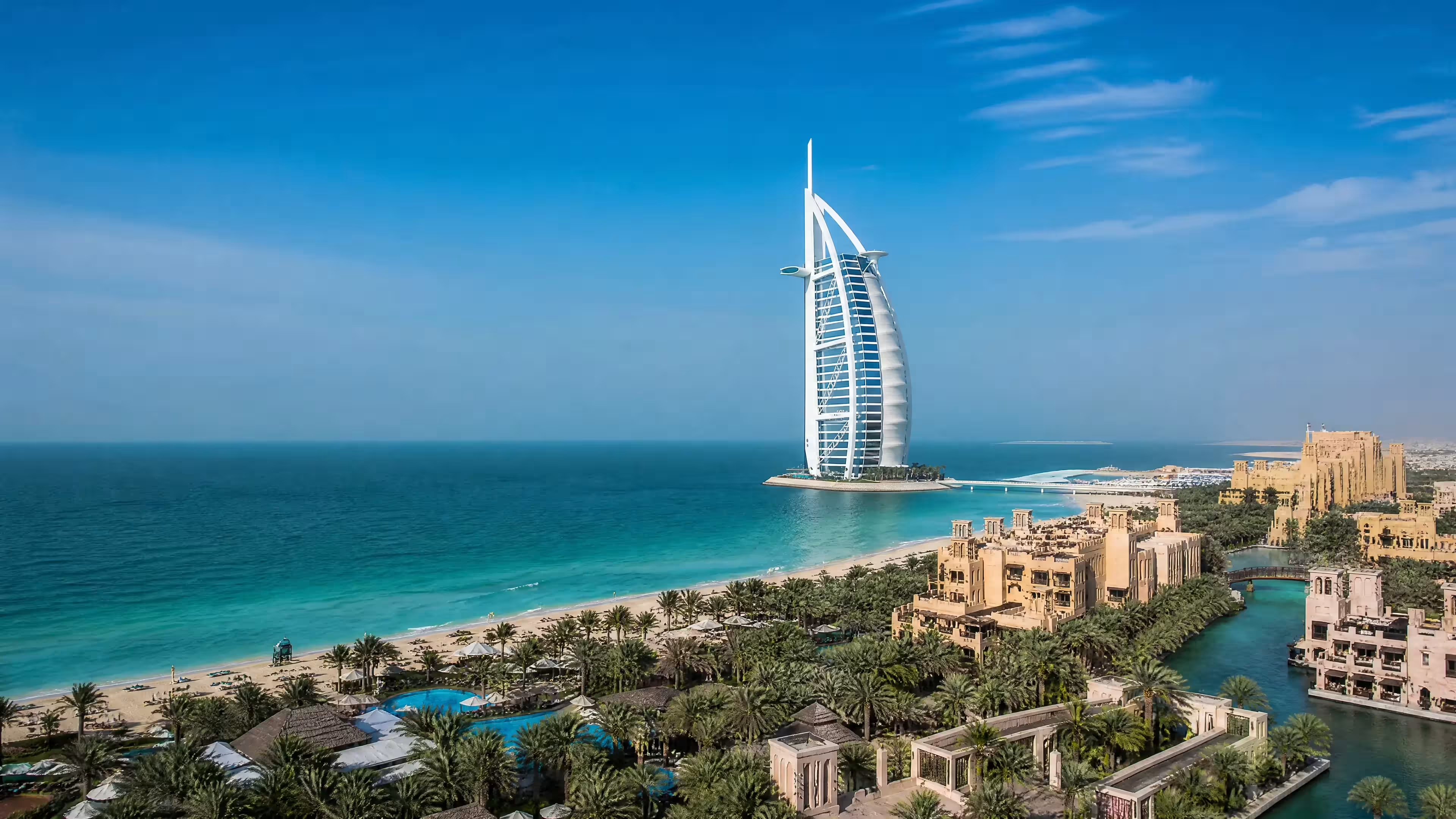
The best time for tours to the UAE from Almaty is from October to March, when daytime temperatures stay at a comfortable +25–30°C, and the water in the Persian Gulf warms up to +24°C. During this period, holidays in the UAE will cost more: hotel and flight prices reach their peak, especially during the New Year holidays.
When is it cheaper and more comfortable to holiday in the UAE by season and weather?
The climate of the Emirates dictates two distinct seasons, and the choice of travel dates directly determines the budget and comfort of a holiday in the UAE. A tourist from Almaty should decide in advance what matters more: mild weather or saving on flights.
High season from October to March: ideal weather and peak prices
From October to March, Dubai and Abu Dhabi maintain temperatures around +25–30°C, with water in the Persian Gulf warmed to +24°C. This is the best time for beach holidays, desert excursions, and long walks along the waterfronts. These months see the main flow of tourists from Kazakhstan, so hotels and airlines raise prices to the maximum. The difference in prices between seasons reaches double. Tours to the UAE for the New Year holidays and spring break should be booked two to three months in advance, otherwise the choice will be limited. In the evening, a light sweater may be needed, but the air conditioning in shopping malls works so powerfully that it will come in handy even during the day.
Summer months: saving on flights and hotels versus daytime heat
From June to September, the thermometer in the Emirates consistently exceeds +40°C, and the humidity on the coast makes being outdoors almost impossible. However, a holiday in the UAE in summer costs 30–50% less than in winter, and this attracts budget-conscious travellers. All life during this period is concentrated inside hotels, shopping galleries, and water parks, where air conditioning runs at full capacity. Water parks in Dubai and Sharjah operate on a special night schedule in summer, allowing you to walk without the risk of heatstroke. If your budget is limited but you want to see the country, choose the summer months and plan activities for the morning or evening.
Ramadan: how the rhythm of life changes and what it means for tourists
Ramadan is the holy month of the Muslim calendar, the dates of which shift by 10–11 days each year. During this time, special rules apply in the UAE: eating, drinking, and smoking in public places is forbidden during daylight hours, and many restaurants are closed during the day. For a tourist from Almaty, this means having breakfast in the hotel room or in specially designated areas. In the evening, after sunset, life in the Emirates buzzes: restaurants open, iftars take place — ceremonial meals breaking the fast. Accommodation prices drop during this period, but the entertainment programme is reduced, and nightclubs stop working altogether. If you are not ready to adjust your schedule to local traditions, it is better to choose another time for your trip.
What documents and entry rules apply for Kazakhstani citizens?
The UAE opens its doors to Kazakhstani tourists without unnecessary formalities, but a number of conditions must be met. Preparing documents takes minimal time if you check all the details in advance. A mistake in the validity period of your passport can cost you a ruined holiday.
Passport and its validity period: the main condition for the flight
To enter the Emirates, a citizen of Kazakhstan only needs a passport valid for at least 6 months from the date of entry. This rule is strictly enforced, and Dubai border control checks it first, so before buying a tour, be sure to check the expiry date of your document. If your passport expires sooner than six months, the trip will have to be postponed until you obtain a new one. Children under 16 are included in their parents' passports, but for travelling abroad they require their own travel document. Please note that the airline will also check the passport validity when checking in for the flight in Almaty, and being late to the counter due to this issue will be your responsibility.
Visa-free regime: 90 days of stay within six months
A tourist trip to the UAE for Kazakhstani citizens does not require a visa, and the total length of stay is limited to 90 days within 180 days. This means you can stay in the country continuously for up to 90 days, after which you must leave for the same period. For a short two-to-three-week holiday, this restriction causes no inconvenience, and the entry stamp is issued free of charge right at the airport. It is important to remember that exceeding the permitted period carries a fine upon departure, so keep track of the dates yourself. A holiday in the UAE from Almaty usually lasts from 7 to 14 days, which fits comfortably within the visa-free limits.
Insurance and medications: what to arrange and how to carry them
Medical insurance is not a mandatory condition for entry, but it is worth taking out: treatment in Emirates clinics is expensive, and a policy with coverage from 30,000 USD will save you from unexpected expenses. When choosing insurance, pay attention to whether it includes holidays with children and active entertainment such as diving or dune safaris. As for medications, the UAE has a strict ban on the import of narcotic substances, including codeine and strong sleeping pills, even if prescribed by a doctor. Such drugs require a prescription translated into English and notarised, while regular fever reducers and painkillers can be carried without issues. Leave herbal tinctures and unlabelled products at home — their composition will raise questions at customs.
How to plan a flight and travel around the Emirates
The transport system of the UAE is excellently developed, but requires understanding of local payment and booking rules. A flight from Almaty takes only a few hours, and inside the country tourists are waiting for a modern metro and high-quality roads.
Direct flights from Almaty: travel time and what to consider when booking
Direct scheduled flights from Almaty to Dubai operate daily, with a flight time of about 4.5–5 hours. This is convenient for families with children and those who do not like long layovers, because in one short flight you find yourself in a different climate zone. The time difference with Almaty is 1 hour all year round: the UAE is on UTC+4, Kazakhstan on UTC+5. Return flights usually depart late in the evening, which gives you the opportunity to spend your last day in Dubai without rushing. If you are flying to Abu Dhabi or Sharjah, there are fewer direct flights from Almaty, but from Dubai it is easy to get to neighboring emirates by taxi or bus. A well-planned travel route will save both time and money.
Metro, buses and taxis: how to pay for fares without cash
Dubai and Abu Dhabi have modern metro systems, and paying cash to a bus driver is impossible — you need a Nol card in Dubai or a Hafilat card in Abu Dhabi for travel. These cards are sold at ticket machines at metro stations and at ticket offices, and they can be topped up with the required amount. Dubai Metro is the fastest way to get from the airport to the city center, and the red line runs along the main attractions. Taxis in the emirates operate on a meter, the boarding fee is about 5–8 dirhams, and card payment is accepted without any problems. For trips along the waterfront and within one district, it is convenient to use aggregator apps where the price is fixed in advance.
Car rental: age and license requirements
Car rental in the UAE is available from age 21, and in some companies — only from age 25, and an international driving permit is required for Kazakhstani licenses. National licenses of Kazakhstan are not recognized by local rental companies, so obtain an international document in advance in Almaty. The cost of renting an economy sedan starts from 100 dirhams per day, and gasoline in the Emirates is significantly cheaper than in Kazakhstan. Traffic in Dubai is heavy, but rules are strictly observed, and speeding fines are automatically issued from cameras. For trips between emirates, for example from Dubai to Abu Dhabi, a rented car gives you freedom, but parking in the center is paid and requires payment through an app.
What is important to know about local laws and customs
Culture and rules of conduct in the UAE differ greatly from Kazakhstani ones, and ignorance of local laws does not exempt from responsibility. It is enough for a tourist to observe basic norms of decency and watch their behavior in public places.
Dress code: how to dress on the street, in shopping malls and near mosques
In public places in the UAE there is a strict dress code: a swimsuit is appropriate on the beach, but outside of it shoulders and knees must be covered, especially in shopping malls and on the street. For women, this means avoiding short shorts and strappy tops when leaving the hotel, although in Dubai tourists are treated more loyally than in Sharjah. When visiting a mosque, for example Sheikh Zayed in Abu Dhabi, women need closed clothing and a headscarf, and men need long trousers, while shoe covers and abayas are provided free of charge at the entrance. Beachwear is acceptable only on the beach or by the pool, and in a hotel elevator it is better to throw on a pareo over a swimsuit. Following these simple rules will save you from comments and create a comfortable atmosphere for everyone. Respect for the country's traditions is the key to a calm holiday in the UAE.
Alcohol and photography: strict prohibitions and fines
Consumption of alcohol in public places in the UAE is prohibited, and it can only be bought in licensed stores, often located at hotels, upon presentation of a passport. Drinking alcohol on the beach, in a park or on the street is not allowed — this carries a large fine and even deportation. Taking photos of people without their consent is also prohibited, as is filming government buildings and military facilities; violating this rule may attract police attention. In hotels and restaurants, alcohol is served freely, but a state of strong intoxication in a public place is considered an offense. A tourist from Kazakhstan should remember that local laws apply to everyone without exception, regardless of citizenship.
Tips and taxes: how prices work in restaurants and stores
The UAE has a sales tax (VAT) of 5%, which is already included in price tags in stores, so you will not have to pay extra at the checkout. In restaurants, tips are often included in the bill (usually 10–16%), and leaving additional tips is not necessary, although no one will refuse gratitude. In fast food cafes and street kiosks, tips are not expected at all. Prices in supermarkets and boutiques are fixed, and bargaining is only appropriate at markets and souvenir shops. If you are planning shopping, know that for purchases above a certain amount you can get a tax refund upon departure through special counters at the airport.
How to prepare for the trip: communication, food and little things
Preparing for a holiday in the UAE from Almaty includes several practical points that make the trip more comfortable. Little things like a plug adapter or a local SIM card matter more than it seems at first glance.
Local SIM card for calls to Kazakhstan: what to choose
For calls from the UAE to Kazakhstan, it is cheaper to buy a local SIM card from du or Etisalat operators upon presentation of a passport. The cost of a starter package with internet traffic is about 50–100 dirhams, and this is enough for two weeks of active use. Calling Kazakhstan via messengers is more convenient than through regular telephone communication, so the main selection criterion is the amount of mobile internet. At Dubai airport, there are counters of both operators where you can connect immediately after arrival. Roaming from Kazakhstani operators will cost significantly more, so a local SIM card is a reasonable saving. Pack your suitcase in advance so as not to waste time looking for the things you need on site.
Water, sockets and adapters: what will come in handy at the hotel
It is not recommended to drink tap water in the UAE, although hotels often provide it free of charge in bottles upon check-in and replenish it daily. In a hot climate, the body needs more fluid, so take a reusable bottle with you and fill it at the hotel restaurant. The UAE uses a British-type socket with three flat pins, so you will need an adapter, which is provided at the hotel or sold at any supermarket for 10–15 dirhams. The mains voltage is the same as in Kazakhstan — 220 V, so your devices will not be damaged. A toothbrush and toothpaste are usually not provided in hotels, so bring them from home.
Friday and Saturday are weekends: how this affects your plans
In the UAE, Friday and Saturday are weekend days, and government institutions on Friday work only until noon. For a tourist, this means that on Friday morning it is better to avoid trips to banks and administrative buildings, while shopping malls, on the contrary, are open longer and offer special promotions. On Friday afternoon, main prayers are held in mosques, so during this period some streets are closed and entry to mosques for tourists is restricted. Restaurants and hotels operate as usual, but dinner at popular places should be booked in advance. When planning sightseeing tours, keep in mind that on Friday morning they may start later than usual.
Visa and entry rules change: check the primary source — the UAE Federal Authority for Identity and Citizenship, https://icp.gov.ae/en/. The information on this page was verified on 09.09.2026.
In brief
- The best season for beach holidays in the UAE from Almaty is from October to March, when daytime temperatures are around +25–30°C.
- Summer tours to the UAE are 30–50% cheaper, but due to the heat above +40°C, plan activity for the morning.
- Kazakhstani citizens do not need a visa to the UAE, and their passport must be valid for another six months from the date of entry.
- A direct flight from Almaty to Dubai takes 4.5–5 hours; to Abu Dhabi you need to fly with a transfer.
- During Ramadan, it is difficult for tourists to eat in public places during the day, but accommodation is cheaper.