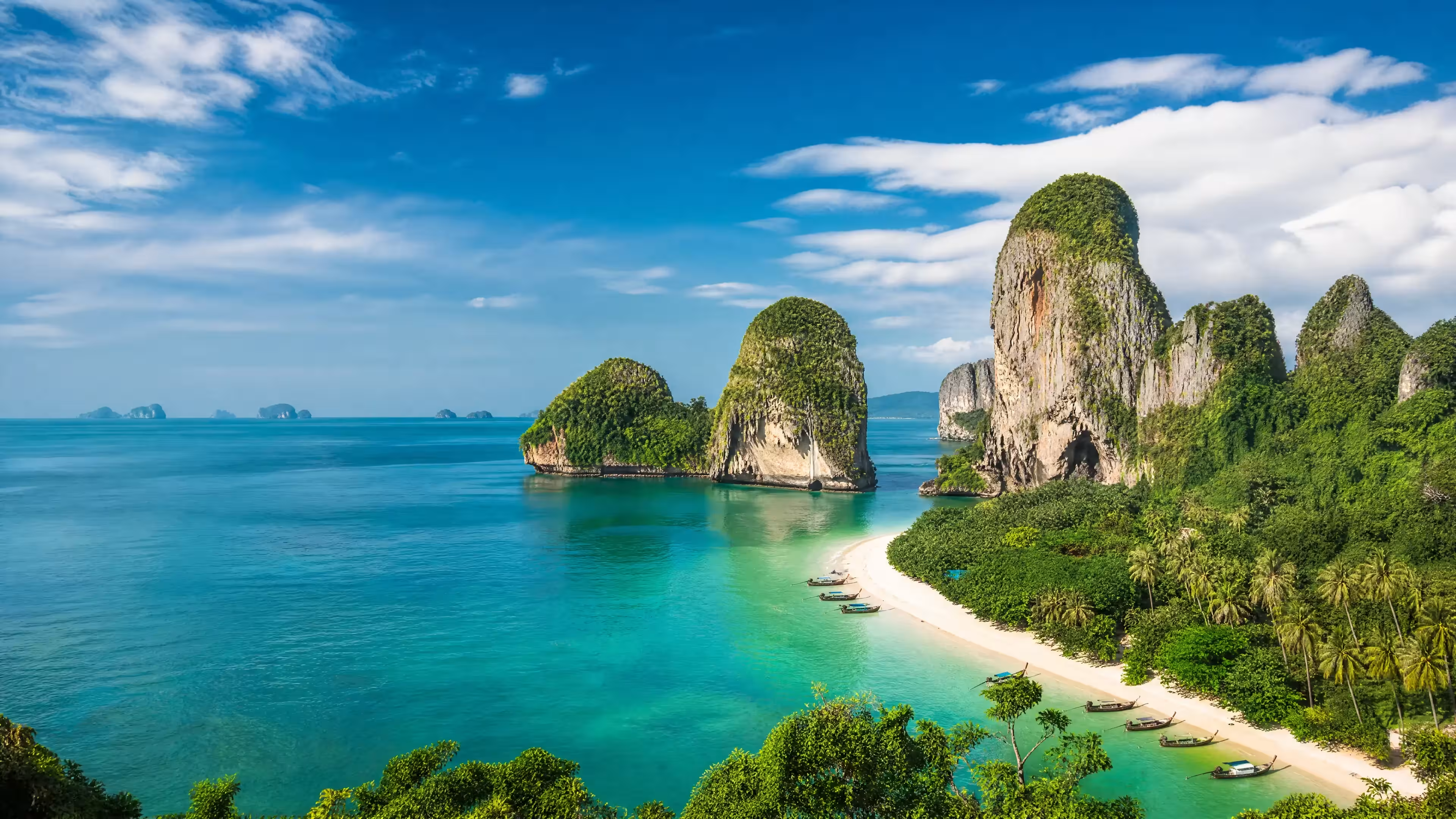
The best time for tours to Thailand is from November to February, when it is dry and sunny in Phuket and the sea is calm. During these months, accommodation prices rise by 1.5–2 times, so hotels need to be booked in advance. To save money, choose May or November: the weather is already good, and the resorts are half-empty.
What you need to know before buying tickets
There is no direct flight from Almaty to Phuket, but this does not make a holiday in Thailand unattainable. Most often, tourists fly with a transfer in Bangkok, and from there they get to the desired resort.
How to get there and how long the journey will take
A flight from Almaty to Bangkok with one stopover takes from 10 hours, including waiting at the transfer airport. A morning arrival in the capital of Thailand is more convenient: you can make it to a domestic flight to Phuket or a bus to Pattaya the same day. An evening connecting flight often means an overnight stay in Bangkok, which lengthens the journey and adds hotel costs. Night buses to southern resorts save your budget but are more tiring than a one-hour flight. For families with children, domestic airlines from Bangkok are almost always more convenient than ground transport.
What documents a Kazakhstani citizen needs for entry
For a short trip, a Kazakhstani citizen only needs a passport whose validity covers the entire trip. Tours to Thailand usually last 10–14 days, so check that your passport does not expire before your return flight. When booking a hotel, save the confirmation on your phone — it is sometimes asked for at check-in for the flight. Medical insurance is not mandatory for entry, but without it, any visit to a doctor in Phuket will become a serious expense item. Also keep your return ticket ready: its presence is checked most often.
Why dollars are more convenient than tenge for a trip
In Almaty, tenge can be easily exchanged for dollars, and already in Thailand they can be exchanged for local baht at a favorable rate. Exchange offices in the tourist areas of Phuket and Pattaya work daily and offer a better rate than banks. Cards from Kazakhstani banks are not accepted everywhere: at markets, street cafes, and when paying for taxis, cash is more often needed. Dollars are more convenient because they are accepted at any exchange office without a commission, while tenge are accepted only at a few points. Take both large bills and small change of 20–50 dollars for minor expenses in the first days.
When to go to avoid the rainy season?
Thailand is large, and the weather on its coasts is subject to different monsoons. The choice of month for a trip depends on which resort you plan to visit.
How the coasts of the Andaman Sea and the Gulf of Thailand differ
Phuket and Krabi face the Andaman Sea, while Pattaya, Samui, and Ko Chang lie in the Gulf of Thailand. From November to April, the Andaman coast enjoys dry, sunny weather, ideal for beach holidays. In the same months, short tropical showers are possible in the Gulf of Thailand, which end quickly. From May to October, the picture changes: the gulf is protected from the monsoon, while Phuket and Krabi receive the main share of precipitation. For a holiday in Thailand with children, Pattaya and Samui are more often chosen precisely because of the mild climate in the summer months. If you want a guaranteed dry season, plan a trip to Phuket from December to February.
What happens in Phuket in September and October
In September and October, the sea in Phuket is rough, and red flags prohibiting swimming are posted on many beaches. Waves stir up sand, the water becomes cloudy, and diving and boat excursions are often canceled due to storm warnings. Rain falls almost daily, although it usually does not last all day — a downpour gives way to sun after a couple of hours. Hotels during this period offer discounts of up to 50%, but the savings are unlikely to justify a ruined beach holiday. It is better to postpone a trip to Phuket to November, when the rainy season ends.
In which months do accommodation prices double
From November to February, Thailand is at the peak of the tourist season, and accommodation prices in Pattaya and Phuket rise by one and a half to two times. New Year holidays and Chinese New Year are the most expensive weeks of the year; hotels need to be booked several months in advance. March and April still maintain high prices, but the flow of tourists noticeably decreases. May, June, and September are the velvet season for budget travelers: hotels cost half as much, and beaches are half-empty. For a holiday in Thailand from Almaty, May or November is the most profitable, when the weather is already good and prices have not yet soared.
Planning a route around the islands
Each resort in Thailand offers its own pace of holiday, and the choice of island determines the character of the entire trip. Decide in advance what is more important to you: nightlife, seclusion, or nature.
What to choose: noisy Pattaya or secluded Ko Chang
Pattaya is round-the-clock partying, developed infrastructure, and a huge selection of Russian-speaking cafes and clinics. Ko Chang is a quiet island with jungles, waterfalls, and almost untouched beaches, where life comes to a standstill in the evening. Tours to Thailand for young people and groups of friends are most often taken to Pattaya because of the abundance of entertainment. Families with children and couples seeking peace choose Ko Chang, where there are no noisy bars under the windows. If you want to combine both formats, stay in Pattaya and take a trip to Ko Chang for a couple of days.
How much time to allocate for the journey to Samui and Krabi
Samui has no land connection to the mainland, so you can only get there by ferry or plane. A domestic flight from Bangkok takes about an hour, while a combination of bus and ferry will stretch to 10–12 hours. Krabi is connected to the mainland, but it is also more convenient to fly there from the capital of Thailand — about an hour and a half. If your holiday in Thailand is limited to a week, allow at least a day each way for the journey to Samui or Krabi. For a short trip, it is more logical to stay in Phuket or Pattaya, which are easier to reach.
When is a night bus more profitable, and when is a domestic flight?
A night bus from Bangkok to Krabi or Phuket costs two to three times less than a flight, but takes a whole night of sleep. Thailand's domestic airlines have democratic prices, especially when booking early a month in advance. For a trip to Ko Chang, a night bus is almost pointless: ferries to the island only run during daylight hours. A flight is justified when you are going to Samui or Krabi with children or with a large amount of luggage. For budget travelers used to long transfers, a night bus to Phuket will save a decent amount.
Which route to choose for a first trip
For a first introduction to the country, Pattaya is optimal: two hours by bus from Bangkok, and you are there. This resort forgives planning mistakes — it is easy to find accommodation without a booking and Russian-speaking assistance here. Phuket requires more travel time but rewards you with picturesque bays and clean sea. Samui and Krabi are better left for a second trip, when you have already mastered Thai logistics. Tours to Thailand from Almaty for 10–12 days allow you to combine Pattaya with a short flight to Samui.
What should you consider first on the spot?
Adapting to Thai cuisine, water, and rules of behavior will save you the first days of your vacation. A few simple habits will protect you from stomach upset and awkward situations.
Why you should ask for "mai phet" in street cafes
Thai cuisine is famous for its spiciness, which can be a challenge for an unaccustomed stomach. The phrase "mai phet" means "not spicy," and you should say it with every order in street cafes. Even if a dish is listed on the menu as not spicy, the cook may add chili by default. Street food in Thailand is safe because it is cooked in front of you over high heat, but spices are a matter of taste. For a Kazakhstani tourist, it is better to start with neutral dishes like pad thai and fried rice, adding spiciness gradually.
What water is safe for drinking and brushing teeth
Tap water in Thailand is not drinkable; even boiling does not make it completely safe for a tourist. For drinking and brushing teeth, use bottled water, which is sold everywhere for 10–15 baht per bottle. Hotels in Phuket and Pattaya usually provide free bottles in the room, but just in case, buy a supply at 7-Eleven. Ice in cafes and restaurants is made from purified water, so you can safely add it to drinks. Wash fruit bought at the market with bottled water before eating.
What temple behavior rules are mandatory
When entering a Buddhist temple, you must take off your shoes and leave them at the door, as locals do. Clothing must cover shoulders and knees: shorts and tank tops are not suitable for temples, for either men or women. Women must not touch monks or hand them objects from hand to hand — it is better to place the item on a table. Inside temples, do not raise your voice, do not point at Buddha statues with your feet, and do not turn your back to them for photos. Following these simple rules will show respect for Thai culture and save you from conflicts with locals.
Which tourist mistakes cost the most?
Thailand is a country with lenient laws for tourists, but some violations can ruin your vacation. Knowing local rules will protect your budget and nerves.
Why insurance will not cover treatment without an international driver's license
Renting a bike in Phuket or Samui without an international driver's license is a popular activity that often ends badly. In the event of an accident, insurance companies refuse to pay out if the driver does not have an international license. Treatment for fractures in Thai clinics costs from several thousand dollars, and this amount will fall on your account. Even if you are an excellent driver, another party to the accident may not be so careful. Get an international license before the trip or use taxis and public transport.
What carries criminal liability in Thailand
Thailand has very strict laws about the monarchy, and jokes about the royal family are unacceptable. Insulting the king or members of his family is punishable by imprisonment, and this applies to tourists too. It is also forbidden to speak disrespectfully about Buddhist statues and images of Buddha. Do not take out of Thailand fragments of corals, seashells from protected beaches, or ivory products. Violating these rules carries criminal liability, not just a fine.
What cannot be taken out of the country and how to avoid a fine
Thai customs strictly monitor the export of plant materials, including coconuts and palm leaves. Before departure, check that your luggage does not contain fruit, seeds, or plants — a fine is provided for this. Do not take out sand, starfish, or corals, even if they were bought in a souvenir shop. Restrictions also apply to Thai massage: bottles of oil larger than 100 ml will have to be checked into baggage. If you are unsure about an item, it is easier to leave it in place than to pay a fine at the airport.
Visa and entry rules change: check the primary source — the Ministry of Foreign Affairs of the Kingdom of Thailand, https://www.mfa.go.th/en/page/types-of-visa. The information on this page was verified on 09.09.2026.
In short
- Choose the season by coast: Phuket and Krabi are good from November to April; Pattaya and Samui are good year-round.
- Compare the cost of a flight to Bangkok and internal transport to the resort before booking.
- Check the validity of your passport and the availability of insurance with coverage from 50,000 dollars.
- Take dollars in cash — they will be exchanged for baht at a better rate than tenge.
- In street cafes, ask for "mai phet," and drink only bottled water.