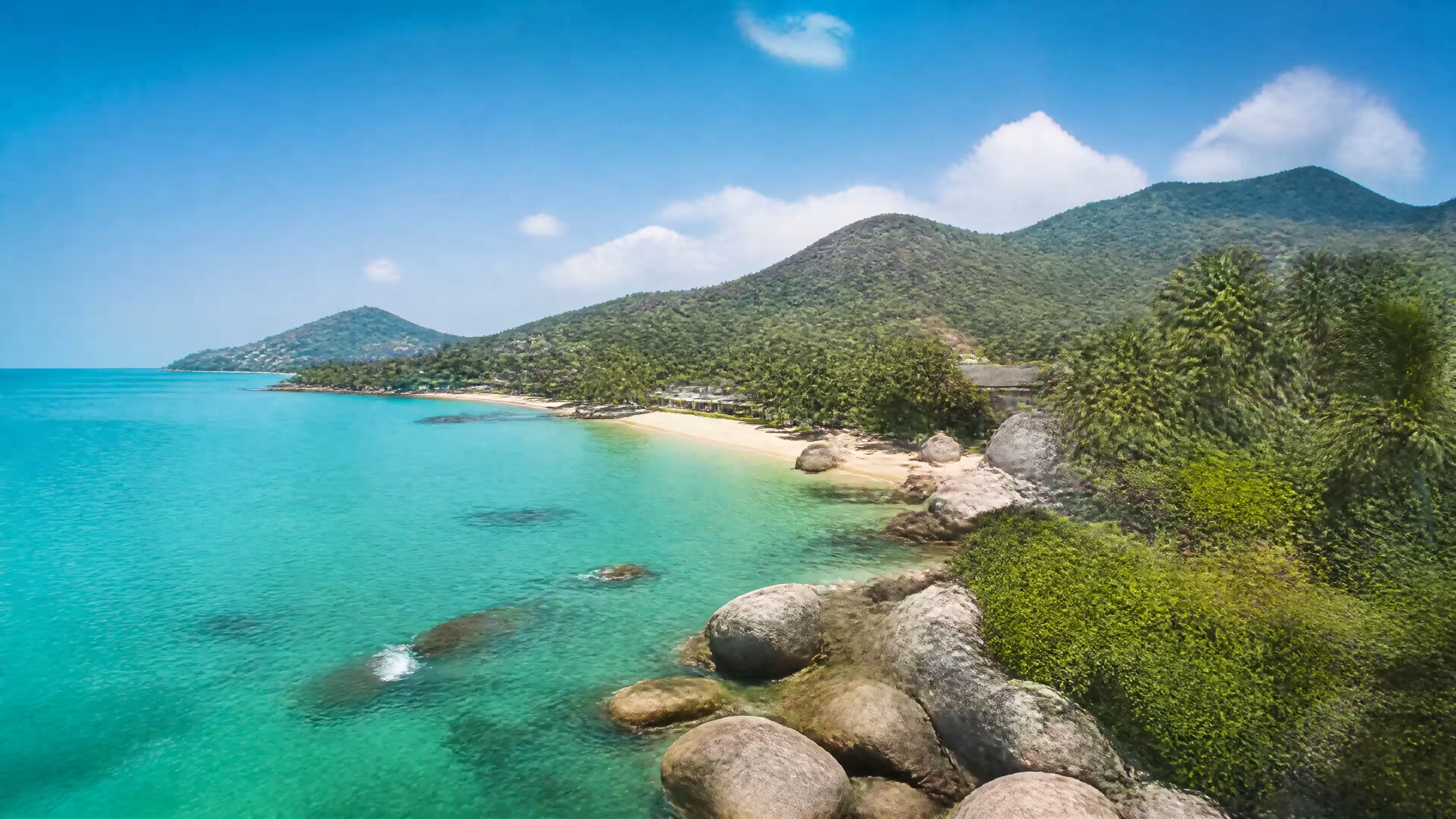
A holiday on Samui is an island in the Gulf of Thailand in Thailand with two seasons: dry from January to March and rainy from October to December. The flight from Almaty always includes a transfer in Bangkok, then an hour to the local airport or a ferry from Surat Thani. The most expensive dates are around New Year, the cheapest is in November.
When is the best time to plan a trip to the island
A holiday here depends on two seasons, and the choice between them determines both the budget and the impressions. Below is a breakdown of how the weather divides the year on the island.
Dry season and high demand for accommodation
The most comfortable trip to Samui comes together from January to March. In these months rain is rare, the sea is calm, and the beaches look like they do in advertising shots. Hotels in high season rise noticeably in price, especially villas with a pool by the water. Tours for New Year dates are bought up several months in advance, and prices during this period are at their maximum. It is worth planning the trip in autumn if January is the goal. Mid-February and March are a little calmer in terms of occupancy. Those who want quiet and available rooms book in advance and choose weekdays.
Rainy season and budget options
From October to December, Samui receives the main part of its annual precipitation. The downpours are short but frequent, the sea is rough, and some beaches on Samui lose their usual look. On the other hand, hotels on Samui become several times cheaper, and tours to Samui cost noticeably less. The weather on Samui in these months is changeable: the morning can be clear, and by midday a wall of rain arrives. The season on Samui in November is considered the wettest. A holiday at this time suits those who are ready to spend their days in spas, cafes, and on sightseeing tours. Prices fall, but some boats and dive spots are closed.
How to get to the island from Almaty
The flight to Samui from Almaty always includes a transfer; there are no direct flights. Then you choose between aviation and a combination with a ferry.
Routes with a transfer in Bangkok
The flight to Samui is most often arranged via Bangkok. Flights from Almaty go to the capital of Thailand, and from there local airlines fly to the island. Samui has its own airport, and the flight from Bangkok takes about an hour. This option is convenient if speed and a minimum number of transfers matter. The connection is planned with a reserve: flights are delayed, and baggage is rechecked separately. Tickets are taken as a single route so that if you are late, the carrier resolves the issue itself. The flight to Samui in high season becomes more expensive, especially for New Year dates.
Combined tickets and ferry crossing
Bangkok and Samui are connected by joint "flight + ferry" tickets from various carriers. First you fly to Surat Thani, then travel to the Donsak pier and cross to the island. The flight to Samui in such a package is cheaper than a direct flight to the local airport. The ferry takes from one and a half to two hours; catamarans are faster. The transfer on Samui from the pier to the hotel is ordered in advance or taken on the spot. During a storm, the crossing is canceled, and this is worth keeping in mind. The combined route takes almost a day, but it saves budget.
Where to stay and how to get around the island?
Hotels on Samui are scattered along the ring road, and the area decides half of the impression. Movement within the island also requires a choice.
Accommodation areas and choosing hotels
Noisy Chaweng is chosen by those who need bars and nightlife. Bophut is quiet and family-friendly, with a gentle entry into the water. Lamai and Chaweng Noi are calmer and greener, with many villas there. Accommodation ranges from guesthouses and bungalows to villas with a pool. Hotels on Samui in high season are booked in advance, otherwise only expensive options remain. Budget guesthouses are concentrated along the main road, not by the beaches. Families are more comfortable on the western coast, where the sea is calmer. Young people are closer to the eastern bays with bars.
Scooter rental, songthaew, and transfer
Scooter rental is the main way to get around, but it requires a license and caution on mountain roads. The roads on Samui wind and are steep in places, and after rain they are slippery. Songthaew — pickup trucks with covered benches — run along the ring road and cost less than a taxi. The transfer on Samui from the airport is ordered in advance so as not to bargain on the spot. A car is taken by those who plan to travel a lot around the island. A helmet is mandatory, and scooter insurance is arranged separately. It is better not to drive at night: lighting is weak.
What to see and what to do?
A holiday here is not limited to beaches: the island has temples, waterfalls, and viewpoints. Water activities and Thai cuisine complete the picture.
Attractions and viewpoints
What to see on Samui is a question the island itself answers. The Big Buddha stands on a hill by the northeastern shore. Na Muang and Hin Lat waterfalls fill with water in the rainy season. A viewpoint on the mountain opens a view of the bay and neighboring islands. Wat Plai Laem temple is known for its statue of Buddha sitting by the water. The fishing village of Bophut turns into a food market in the evening. The old stilt house in Chaweng shows how the island used to live. Viewpoints are best visited in the morning, while it is not hot.
Diving, snorkeling, and Thai massage
Diving and snorkeling near the neighboring islands of Ko Tao and Ko Nang Yuan are considered the best on this coast. Underwater visibility is highest from February to April. Beginners will suit trial dives near the shore, while experienced divers can go out to the reefs. Thai massage and spa treatments are widespread everywhere, and prices depend on the level of the establishment. Street salons charge inexpensively, while hotel spas charge several times more. After diving, you cannot fly for 24 hours; this is taken into account when booking the return flight. Oil massage and herbal compresses are separate types of services. It is worth booking popular spas a day in advance.
How much does a holiday cost and how to prepare?
Prices for tours to Samui depend on the season, and preparation depends on what you plan to do. Let's break down the budget and formalities.
Prices for tours, accommodation, and food
The cost of a holiday in Samui consists of accommodation, food and transport. In high season, hotels in Samui become two to three times more expensive compared to the rainy months. Street food and markets offer Thai cuisine cheaper than hotel restaurants. Dinner at a local cafe costs several times less than at a hotel. Prices for package tours to Samui are usually lower than assembling them independently. Renting a scooter and petrol are inexpensive, while taxis on the island are noticeably more expensive. Excursions and diving are a separate expense item.
Visa, insurance and local money
The local currency is the Thai baht; it is more profitable to exchange money at banks and exchange offices rather than at a hotel. ATMs on the island charge a commission for withdrawing cash from foreign cards. Medical insurance with coverage for active recreation is recommended due to the condition of the roads and the water. Insurance is arranged before departure, not on site. Cash will come in handy where cards are not accepted: at markets and in small cafes. The exchange rate at the airport is less favourable than in the city.
Visa and entry rules change: check with the primary source — the Ministry of Foreign Affairs of the Kingdom of Thailand, https://www.mfa.go.th/en/page/types-of-visa. The information on this page was verified on 10.09.2026.
In brief
- A holiday on the island is most comfortable from January to March, and cheapest from October to December.
- The flight from Almaty goes via Bangkok or with a ferry from Surat Thani.
- Accommodation is booked in advance in high season, otherwise the choice narrows to expensive options.
- The area decides half of the impression: Chaweng is noisy, Bophut is family-friendly.
- A scooter, songthaew and transfer cover almost all movement around the island.