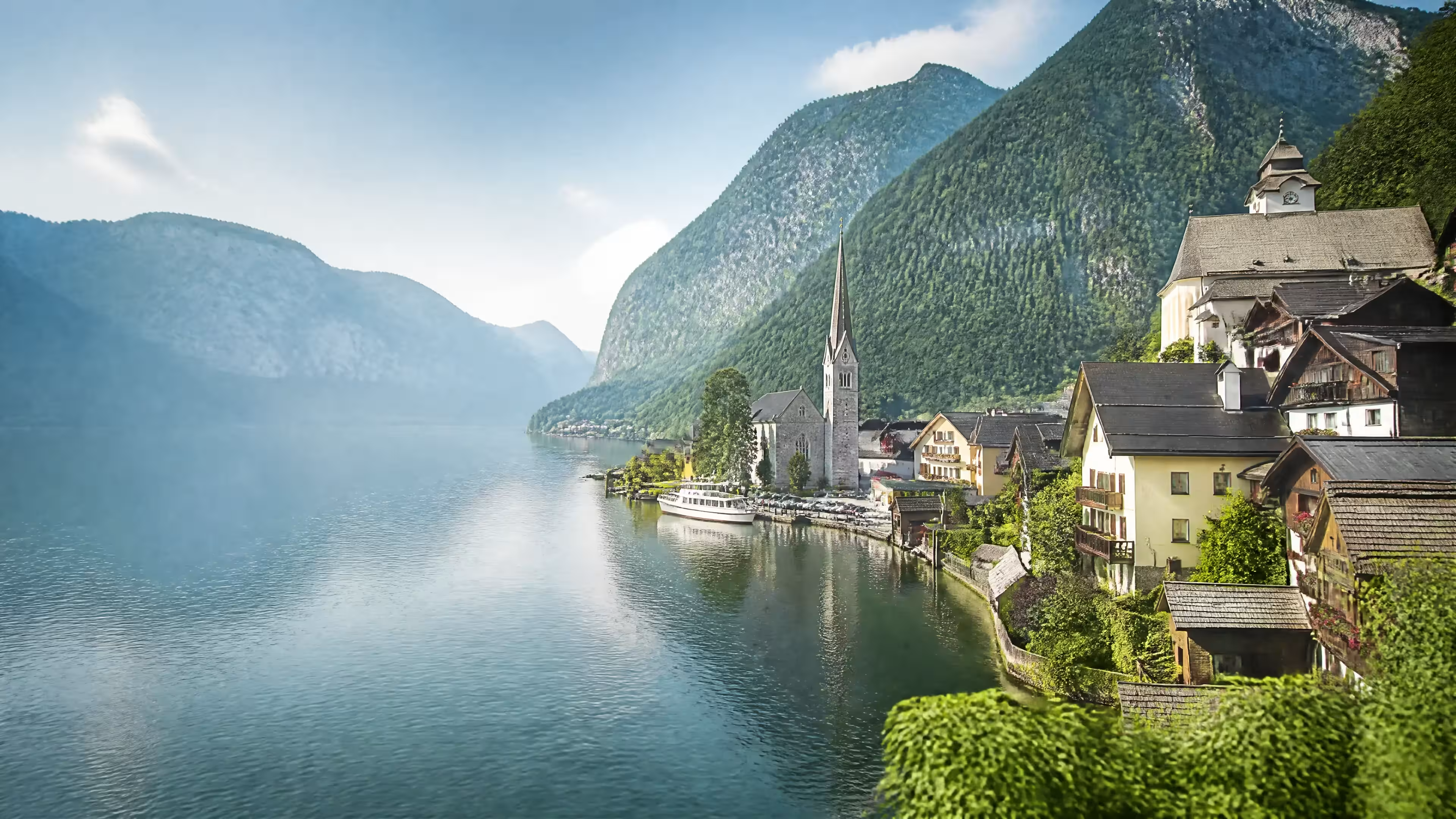
Austria is a year-round holiday destination: in winter people come here for the ski resorts of Tyrol, in summer for sightseeing tours of Vienna and Salzburg and hikes in the Alps. There are no direct flights from Almaty, the journey takes from ten to sixteen hours with one or two connections. High season is December, February, July and August, while May and September offer soft prices and a moderate flow of guests.
How is the flight from Almaty arranged and what is needed for entry?
The journey to Austria begins with a flight, and preparing for it takes more time than the flight itself. Let's break down how the route is arranged and what to prepare in advance.
Connections and travel time
There are no direct flights from Almaty to Austrian cities, so tours to Austria are built with one or two connections. It is most convenient to fly through Istanbul, Dubai or Frankfurt. Connecting options also go through Vienna, but then the Austrian capital becomes the first point of the route. The total travel time including the connection usually takes from ten to sixteen hours. A short connection saves energy but leaves little margin if the first segment is delayed. Night departures from Almaty are convenient because the tourist sleeps for most of the journey. A long connection in Istanbul or Dubai allows you to go out into the city and stretch your legs. When flying through Frankfurt, it is worth allowing more time for the connection due to the size of the airport. The time difference with Almaty is 4 hours in winter and 3 hours in summer: Austria changes its clocks (UTC+1 in winter, UTC+2 in summer), while Kazakhstan stays on UTC+5 all year round. The first day of rest in Austria is best planned without a busy program.
Documents and insurance
A trip to Austria is prepared in advance, with a margin in deadlines, especially in high season. In addition to permits, you will need a valid passport, medical insurance with coverage from thirty thousand euros and confirmation of accommodation booking for the entire period. Insurance is issued for the dates of the trip, not for the whole year. Documents are submitted through the visa center, and not at the last moment before departure. Copies of the hotel booking and air tickets are kept at hand when passing control. For ski tours, insurance for active recreation is sometimes added. All documents are best kept both in paper form and on the phone. Tours to Austria from Almaty are convenient to book together with document support so as not to miss deadlines.
Visa and entry rules change: check with the primary source — the Embassy of the Republic of Austria in the Republic of Kazakhstan, https://www.bmeia.gv.at/ru/oeb-astana/reisen-nach-oesterreich/einreise-und-aufenthalt/wie-stelle-ich-einen-antrag. The information on this page was verified on 12.09.2026.
When is the best time to plan a trip?
Austria welcomes guests all year round, but the impressions strongly depend on the month. Below is about the seasons and how the weather changes with altitude.
High season and shoulder season
Peak demand falls on December and February, when ski holidays in Austria are operating. In these months, hotels in Tyrol and Salzburg are booked several months in advance, and prices reach their maximum. The summer peak is July and August, the time for city sightseeing and hikes in the Alps. The shoulder season falls on April, May and November. In spring, some cable cars are already closed, but there are fewer tourists in Vienna and prices are softer. In autumn, Austrian nature is beautiful, but it gets dark early in the mountains. May and September are considered the golden mean: the weather is still or already comfortable, and the flow of guests is moderate. January after the holidays offers good snow and less fuss. It is worth planning a trip with an eye on school holidays in Europe, when accommodation becomes more expensive.
Weather in the mountains and on the plain
On the plain, in Vienna and Salzburg, in summer the temperature stays around twenty-five degrees, and winters are mild and often snowless. In Innsbruck and its surroundings the climate is noticeably harsher: in winter there is a stable minus, and in summer it is cooler than in the valleys. In the mountains the temperature drops by about six degrees for every thousand meters of ascent. Therefore, on glaciers and observation decks snow lies even in July. Rain in the Alpine region occurs in any month, more often in the second half of the day. Windy weather at altitude feels colder than the thermometer shows. Austrian autumn in the valleys is warm and dry, but in the mountains the first snow is already possible. When heading to an observation deck, it is worth taking a jacket regardless of the forecast in the city.
How to get around the country and between cities
Within the country the distances are short, and transport runs precisely on schedule. Let's break down trains and city passes.
Trains between Vienna, Salzburg and Innsbruck
Between Vienna, Salzburg and Innsbruck it is most convenient to travel by train. Austrian railways connect these cities with direct lines almost every hour. The journey from Vienna to Salzburg takes about two and a half hours. From Salzburg to Innsbruck the train goes about two hours through the Alpine passes. It is more profitable to buy tickets in advance: the closer to the date, the higher the fare. One-time tickets for a specific train are cheaper than flexible ones, but they cannot be returned without losses. In second class the seats are comfortable, while in first class more space and quiet are added. Large luggage is placed on the racks at the entrance to the carriage. For several trips around the country, it is worth comparing the cost of a pass and separate tickets.
City transport and passes
In Austrian cities, the metro, trams and buses operate on a single ticket system. In Vienna, a single ticket is valid for one journey with transfers within one hour. A day pass is worthwhile if more than three journeys are planned per day. Tourist cards include transport and discounts to museums, but they only pay off with a packed itinerary. In Salzburg, the center is compact, and some routes are easier to walk. In Innsbruck, trams connect the center with mountain suburbs and cable cars. Tickets are bought from machines or in the app; they are more expensive from the driver. A paper ticket must be validated before the start of the journey, otherwise it is considered invalid. For traveling by car, a vignette is required for toll roads, and some mountain passes are closed in winter.
Where to stay and how much a holiday costs
Accommodation and food consume the main part of the budget. Let's look at accommodation options and everyday expenses.
Hotels, apartments and guesthouses
A holiday in Austria is expensive, especially in the center of Vienna and during the peak ski season. Hotels in the capital offer full service, but breakfast is often paid separately. Apartments are worthwhile for families and those who cook themselves: there is a kitchen and more space. Guesthouses in mountain villages are cheaper than hotels and often operate on a half board basis. In Tyrol and Salzburg, guesthouses with breakfast included are common, which noticeably saves on food. Accommodation should be booked several months in advance, otherwise the only choice left is in the suburbs. Accommodation near the station is convenient for short stops and trains between cities. In high season, the minimum booking period in the mountains is often a week.
Food, tips and everyday expenses
Austrian cuisine is hearty and meaty, and the portions are generous. It is worth trying Wiener schnitzel, Tafelspitz, Knafel, strudel and local cheeses from the Alpine regions. Lunch in tourist areas costs more than in residential neighborhoods. It is more worthwhile to choose places away from the main attractions. During the day, many restaurants offer a menu of the day at a reduced price. In Austria, it is customary to leave a tip of about five to ten percent of the bill. It is usually added directly when paying, stating the final amount. Coffee and pastries in a pastry shop cost less than a full lunch. Tap water in Austrian cities is drinkable, which also saves money.
What to consider before departure
The final preparations concern money, communications and small habits that make the trip easier.
Money, cards and cash
The country's currency is the euro, and some payments are more convenient in cash. Cards from Kazakhstani banks work unstable in Austria, so it is worth having a reserve of cash or a card of an international payment system. Cash will come in handy at markets, in small guesthouses and mountain villages, where cards are not accepted everywhere. Large hotels, supermarkets and train stations usually accept cards without problems. Currency exchange offices in the center of Vienna give a less favorable rate than banks. It is worth withdrawing money from an ATM at a bank branch, not in a dark alley. Small banknotes are more convenient for tips and tickets from machines. It is reasonable to keep part of the amount separately from the main one.
Communications, safety and useful habits
Austria is considered a safe country, but in tourist places and on transport it is worth keeping an eye on your belongings. Keep your wallet and phone in an inner pocket, and do not leave your bag unattended. A local SIM card or roaming is needed for maps and tickets in the app. Many museums and palaces in Vienna are closed on Mondays, and it is better to come to popular places at opening time. Online tickets save time in lines at ticket offices. For high-altitude viewing platforms, glaciers and cable cars, warm clothing is needed even in summer. A first aid kit with usual medicines will come in handy if the prescription at home remains without translation. Drinking water is taken along on hikes along Alpine trails.
In short
- A flight from Almaty is built with one or two connections through Istanbul, Dubai or Frankfurt.
- Documents, insurance and accommodation booking are prepared in advance, with a margin of time.
- Peak demand is December, February, July and August, while May and September offer softer prices.
- Between Vienna, Salzburg and Innsbruck it is convenient to travel by trains; tickets are taken in advance.
- Accommodation is expensive; it is worth booking it several months before the trip.