
Tours to the Czech Republic from Astana: prices
from $1,759 ≈ 789,000 ₸ for 2 adults with a flight from Astana or from 37,478 ₸/month in instalments A manager replies within 15 minutes
Tours to Czechia
Resorts of the country


No data yet
We have no supplier prices for this destination yet. Leave a request and a manager will quote a price and check availability.
Leave a requestLow-price calendar for tours to Czechia
The lowest price by month for the chosen destination.
Tour collections for Czechia


How to buy a tour to Czechia
- 01
Find a tour
Departure city, destination, dates, nights and who is travelling — five fields in one row.
- 02
Choose and book
Compare the price for two, the board and the beach line, then hold your choice with a request.
- 03
Pay
By card, in instalments through a bank, by bank transfer or in cash at the office.
- 04
Get the documents
The contract, the voucher, the insurance policy and the itinerary receipts arrive by e-mail.
Tours to Czechia: facts for the traveller
Ready to travel?
Leave a request and a manager will suggest options for your budget, dates and party.
Tours to Czechia: what to know
Tours to the Czech Republic from Astana are most often taken for 7–14 days: during this time it is realistic to combine Prague and one or two resorts. There are no direct flights; you will have to fly with a transfer through Istanbul, Dubai, Warsaw or Frankfurt. The calmest months for a trip are May, June and September. In winter, the occupancy of the sanatoriums in Karlovy Vary and Marianske Lazne increases.
Visa, flight and first steps: what do you need to know?
The trip begins with documents and logistics, and here a tourist from Astana has their own nuances. Below is how to prepare for a trip to the Czech Republic and how to choose a convenient route.
Applying for a Schengen visa through visa centers
An application for a Schengen visa is submitted to the Czech visa center, and tours to the Czech Republic from Astana usually include support for this stage. In summer, appointments are tighter, so documents are prepared in advance, not at the last moment. The form, photo, confirmation of accommodation and booking of tickets are the standard set for a Czech application. Medical insurance with coverage from 30,000 euros is included in the mandatory package. Processing times depend on the season, and during the high period the wait is longer. It is better to submit documents 4–6 weeks before departure so that there is a reserve for clarifications. Some tourists arrange everything through the visa center in Almaty if that is more convenient by dates. The exact list of documents and current deadlines should be checked with the visa center before submitting. Prague receives the main part of guests, so the Czech application is the most frequent for this destination.
Routes with a transfer and choosing the departure airport
There are no direct flights from Astana to the Czech capital, and the flight usually goes with one connection. Convenient options are through Istanbul, Dubai, Warsaw or Frankfurt, each with its own waiting time. When transferring in Schengen, the first thing you do is go through passport control, and you need a time reserve for this. Baggage with a connection under one booking is usually checked through to the final point. If tickets are bought separately, the suitcase will have to be collected and checked in again. Prague as the final point is convenient because the airport is connected to the center by buses and taxis.
When to go and how many days to plan?
The climate in the Czech Republic is mild temperate, and the season affects prices and resort occupancy. Holidays in the Czech Republic are planned differently depending on whether procedures or walks around the city are needed.
Weather and resort occupancy by month
May, June and September are the calmest months for a trip to the Czech Republic. In summer Prague is crowded and hot, and accommodation prices are higher. Winter at the resorts lasts from November to March, and during this time the occupancy of the sanatoriums increases. In spring and autumn the weather is changeable, so an umbrella will be useful in any season. Karlovy Vary and Marianske Lazne receive the most guests in summer. In winter, Christmas markets operate in the Czech capital, which attracts a separate flow of tourists. In autumn the queues for procedures are shorter, and walks along the colonnades are more comfortable. It is worth planning the trip with an eye on school holidays in Europe — prices are higher during these weeks.
| Season | Resort occupancy | Weather |
|---|---|---|
| May–June | Moderate | Warm, rain possible |
| July–August | High | Hot, crowded |
| September–October | Moderate | Cool, calm |
| November–March | High at resorts | Around zero, snow |
A short trip for 5–7 days or a long one for two weeks
A short trip for 5–7 days suits those who want to see Prague and one resort. During this time it is realistic to combine a couple of days in the capital and three or four days of procedures in Karlovy Vary. Two weeks allow you to calmly complete a course of treatment and add excursions around the country. The long format is convenient for holidays in the Czech Republic with a measured schedule without haste. With a short period, it is better not to spread yourself thin and choose one destination. A two-week tour gives time both for Jachymov and for Frantiskovy Lazne. If the goal is a therapeutic course, doctors usually prescribe procedures for 10–14 days. To get acquainted with the Czech capital, three or four days are enough, the rest — resorts.
Therapeutic resorts and procedures
The Czech resort triangle is known for its mineral springs and sanatoriums. Holidays here are built around the doctor's prescriptions and the drinking regime.
How treatment goes and what to take with you
The course begins with an examination by a doctor, who prescribes procedures according to indications. Take extracts, test results and conclusions in Russian or English. Karlovy Vary and Marianske Lazne specialize in diseases of the stomach, liver and musculoskeletal system. Jachymov works with radon springs, and Teplice and Frantiskovy Lazne — with the musculoskeletal system. Procedures include baths, mud, massage and drinking treatment. Comfortable shoes and a swimsuit will be needed at almost every resort. Between procedures there is time for walks along the colonnades and health trails. The duration of the course and the set of procedures depend on the condition and the doctor's recommendations.
Resort fee and rules of behavior at the springs
The resort fee is charged in hotels in Karlovy Vary, Marianske Lazne, Jachymov, Teplice and Frantiskovy Lazne. Payment is made on site, usually at check-in or check-out. The drinking springs in Karlovy Vary and Marianske Lazne are free, but a special resort cup with a spout is needed. Water is supposed to be drunk in small portions during a walk, and not in one gulp. Between taking different springs, a pause is maintained, as the doctor advises. On the territory of the colonnades, silence is observed and other vacationers are not disturbed. Smoking and eating at the springs is not customary. Observing simple rules makes holidays in the Czech Republic comfortable both for the guest and for those around them.
Prague and trips around the country
The Czech capital is a convenient base for trips around the country. Transport here is developed, and moving between cities is not difficult.
Transport tickets and getting around the city
In Prague, single tickets are valid for 30 and 90 minutes, as well as for one day and three days. Tickets must be validated when entering transport, otherwise they are considered invalid. The metro, trams and buses operate under the same payment scheme. For frequent trips, a one-day or three-day pass is more economical. Taxis in the centre cost more than public transport. Walking around the historical centre is convenient, but the distances between districts are long. Tickets are sold in machines, in kiosks and via mobile applications. Inspectors check tickets selectively, and the fine for travelling without a ticket is substantial.
Buses between cities and car rental
Between Prague and the resort triangle, it is convenient to travel by RegioJet and FlixBus buses. Tickets are cheaper than rail tickets, and the travel time is comparable. From the capital to Karlovy Vary, the bus takes about two hours. Renting a car gives freedom, but requires an international driving licence. Parking in the centre of Prague is paid and expensive, and in resort towns spaces are limited. There is zero tolerance for alcohol while driving, so it is better to postpone beer with lunch. In winter, winter tyres are required on mountain sections. For short trips between cities, a bus is often more convenient than your own car.
Money, communications and safety
Financial and everyday details affect the comfort of a trip no less than the route. Let us look at what to consider regarding money, communications and safety.
The koruna, currency exchange and card payment
The currency of Czechia is the Czech koruna, not the euro, and this is important to remember when paying. Exchange is more favourable at banks and exchange offices in the centre, not at the airport. Visa and Mastercard cards are widely accepted, but cash korunas will come in handy at markets and in small cafes. In resorts, too, there are establishments that work only with cash. The exchange rate in the tourist areas of Prague is often less favourable than at banks. It is better to exchange large sums in portions so as not to be left with extra korunas. Tips in Czech restaurants are customarily left at 5–10% of the bill. Beer in Czechia is cheaper than water in tourist areas, but this is not a reason to lose track of your money.
Insurance, tips and local rules
Medical insurance for Schengen is mandatory, with a minimum coverage of 30,000 euros. The policy should be kept at hand together with travel documents. Tips are stated aloud when paying, and their amount is 5–10% of the bill. In the cafes and restaurants of Prague this is common practice, not an exception. The time difference with Almaty is 4 hours in winter and 3 hours in summer: Czechia changes its clocks (UTC+1 in winter, UTC+2 in summer), while Kazakhstan stays on UTC+5 all year round. Locals are calm about tourists, but loud behaviour in public places is not welcomed. At night in the centre of Prague, you should keep an eye on personal belongings. Calm observance of local rules makes a holiday in Czechia pleasant.
| Parameter | Value |
|---|---|
| Medical insurance | mandatory for Schengen |
| Minimum coverage | 30,000 euros |
| Amount of tips | 5–10% of the bill |
| Time difference with Almaty | 4 hours in winter, 3 hours in summer |
| Loud behaviour | not welcomed |
| At night in the centre of Prague | keep an eye on personal belongings |
Visa and entry rules change: check with the primary source — the Embassy of the Czech Republic in the Republic of Kazakhstan, https://mzv.gov.cz/astana/ru/vizy_i_konzulskie/index.html. The information on this page was checked on 16.09.2026.
In short
- There are no direct flights from Astana: fly with one transfer via Istanbul, Dubai or Warsaw.
- The calmest time to go is May, June and September, while in winter it is high season at the resorts.
- The optimal length of a trip is from one week to two, in order to combine Prague and treatment.
- The resort fee is paid on site at hotels in Karlovy Vary, Jachymov and Teplice.
- The country's currency is the Czech koruna; cash will come in handy in small cafes and at markets.
Tours by destination and departure city
Turkey
Tours to Turkey from Almaty Tours to Turkey from Astana Tours to Turkey from Shymkent Tours to Turkey from Kostanay Tours to Turkey from Aktobe Tours to Turkey from AktauEgypt
Tours to Egypt from Almaty Tours to Egypt from Astana Tours to Egypt from Shymkent Tours to Egypt from Kostanay Tours to Egypt from Aktobe Tours to Egypt from AktauUAE
Tours to UAE from Almaty Tours to UAE from Astana Tours to UAE from Shymkent Tours to UAE from Kostanay Tours to UAE from Aktobe Tours to UAE from AktauFrequent questions about tours to Czechia
Most often they choose Karlovy Vary, Marianske Lazne, Jachymov, Teplice and Frantiskovy Lazne. Prague usually goes as a separate block of the route.
It is most comfortable from May to June and in September. In winter it is also interesting because of the fairs, but warm clothes are needed.
The exact time depends on the connection.
The resorts are conveniently visited as part of the route. Prague is connected to them by trains and buses.
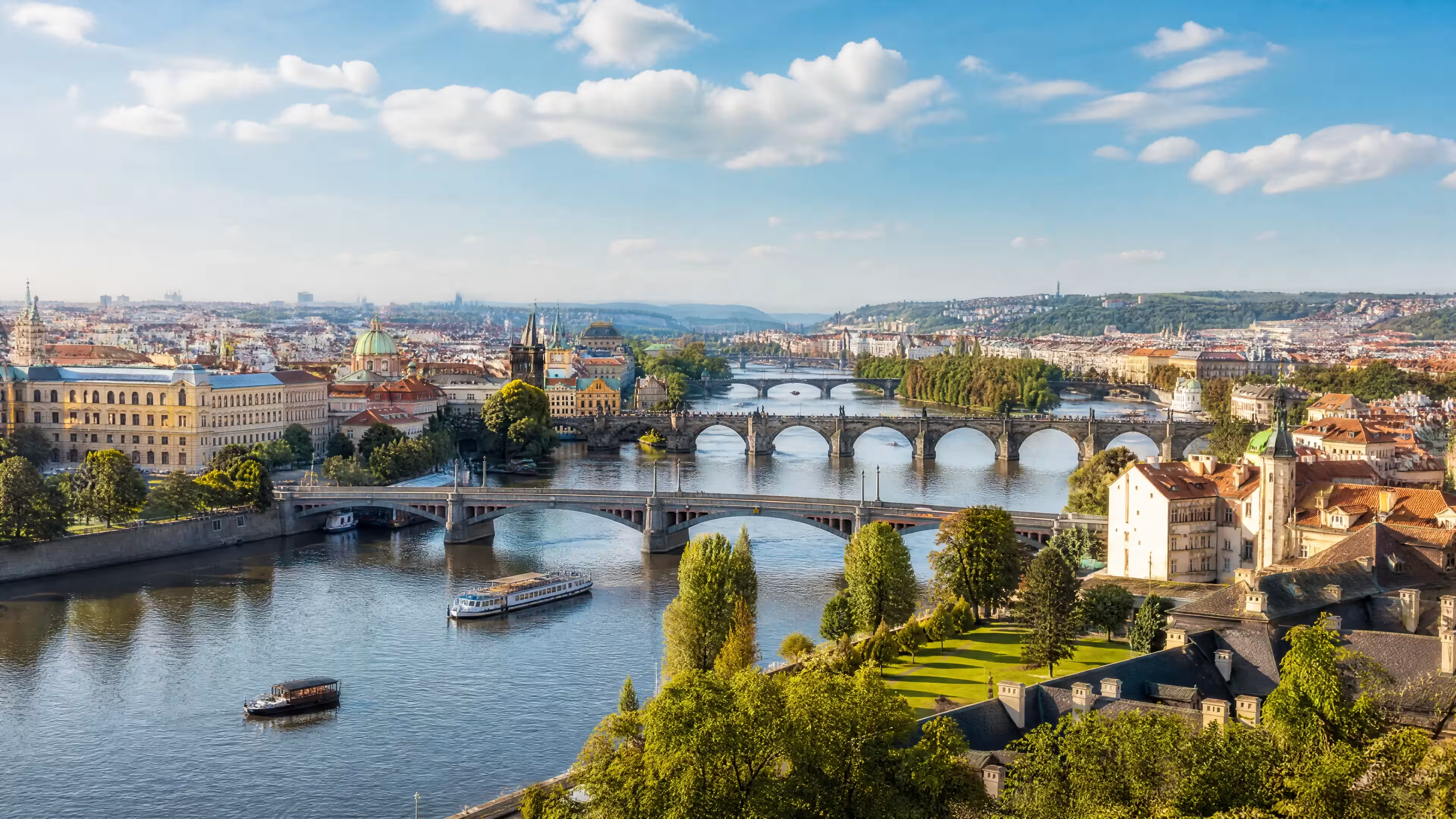
Walks along Charles Bridge, Prague Castle and Old Town Square. It is also worth trying the local cuisine.
Yes, especially Frantiskovy Lazne and Teplice. There it is calm, green and there are parks for walks.
Summer is warm and moderately dry. There are rains, so a light umbrella will come in handy.
Soup in bread, pork knee and local beer. The portions are large, so it is better not to order everything at once.
Yes, this is the most convenient option. Prague is the base, and the resorts are one-day or two-day trips.
Bohemian glass, costume jewelry, herbal cosmetics, and local sweets. It is better to buy away from tourist streets.
Trains and buses are enough for the resorts. A car is convenient, but parking in Prague is difficult and paid.
Comfortable shoes, layers, and a swimsuit for the resorts. It is also worth taking your usual medications.
Visa and entry rules change: check with the primary source — the Embassy of the Czech Republic in the Republic of Kazakhstan, https://mzv.gov.cz/astana/ru/vizy_i_konzulskie/index.html. The information on this page was verified on 28.09.2026.
Reviews of tours to Czechia
What travellers write afterwards: the hotel, the dates and what is worth knowing in advance.
No data yet
No one has left a review yet. Yours would be the first.
Write a review
The review appears on the site after a moderator checks it.
Destination guide
Short guides: season, hotels, money and documents.
Are international driving permits required
The answer depends on the country and on whether you plan to get behind the wheel.
ReadHow to dress when visiting temples
Many tourists wonder in advance how to dress when visiting temples. Modesty rules apply in mosques, Hindu and Buddhist temples.
ReadOnline check-in for the flight
Online check-in opens 24 hours before departure. The procedure takes a few minutes and saves you from queues at the airport. Check that your luggage meets the baggage allowance.
ReadConsent for a child's departure
Consent for a child to travel abroad is arranged in advance. A notary in Almaty certifies a power of attorney for the accompanying person. Parents decide who will take the minor on the trip.
ReadHand luggage rules
Hand luggage is the items a passenger takes into the aircraft cabin. Airlines set their own weight and size standards. Carriage of large bags in the cabin is usually not allowed.
ReadTransfer between flights
A transfer between flights is a stop at an intermediate airport, after which the traveler continues the journey on another plane.
Read