
Tours to Tunisia from Astana from Astana: prices
Instalments up to 24 months on any tour A manager replies within 15 minutes
Tours to Tunisia

Low-price calendar for tours to Tunisia
The lowest price by month for the chosen destination.
Tour collections for Tunisia


How to buy a tour to Tunisia
- 01
Find a tour
Departure city, destination, dates, nights and who is travelling — five fields in one row.
- 02
Choose and book
Compare the price for two, the board and the beach line, then hold your choice with a request.
- 03
Pay
By card, in instalments through a bank, by bank transfer or in cash at the office.
- 04
Get the documents
The contract, the voucher, the insurance policy and the itinerary receipts arrive by e-mail.
Tours to Tunisia: facts for the traveller
Ready to travel?
Leave a request and a manager will suggest options for your budget, dates and party.
Tours to Tunisia: what to know
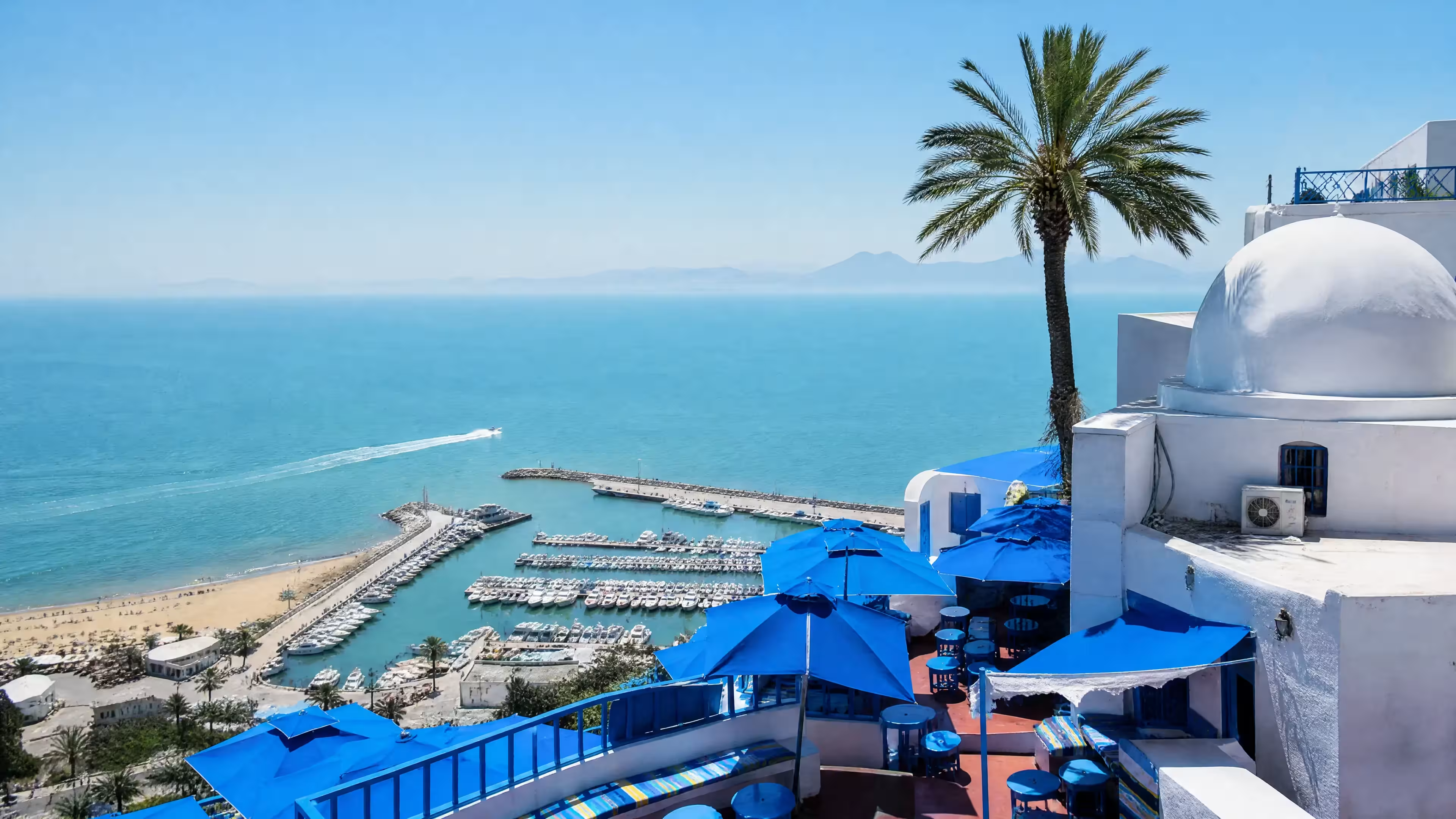
Tours to Tunisia from Astana are flights with one or two connections via Istanbul, Dubai or Doha, with travel time from 10 to 20 hours. The best beach season lasts from May to October, the water warms up to +26°C. The resorts of Hammamet, Sousse, Monastir, Mahdia and Djerba are suitable for both beaches and sightseeing. Holidays in Tunisia in winter are cheaper, but swimming is replaced by the Sahara and oases.
Visa, flight and first steps upon arrival: what do you need to know?
A trip to Tunisia from Astana begins with documents and the route. Such tours are most often built through major connecting hubs, and it is worth preparing for this in advance.
Documents for citizens of Kazakhstan
A holiday in Tunisia begins with checking current document requirements. The Tunisian side accepts guests from Kazakhstan according to its own rules, and they change periodically. Before buying tours, it is worth verifying the list of papers with an official source. Medical insurance is mandatory for entry; it is arranged in advance. Vaccinations for the trip are not required, except for standard recommendations. Take printed copies of your hotel booking and return tickets. Keep copies of documents separately from the originals.
Routes with connections and travel time
Istanbul and Dubai are the most frequent connecting points. The time difference with Almaty is 4 hours all year round: Tunisia is on UTC+1, Kazakhstan on UTC+5. A long connection is a reason to choose a night segment. The first steps upon arrival are simple: exchange a small amount and transfer to the hotel.
| Route | Number of connections | Time guide |
|---|---|---|
| Via Istanbul | 1 | 10–14 hours |
| Via Dubai | 1–2 | 14–20 hours |
| Via Doha | 1 | 12–16 hours |
When is the best time to plan a trip?
A holiday in Tunisia depends on the month more than it seems. The coast lives by the beach season, while winter opens up completely different routes.
Beach season on the coast
The best time for beach holidays is from May to October. The water warms up to +26°C, and the Tunisian coastline operates at full capacity. In July and August the coast is hot and crowded. Accommodation prices are higher in these months, and the beaches of Hammamet and Sousse are packed. May and June offer gentle sun and a calm sea. Holidays in Tunisia at the beginning of the season cost less. Tunisian cuisine and sightseeing are available in any month. For families with children, June and September are more comfortable.
Velvet season and winter destinations
The velvet season in September–October is suitable for sightseeing and a calm holiday. The sea remains warm, and the heat subsides. This is a good time for trips to Monastir and Mahdia. In winter the resorts are cool, but you can visit the Sahara and the oases. Travel to Tunisia from Astana in winter is chosen for the desert and the south. Djerba in winter is milder than the mainland and suitable for walks. Swimming at this time is rare, but prices are lower. Plan a winter trip for impressions, not for the beach.
Money, communication and safety on site
Financial habits in Tunisia differ from those in Kazakhstan. The Tunisian currency is closed, and this changes the entire logic of payments.
Exchanging dinars and working with cards
The Tunisian dinar is a closed currency; taking it outside the country is prohibited. It is better to exchange money in banks or official exchange offices. The rate in hotels is less favorable than in the city. Visa and Mastercard cards are accepted in large hotels and restaurants. Cash is needed at markets, and this applies to Sousse and Hammamet. Keep small notes for taxis and tips. Exchange the remaining dinars back before departure.
Insurance, medicine and useful habits
Medical insurance is mandatory for entry, and it is worth arranging with a reserve. It is recommended to include coverage for active recreation. Drinking tap water is not advisable even in hotels. The sun on the coast is active, and sunscreen is needed from the first day. Pharmacies in Hammamet and Sousse are open until evening. Take basic medicines with you. Keep your phone charged and save the guide's contacts.
Visa and entry rules change: check with the primary source — the Ministry of Foreign Affairs of the Tunisian Republic, https://www.diplomatie.gov.tn/. The information on this page was verified on 16.09.2026.
How to get around between cities
Tunisia is compact, and the resorts are connected to each other. Between Hammamet, Sousse and Monastir it is easy to travel without a car.
Transport between Hammamet, Sousse and Monastir
Public transport between the resorts is represented by buses, minibuses and trains. Trains connect Sousse, Monastir and Mahdia along the coast. Louages — local minibuses — run frequently and cost little. Taxis in the cities are yellow, the meter is used, but it is better to agree on the price in advance. The road between Hammamet and Sousse takes less than an hour. Monastir is convenient as a base for sightseeing in both directions. Check schedules on site, they change by season.
Car rental and trips to Djerba
Car rental is possible with an international license. Traffic in Tunisia is right-hand, as in Kazakhstan. Roads on the coast are good, but inland they are narrow. A trip to Djerba is more convenient via ferry or along the causeway. The island is worth a separate route for two or three days. Djerba is known for its beaches and the atmosphere of the south. Gas stations are common, but there are few in the desert. Take a car with full insurance.
Impressions and souvenirs
Tunisian culture reveals itself through food and markets. Such trips rarely go without shopping and tastings.
Gastronomy and local markets
Tunisian cuisine is based on couscous, seafood, olive oil and spicy harissa sauces. Alcohol is served in hotels and tourist restaurants; outside them — in a limited way. The markets of Sousse and Hammamet work from morning until evening. Bargaining at markets is customary; the starting price may be inflated by 2–3 times. Try brik, lablabi and fresh fish. Street food is cheaper than restaurant food, but choose crowded places. Olive oil here is a basic product, not a delicacy.
| Category | Feature | Where |
|---|---|---|
| Base of cuisine | Couscous, seafood, olive oil | Tunisia |
| Spicy sauces | Harissa | Tunisia |
| Alcohol | Served in hotels and tourist restaurants | Hotels, tourist restaurants |
| Alcohol | Limited | Outside hotels and tourist restaurants |
| Markets | Open from morning until evening | Sousse, Hammamet |
| Trading | Bargaining is customary | Markets |
| Trading | Starting price is inflated by 2–3 times | Markets |
| What to try | Brik, lablabi, fresh fish | Tunisia |
| Street food | Cheaper than restaurant food | Crowded places |
| Olive oil | A staple product, not a delicacy | Tunisia |
What to bring from Mahdia and other cities
Shopping in Tunisia means ceramics, carpets, olive oil, dates and leather goods. From Mahdia people bring fish, ceramics and textiles. Djerba is famous for palm leaf products. Handmade carpets are bought in Carthage and Kairouan. Dates are better to buy at the market, not at the airport. Ceramics are packed carefully, otherwise you will not get them home. Take olive oil in factory containers.
Briefly
- The beach season at the resorts of Hammamet, Sousse and Monastir lasts from May to October.
- The velvet season in September and October is convenient for sightseeing tours and trips to Mahdia.
- In winter, Tunisian destinations are chosen for the Sahara, oases and the island of Djerba.
- The Tunisian dinar is closed, the remainder is exchanged before departure, cash is needed at the markets.
- Trains, buses and minibuses run between the resorts, a car is rented with a license.
Tours by destination and departure city
Turkey
Tours to Turkey from Almaty Tours to Turkey from Astana Tours to Turkey from Shymkent Tours to Turkey from Kostanay Tours to Turkey from Aktobe Tours to Turkey from AktauEgypt
Tours to Egypt from Almaty Tours to Egypt from Astana Tours to Egypt from Shymkent Tours to Egypt from Kostanay Tours to Egypt from Aktobe Tours to Egypt from AktauUAE
Tours to UAE from Almaty Tours to UAE from Astana Tours to UAE from Shymkent Tours to UAE from Kostanay Tours to UAE from Aktobe Tours to UAE from AktauFrequent questions about tours to Tunisia
The most comfortable time is from May to October, when the sea is warm and the air is dry.
With one layover, the journey takes from eight to twelve hours.
Hammamet and Sousse are suitable for holidays with children because of the calm sea.
The island is windier and quieter; kitesurfing and boat trips are well developed there.
The old town, the fortress and the craft market within walking distance.
During the day it is usually sunny and warm, in the evening it is cool, and the sea is cold for swimming.
Yes, thalassotherapy centers operate in Hammamet, Sousse and Monastir.
Couscous, brik and fresh fish in the coastal restaurants of Mahdia.
Trips to the Sahara are organized from Sousse and Djerba for several days.
The Tunisian dinar; exchange is possible in banks and hotels.
Yes, in winter it is mild and convenient for sightseeing, but not for swimming.
Sunscreen, a hat and light clothing made of natural fabrics.
Reviews of tours to Tunisia
What travellers write afterwards: the hotel, the dates and what is worth knowing in advance.
No data yet
No one has left a review yet. Yours would be the first.
Write a review
The review appears on the site after a moderator checks it.
Destination guide
Short guides: season, hotels, money and documents.
Are international driving permits required
The answer depends on the country and on whether you plan to get behind the wheel.
ReadHow to dress when visiting temples
Many tourists wonder in advance how to dress when visiting temples. Modesty rules apply in mosques, Hindu and Buddhist temples.
ReadOnline check-in for the flight
Online check-in opens 24 hours before departure. The procedure takes a few minutes and saves you from queues at the airport. Check that your luggage meets the baggage allowance.
ReadConsent for a child's departure
Consent for a child to travel abroad is arranged in advance. A notary in Almaty certifies a power of attorney for the accompanying person. Parents decide who will take the minor on the trip.
ReadHand luggage rules
Hand luggage is the items a passenger takes into the aircraft cabin. Airlines set their own weight and size standards. Carriage of large bags in the cabin is usually not allowed.
ReadTransfer between flights
A transfer between flights is a stop at an intermediate airport, after which the traveler continues the journey on another plane.
Read