
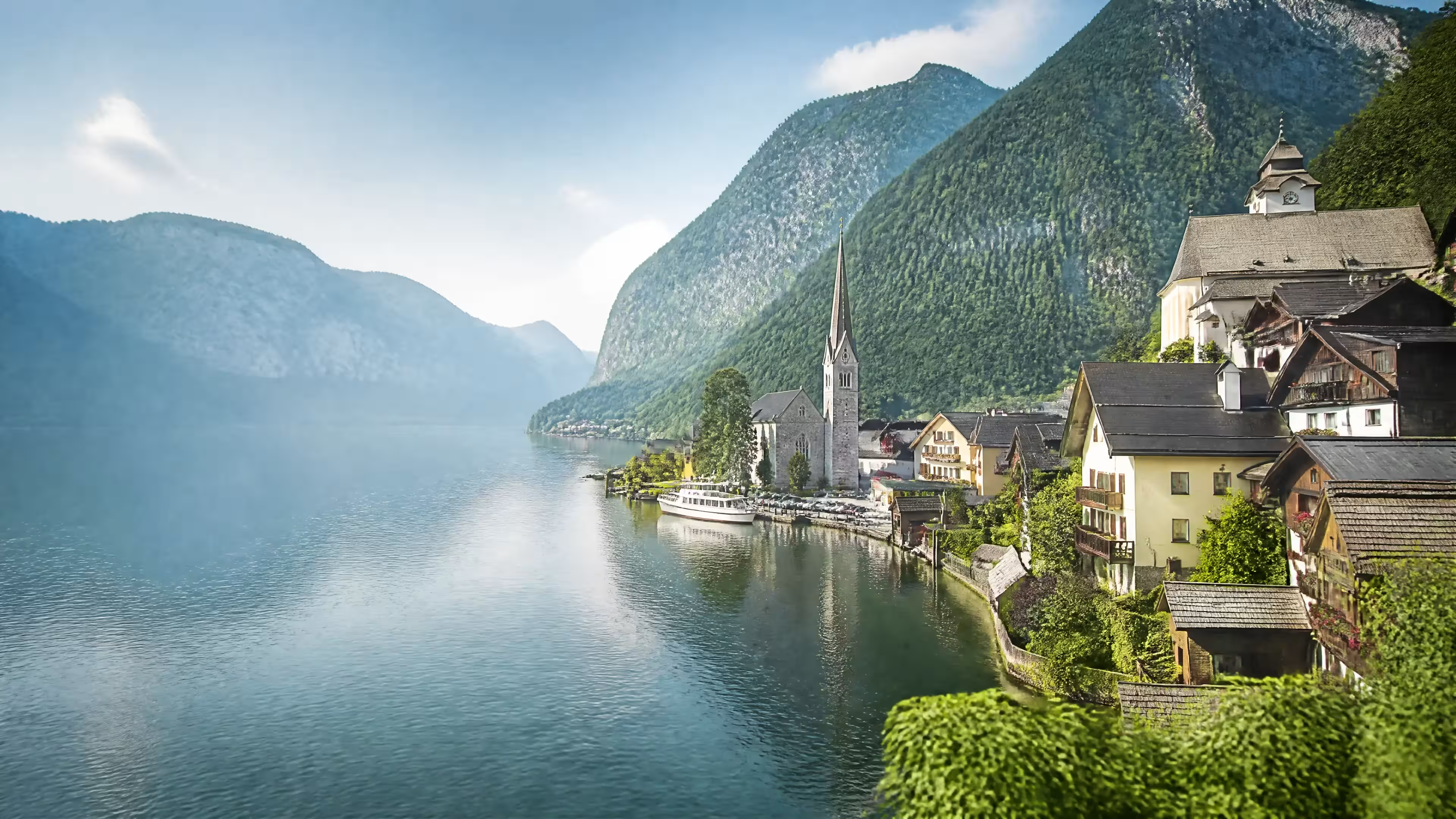
Tours to Austria from Kostanay: prices
Instalments up to 24 months on any tour A manager replies within 15 minutes
Tours to Austria
Resorts of the country
No data yet
We have no supplier prices for this destination yet. Leave a request and a manager will quote a price and check availability.
Leave a requestLow-price calendar for tours to Austria
The lowest price by month for the chosen destination.
Tour collections for Austria

How to buy a tour to Austria
- 01
Find a tour
Departure city, destination, dates, nights and who is travelling — five fields in one row.
- 02
Choose and book
Compare the price for two, the board and the beach line, then hold your choice with a request.
- 03
Pay
By card, in instalments through a bank, by bank transfer or in cash at the office.
- 04
Get the documents
The contract, the voucher, the insurance policy and the itinerary receipts arrive by e-mail.
Tours to Austria: facts for the traveller
Ready to travel?
Leave a request and a manager will suggest options for your budget, dates and party.
Tours to Austria: what to know
The best months for a trip are May, June, September and October: warm, but without summer heat and crowds.
Visa and documents for a trip to Austria
Trips to Austria from Kostanay begin with paperwork, and it takes more time than the flight itself. Let us break down which papers are collected in advance and when people book an appointment at the visa center.
Which documents are needed for a Schengen visa category C
An application for a Schengen visa category C is submitted to the Austrian visa center, and the package is assembled in advance. For a trip to Austria, an insurance policy with coverage of at least 30,000 euros is required, valid throughout the entire Schengen area. It is supplemented by confirmation of hotel booking and the travel route through cities. Holidays in Austria are rarely limited to one point, so the route is laid out by day. Visa center fees are paid separately from the cost of the tour, and the amounts are clarified at the time of submission. Biometrics are submitted in person, and the data is valid for 59 months. The procedure does not need to be repeated. It is better to check the full list of papers on the visa center website before booking an appointment.
Deadlines for submitting the application and booking an appointment at the visa center
An application for a visa to Austria is considered for up to 15 calendar days, but during high season the period stretches out. Appointments at the visa center in Almaty or Astana open in advance, and in summer available slots are taken quickly. It is better to submit papers for Austrian tours from Kostanay 4–6 weeks before departure. Then there remains a margin for clarifications and a repeat appointment. In winter, before the Christmas holidays, the queue is also dense. If the departure date is already close, it will not be possible to speed up consideration. Plan submission so that at least a month remains before departure.
Visa and entry rules change: check with the primary source — the Embassy of the Republic of Austria in the Republic of Kazakhstan, https://www.bmeia.gv.at/ru/oeb-astana/reisen-nach-oesterreich/einreise-und-aufenthalt/wie-stelle-ich-einen-antrag. The information on this page was verified on 17.09.2026.
The journey from Kazakhstan to Austrian cities
Flight routes from Kostanay with a connection
Frankfurt and Warsaw provide convenient connections for morning departures. When connecting in Schengen, the first check takes place there. Baggage is usually checked through to the final point of the route.
How to get from Vienna to Salzburg and Innsbruck by train
ÖBB trains connect Vienna, Salzburg and Innsbruck with high-speed lines at intervals of 1–2 hours. From the capital to Salzburg the journey takes about two and a half hours. To Innsbruck it is longer, about four hours via Salzburg. Tickets for trains in Austria are cheaper to buy in advance online. 2–3 weeks ahead the price is lower than at the ticket office at the station. Within Vienna, a 24, 48 or 72 hour pass is worthwhile. It is valid on the metro, tram and bus. Such a pass pays for itself after just a few trips around the city.
| Direction | Transport | Travel time |
|---|---|---|
| Vienna — Salzburg | ÖBB train | about 2.5 hours |
| Vienna — Innsbruck | ÖBB train | about 4 hours |
| Salzburg — Innsbruck | ÖBB train | about 2 hours |
| Vienna, center | metro and tram | 24–72 hour pass |
What to see in Austrian cities?
Austrian cities are compact, and the center of each can be walked in a day. Let us start with the capital, then move to the Alpine cities.
Vienna: imperial palaces and the museum quarter
Vienna keeps the country's main palaces within walking distance of each other. Hofburg Palace and the Schönbrunn complex each take half a day. The Museum Quarter stands between them and works as a separate route for an evening. Holidays in Austria here are conveniently built around the center, without wasting time on transport. In summer the capital is hot and crowded, so it is better to see the palaces in the morning. In winter the queues are shorter, but it gets dark early. In December people come to the square in front of the town hall for the fair. Allow at least two full days to explore the capital.
Salzburg and Innsbruck: old town and Alpine panoramas
Salzburg welcomes tourists with its old town and a fortress on the hill. In Salzburg it is worth trying Salzburger Nockerln, a local dessert. Innsbruck stands in a valley, and Alpine panoramas open right from the center. Even in the warm months, Innsbruck is cooler than Vienna due to the proximity of the mountains. A separate ticket is taken for the cable car in the mountains. Salzburg's old town can be covered in half a day, Innsbruck in a day. Both cities are connected by direct trains, and the journey between them is short. Leave a day for each if you are going for the first time.
Austrian cuisine and everyday expenses
Austrian cuisine is hearty, and food expenses are predictable. Let us break down how much lunch costs and how to pay in different establishments.
How much lunch costs and where to leave a tip
Lunch at a mid-range restaurant in Vienna will cost about 15–25 euros per person without drinks. In Salzburg and Innsbruck prices are close to the capital, the difference is small. Austrian cuisine in Vienna means Wiener Schnitzel, Tafelspitz and apple strudel. In tourist quarters the same dishes cost more. Lunch from the menu of the day is cheaper than ordering from the main menu. Tips in Austrian cafes and restaurants are customarily left by rounding the bill up by 5–10%. The amount is stated to the waiter when paying, not left on the table. In bakeries and at markets no tips are given.
| What we compare | Price |
|---|---|
| Lunch at a mid-range restaurant in Vienna | 15–25 euros per person without drinks |
| Lunch in Salzburg and Innsbruck | Prices are close to the capital's |
| Lunch in tourist districts | The same dishes are more expensive |
| Lunch by the menu of the day | Cheaper than by the main menu |
| Tips in cafes and restaurants | Rounding the bill by 5–10% |
| Tips in bakeries and at markets | Not given |
Cash, cards and payment in small establishments
In Austria the euro is in circulation, and Visa and Mastercard are accepted almost everywhere. At markets and in small bakeries cash will come in handy. Small family establishments sometimes work only for cash. Keep 30–50 euros in small notes with you per day. In large hotels and restaurants card payment goes through without questions. ATMs are in the center of every city, but check the commission on the screen. The exchange rate at the airport is usually unfavorable. Exchange money in the city, not on arrival.
How to prepare for the trip?
Preparing for the trip is divided into two parts: accommodation and transport on site. Both issues are resolved in advance, otherwise the choice narrows.
Booking hotels and seasonal demand
In high season hotels in Vienna and Salzburg are booked 2–3 months in advance. This is July, August and the Christmas holidays. Austrian hotels are classified by stars, but breakfast is often paid separately. Clarify this when booking, otherwise expenses will grow on site. In Innsbruck demand is more even, but in winter the city is filled by skiers. In spring and autumn prices are lower, and the queues to the sights are shorter. Holidays in Austria in the shoulder season cost noticeably less. Book with free cancellation if the dates are not yet fixed.
Car rental, vignette and environmental zones
For car rental in Austria a vignette is needed, and it is sold at gas stations. Without it, driving on toll motorways is not allowed. The country has a system of environmental zones, and in the center of Vienna a corresponding sticker is needed. Rental companies usually issue cars already with a vignette, but this is clarified when ordering. Parking in the center of Vienna is paid and expensive, so a car more often gets in the way than helps. Between cities the train is more convenient and cheaper than rental. If the route leads to the mountains, a car is justified. For a trip through three cities, take the train.
Briefly
- The page answers how to assemble a trip to Austria from Kostanay step by step.
- A category C visa is issued in advance, an appointment at the visa center opens a month ahead.
- Within the country it is more convenient to move by ÖBB trains between Vienna, Salzburg and Innsbruck.
- Lunch costs 15–25 euros, hotels in high season are booked 2–3 months in advance.
Tours by destination and departure city
Turkey
Tours to Turkey from Almaty Tours to Turkey from Astana Tours to Turkey from Shymkent Tours to Turkey from Kostanay Tours to Turkey from Aktobe Tours to Turkey from AktauEgypt
Tours to Egypt from Almaty Tours to Egypt from Astana Tours to Egypt from Shymkent Tours to Egypt from Kostanay Tours to Egypt from Aktobe Tours to Egypt from AktauUAE
Tours to UAE from Almaty Tours to UAE from Astana Tours to UAE from Shymkent Tours to UAE from Kostanay Tours to UAE from Aktobe Tours to UAE from AktauFrequent questions about tours to Austria
The ski season runs from December to April, the best snow is usually in February.
Museums, opera, the old town and coffee houses.
Salzburg is music and the old town, Innsbruck is the Alps and mountain slopes.
To the lakes of Carinthia and Salzkammergut, as well as thermal complexes.
Yes, there are children's schools and calm slopes here.
Euro.
No, cities and resorts are connected by trains.
A warm layer, a waterproof jacket, goggles and sunscreen.
Light clothes and comfortable footwear for trails.
In the shoulder season, in spring and late autumn.
The price depends on the season, resort and number of nights.
Reviews of tours to Austria
What travellers write afterwards: the hotel, the dates and what is worth knowing in advance.
No data yet
No one has left a review yet. Yours would be the first.
Write a review
The review appears on the site after a moderator checks it.
Destination guide
Short guides: season, hotels, money and documents.
Are international driving permits required
The answer depends on the country and on whether you plan to get behind the wheel.
ReadHow to dress when visiting temples
Many tourists wonder in advance how to dress when visiting temples. Modesty rules apply in mosques, Hindu and Buddhist temples.
ReadOnline check-in for the flight
Online check-in opens 24 hours before departure. The procedure takes a few minutes and saves you from queues at the airport. Check that your luggage meets the baggage allowance.
ReadConsent for a child's departure
Consent for a child to travel abroad is arranged in advance. A notary in Almaty certifies a power of attorney for the accompanying person. Parents decide who will take the minor on the trip.
ReadHand luggage rules
Hand luggage is the items a passenger takes into the aircraft cabin. Airlines set their own weight and size standards. Carriage of large bags in the cabin is usually not allowed.
ReadTransfer between flights
A transfer between flights is a stop at an intermediate airport, after which the traveler continues the journey on another plane.
Read