
How much to tip
How much to leave at a restaurant
Tipping in Almaty and abroad is calculated differently. It is important for a tourist from Kazakhstan to decide in advance how much to leave in each country. Tips depend on local customs, not on the bill amount.
Europe and the Mediterranean
In Greece, Italy and Spain, tips are often already included in the bill as a service charge. If there is a line about service, leaving extra is optional. When there is none, tourists from Almaty add about a tenth. In France, tips are included almost everywhere, and coins on the table are considered a sign of politeness. In Germany and Austria, it is customary to round the amount up or add a small part.
In Scandinavia, tips are almost not accepted because waiters' salaries are high. In Czechia and Hungary, tips are left in cash directly into the waiter's hands. How much to leave in each country is best clarified with a guide on the first day.
Asia and the Middle East
In Turkey and Egypt, tips are part of the service culture. In cafes and restaurants, tourists from Almaty usually leave about ten percent. In the UAE and Qatar, tips are accepted in hotels and restaurants, but not in shops. In Japan and Korea, tips are not accepted at all and may even embarrass the staff. In Thailand and Vietnam, tips are left in small notes for good service.
In India, tips are widespread, but their size is modest. How much to leave in Asia depends on the level of the establishment and the city.
To whom and for what they give
Tips are received not only by waiters. In hotels they are given to the porter, the maid and the front desk employee. Taxi drivers are left tips by rounding the amount or adding a little extra. The guide and driver on an excursion are given tips at the end of the day. In spas and hairdressers, tips are also appropriate. A tourist from Almaty should keep small notes at hand.
How much to leave to each depends on the amount of work and the quality of the service.
Cash or card
Tips are more convenient to give in cash in the local currency. The terminal sometimes has a separate line for tips, but not everywhere. Small notes help avoid looking for change in a hurry. In some countries, adding tips by card is easier than in cash. A tourist from Almaty should exchange a little currency in advance. How much to leave when paying by card is clarified with the waiter before making the payment.
Tipping in Kazakhstan
In Almaty, tips in cafes and restaurants usually amount to about ten percent. In some establishments, the service charge is already included in the bill. In taxis, tips are not mandatory, but rounding the amount up is welcomed. In hotels, tips are given for additional service. How much to leave at home, the tourist decides for themselves, focusing on the service. Local customs here are softer than in Turkey or Egypt.
Tipping on cruises
On cruise ships, tips are often charged automatically for the entire voyage. A tourist from Almaty can clarify the amount at the service desk. Additional tips are given for special attention from the staff. In bars and spas on board, tips are sometimes added to the check. How much to leave on a cruise depends on the policy of the specific company.
Tipping in the mountains and at resorts
At ski resorts, tips are given to the instructor and rental staff. In spa centers at hotels, tips are left after the procedure. At beach resorts, tips are received by waiters by the pool. It is convenient for a tourist from Almaty to carry small notes in a bag. How much to leave at a resort depends on the hotel category and the season.
Tourists' mistakes
Tips should not be left on the table in countries where this is not customary. It is awkward to give tips where the service is already included in the bill. Tourists from Almaty sometimes confuse tips with a service charge. Large notes without change are inconvenient for the staff. How much to leave is best decided before going to the establishment. Haste in this matter often leads to overpaying.
What to take with you
- Small notes of local currency
- A wallet for tips separate from the main money
- An envelope for the maid's tip
- A supply of coins for taxis
- A list of trip countries with local customs
- Notes about the included service charge
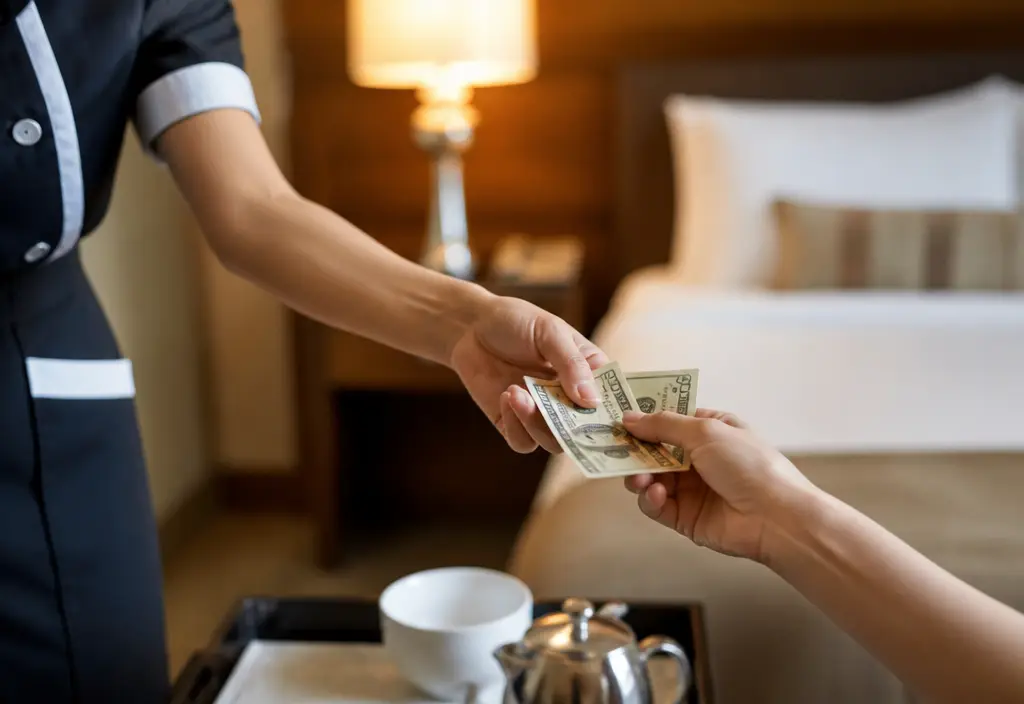
Tipping works differently in different countries: in some places it is a mandatory part of a waiter's income, while in others it is an awkwardness. In the USA and Canada, 15–20% before taxes is left, in Europe 5–10% or rounding up is enough, in UAE and Turkey the fee is often already in the bill. In Japan and Korea, it is better not to give money for service at all.
Before paying, look at the check and keep small bills handy.
How to get ready for the road: weather, policy and adaptation on site
Preparation begins long before departure, and how much energy remains for the holiday depends on it. A tourist from Almaty should decide in advance in which season he is traveling and what he will arrange before the trip.
When it is better to fly to hot countries and why the shoulder season is more profitable
The shoulder season in hot countries falls in the months before and after the peak, and that is exactly when it is most comfortable to travel. At the height of the season, the temperature often rises above forty degrees, and prices for accommodation and flights increase. In the shoulder season, the air is milder, the beaches are freer, and hotels offer discounts.
For a tourist from Almaty, this is also a convenient junction: direct flights to popular cities cost less outside school holidays. In the first two days in the heat, it is better not to plan long excursions. Acclimatization takes up to three days, and during this time the body asks for water and shade. Take sunscreen and a head covering with you. Such preparation costs little, but saves you from a ruined vacation.
What to arrange before departure: insurance, booking and child seats in taxis
A medical policy is arranged in advance, because in the first days of the trip the risk of catching a cold or getting sunstroke is highest. The hotel booking is confirmed by a letter from the hotel so that there are no questions at the front desk. If you are traveling with a child, check with the carrier whether there is a child seat in the car.
In some countries, such seats are not provided in taxis, and carrying a small child in your arms is unsafe. Your own folding seat solves the problem, but takes up space in the luggage. It is reasonable to arrange a transfer with a child seat in advance. Separately, think through how much cash to take for the first day: exchange offices at the airport give an unfavorable rate.
How are tips structured in different cultures?
Attitudes toward money for service vary greatly from country to country, and there is no universal percentage. For a tourist from Almaty, it is useful to understand the logic of the place rather than memorize numbers.
Where money for service is considered a sign of respect
In the countries of the Persian Gulf and in Turkey, gratitude in the form of money is read as a sign of good manners. The amount depends on the level of the establishment, not on a strict rule. In Egypt and Tunisia, an extra payment is expected almost everywhere: at the hotel, by the pool, in a taxi, and even in restrooms. In India and Nepal in tourist areas, this is also a customary part of the payment.
In such places, it is worth keeping small bills handy, otherwise you will have to round up a large banknote. A tourist from Almaty, accustomed to a relaxed attitude toward extra payments, feels the difference here immediately. A beginner's mistake is to leave a lot where it looks showy. It is better to focus on a modest amount and on the reaction of the staff.
Where gratitude in the form of money can offend or embarrass
In Japan and South Korea, money on top of the bill can put a person in an awkward position. The staff there takes pride in their work, and an extra payment is read as doubt about the quality of service. In cheap cafes and markets in Southeast Asia, an extra payment is also not expected. In Japan, if you still want to show gratitude, an envelope with money is more appropriate than a banknote from hand to hand.
Asking about the local custom from a guide or at the front desk is the simplest way not to make a blunder. In Korea, in some establishments the amount is rounded up, and that is enough. Persistence, when money is not accepted, is perceived worse than its absence. Respect for someone else's order here matters more than the amount.
How much to leave as a tip depending on the establishment
The establishment sets the framework more strongly than the country: in a restaurant with a waiter the logic is one, in a street stall it is completely different. Below are reference points from which it is convenient to start.
When service is at the table: from the final amount to taxes
In the USA and Canada, a waiter receives a significant part of income precisely from the extra payment, and there it is customary to leave 15–20% of the amount before taxes. In Europe, service is more often already included in the bill, so 5–10% for good service or simple rounding up is enough. In UAE and Qatar, a service fee is often included in the check, and then adding anything is not necessary.
In Turkey, in restaurants and cafes, the "service" line is also often included in the bill. Before calculating the percentage, look at the check: paying extra on top of the fee again is a common mistake. If service is not included, focus on quality: for attentive service it is appropriate to give more. Cash is more convenient, because the money reaches the waiter immediately.
By card is also possible if the terminal offers such an option.
Cafes, markets and street food: when you can do without an extra payment
In street cafes and markets in Southeast Asia, an extra payment is not accepted, and its absence will not surprise anyone. In Thailand, in hotel restaurants the fee is usually included, while at street stalls money for service is left only if desired. In Turkey, in tea houses and street establishments, an extra payment is also not mandatory.
In India and Nepal in tourist quarters it is widespread, but it is better to agree on the amount with a guide or driver in advance. At the market it is easier to round up the purchase amount than to count out a percentage. A tourist from Almaty often intuitively reaches to leave the change — in these places that is enough. If the seller himself returned the change down to the last coin, there is no need to insist.
A good rule: pay exactly as much as they ask, and do not turn a purchase into a ritual.
To whom and how to give for service in a hotel and transport
In hotels and transport, the logic differs from restaurant logic, because the service is often one-time and unnoticed. Here the method of giving matters more than the amount.
Housekeepers, porters and the pool: who to tip and how to hand over money
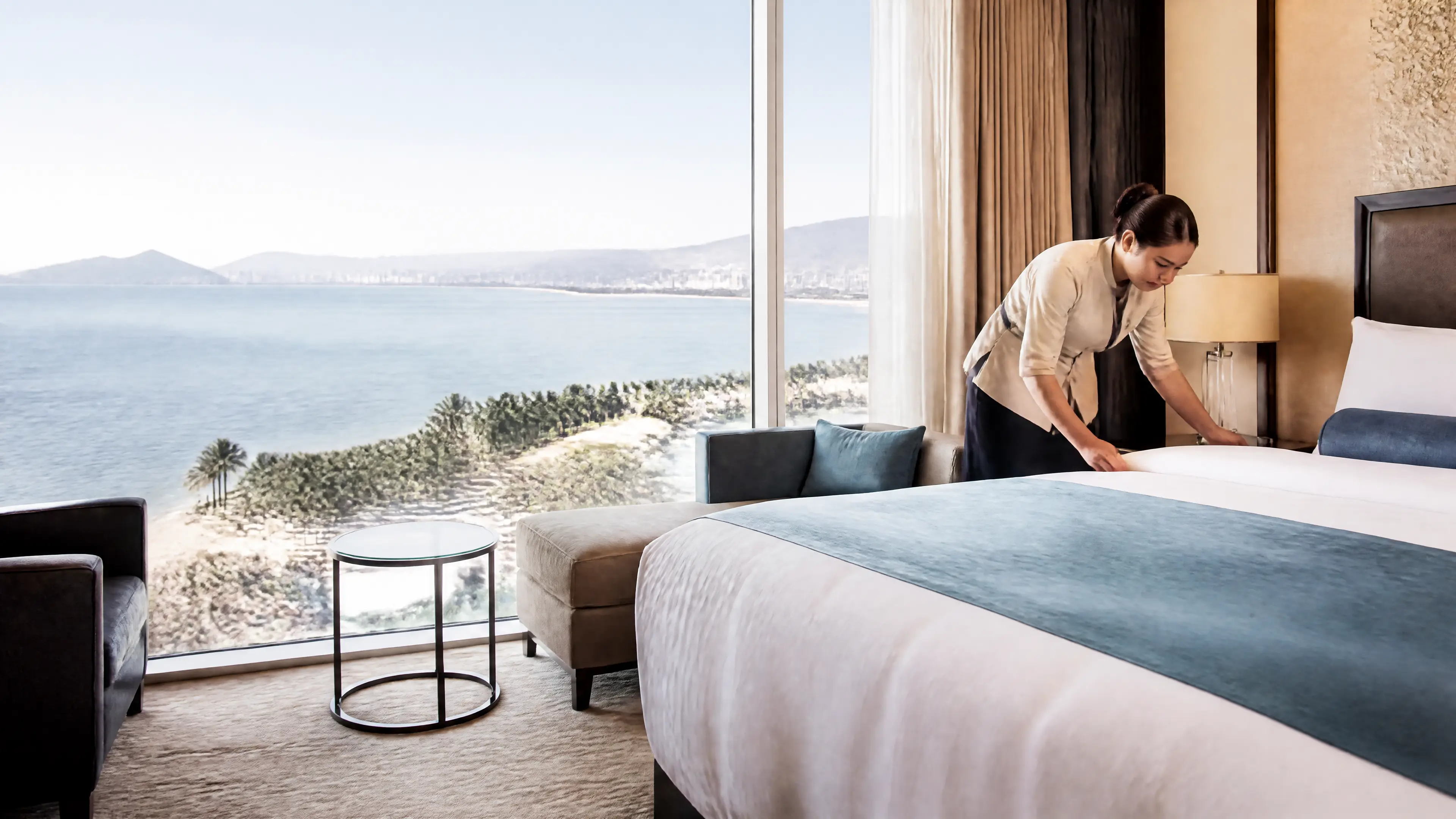
Housekeepers are left money in a visible place or on the pillow, but in some countries such a banknote reads as forgotten. It is safer to leave it together with a short note or hand it over in person. A porter is usually given money for each suitcase, and the amount depends on the hotel's level. At the pool and on the beach, the employee who brought a towel or an umbrella also expects a small thank-you.
In Egypt and Tunisia such expectations are especially noticeable, so it is worth keeping small banknotes with you. In UAE and Qatar, a service charge is often already included in the cost of stay, and then an extra payment remains a matter of desire. In Japan and Korea, it is better not to leave money in the room at all. If you are unsure, ask at the reception how it is customary there.
Driver, transfer and guide: rate, app and agreement in advance
In a taxi, the extra payment may already be included in the rate, or it may be expected separately, so check with the driver or in the app. In the app, the amount is fixed in advance, and after the ride all that remains is to rate the driver. In countries where the meter is not used, it is better to agree on the price before getting in.
It is appropriate to give the guide and driver more on a long sightseeing tour than for a short ride, because the work lasts all day. In India and Nepal, it is reasonable to discuss the size of such a thank-you in advance so as not to argue at the end of the route. A tourist from Almaty ordering a transfer from the hotel usually pays by agreement and adds as desired.
If the trip was with children and the driver helped with a seat, that is also a reason to thank him. The main thing is not to leave the question open until the last minute.
What to pay with and how to get out of awkward moments?
The payment method affects how it is more convenient to give a thank-you, and there are subtleties here. Let us break down what to do with small change, a terminal and a refusal.
Small banknotes, a terminal with a prompt and a service charge in the bill
It is worth exchanging small banknotes in advance, because change from a large banknote will not be given everywhere. When paying by card, in some countries the terminal itself will offer to add an amount, and this is a convenient way out if you have no cash. In UAE, Qatar and Turkey, a service charge is often already in the bill as a separate line.
Check the receipt before you reach for your wallet: paying extra on top of the charge looks absurd. In Egypt and Tunisia, cash helps where there is simply no terminal. Keep a separate pocket for small change so as not to rummage through your whole bag at the cash register. Such a reserve comes in handy in a taxi, at the pool, and at the market.
When money is not accepted: how to politely get out of the situation
When money is not accepted, you should not insist: in some cultures this reads as disrespect or a violation of the establishment's rules. It is enough to smile, thank them in words and put the banknote away. In Japan and Korea, a refusal is almost always final, and a repeated attempt will only spoil the impression.
If you want to give a thank-you in another way, write a good review or tell the manager about the service. In establishments with fixed rules, the staff simply has no right to accept money. A tourist from Almaty may get confused in such a moment, but it is enough to remember: the refusal is not about you. A calm reaction leaves a better impression of you than persistence.
Sometimes the best thank-you is to come back here again.
In short
- Choose the season in hot countries by mild weather, not by the peak.
- The shoulder season gives less heat and lower prices for accommodation and flights.
- Leave the first days in the heat for acclimatization, not for sightseeing tours.
- Arrange medical insurance and booking confirmation before departure.
- The attitude toward money for service depends on culture, not on the amount.


