
How to pay by card abroad

Payments during the trip
A tourist from Almaty often takes a bank card as the main method of payment. Paying with it is convenient, but abroad there are their own rules. Let's figure out how to prepare in advance.
What to check at home
Before departure from Almaty, it is worth making sure that the card is active and does not expire during the trip. The bank may block transactions in an unfamiliar country, so it is better to inform about the trip in advance. Many banks provide this option through the app. It is worth checking whether the card works in the required country and with which currencies.
If you will be paying in several countries, check the support of all required currencies. Keep a reserve on the card, but not the entire budget at once. Take a second card from another bank as a backup. Write down the number for contacting the bank separately from the phone. This way you can quickly resolve the issue if payment fails.
Cash and card on the road
It is not worth completely giving up cash even with the most reliable card. Small amounts are needed for taxis, cafes and markets. The exchange rate at the airport is usually less favorable than in the city. Keep part of the money in the local currency, part in dollars or euros. Do not keep everything in one place. A wallet, bag and inner pocket are three different points.
This way, losing one item will not leave you without funds. The card remains the main instrument for large expenses. Hotels, tickets and car rentals are more convenient to pay with it.
Magnetic stripe and chip
Old terminals read only the magnetic stripe, new ones read the chip. In Europe and Asia, chip and contactless payment are more common. If the card is not read, ask the cashier to process the transaction manually. Sometimes wiping the chip with a napkin helps. The magnetic stripe is sensitive to heat and magnets, so keep the card away from the phone. When paying, do not let it out of your hands unnecessarily.
In some countries it is customary to take the card to the cash register — keep an eye on this. If the terminal asks for a PIN, enter it while covering the keypad. If declined, try another card or pay in cash.
Contactless payment
Contactless is faster and more convenient to pay in cafes and transport. The limit for one transaction without a PIN depends on the country and the bank. Large amounts will still require confirmation. A phone with a linked card works the same way, but depends on the charge. Keep a power bank at hand. In the metro and buses of large cities, contactless is often accepted directly.
This saves you from buying tickets on the spot. If the terminal does not work, try placing the card differently. Sometimes a case with metal interferes.
Online payment
Booking hotels and tickets from Almaty often goes through the internet. Here the card is needed to confirm the booking. Some sites require a card with 3D confirmation support. The code comes to the phone, so roaming or a local SIM must work. If the booking does not go through, check the limits on online transactions. Sometimes the bank blocks a suspicious transaction. Call support and confirm the payment.
Save screenshots of confirmations. They will be useful at check-in.
Fees and exchange rate
The bank may charge a fee for a transaction in another currency. The conversion rate also differs from the market one. When paying in the local currency, conversion is usually more favorable. If the terminal offers to choose the account currency, choose the local one. This rule saves money on every purchase. Check the final amount in the bank app. A discrepancy with the receipt is a reason to contact support.
Security
- Do not show your PIN to strangers.
- Cover the keypad when entering it.
- Do not leave the card at the bar or by the pool.
- Enable transaction notifications.
- Keep the second card separately.
If the card does not work
Sometimes the bank blocks a transaction due to suspicions. Call support and confirm that you are the one going to pay. Check whether the expiration date has passed. Make sure there are funds in the account. Try another terminal or ATM. If the problem repeats, use the backup card. Cash helps in such a situation.
What to take with you
- A second card from another bank.
- A small amount of cash.
- A charger and power bank.
- The bank's support number.
- Copies of hotel bookings.
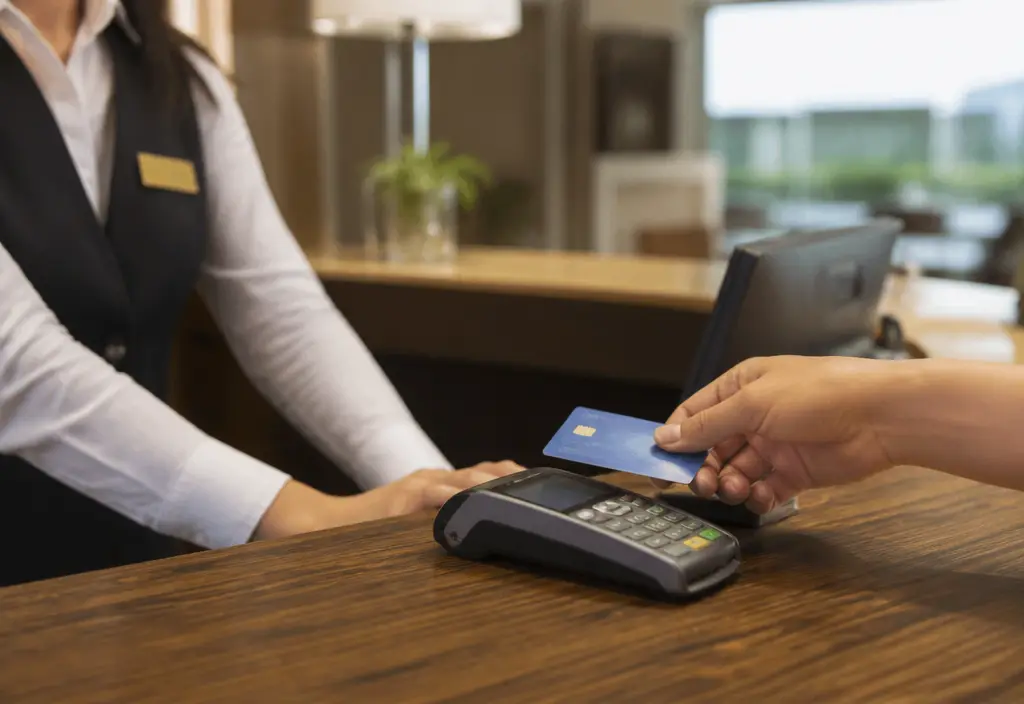
Paying by card abroad in 2024 requires preparation at home. Check the expiry date of your plastic card and passport, remember your PIN code, and allow transactions abroad in your bank's app. Keep your card, cash, and phone in different places, and essentials in your carry-on luggage.
In peak season, book accommodation and tickets several months in advance; in the shoulder season, prices are lower and there are fewer queues.
How to prepare a card for a trip from Almaty?
Packing for a journey begins long before the taxi to the airport. The card and documents require attention at home, otherwise paying abroad will turn into nerves. Let's break down how to pay by card abroad without surprises.
Checking the expiry date of the card and passport before departure
The card's expiry date is checked at least a month before departure. If the plastic card expires in the middle of the trip, replacing it abroad is almost impossible, and cashless payment will become unavailable at the most inconvenient moment. Look at the front side: it shows the month and year until which the card works.
The passport's expiry date should also be checked with a margin, since some destinations require it to remain valid for several months after return. It is useful to photograph both sides of the card in advance and save the images in a secure place. That way you can quickly restore the data if the plastic card is lost. Also check whether SMS notifications and mobile banking are connected.
The conclusion is simple: spend half an hour at home so you don't have to solve these issues in a foreign country.
PIN code, signature, and card settings for paying abroad
A PIN code is needed almost everywhere, and it's better to recall it before departure. In a number of countries, the terminal asks for exactly the code, not a signature, and if you don't remember it, the payment will fail right at the checkout. Check the code at an ATM at home or in the bank's app. The signature on the back of the card should also be added — some merchants verify it against the passport.
Separately, clarify in the app whether there is a restriction on transactions abroad. Some banks block such payments by default, and the ban must be lifted in advance. Make sure the card is active and not blocked for any other reason. These simple steps take ten minutes but add peace of mind for the entire trip.
What to consider when transiting through Istanbul, Dubai, and Seoul?
A long layover is not only waiting in the lounge but also spending. It's worth understanding in advance how you will pay in the transit country.
Availability of banking services in the transit country
In the airports of Istanbul, Dubai, and Seoul, there are cafes, shops, and duty-free, and payment there usually goes through by card. But if you plan to go out into the city for a few hours, the situation changes: not every terminal accepts your card, and ATMs may charge a noticeable commission. Keep a small amount of cash for small expenses.
Clarify in advance in the bank's app whether your card works in the transit country. Internet in the airport is usually available, but free Wi-Fi requires registration by phone number. Screenshots of the booking and boarding pass help when there is no connection. The conclusion: don't rely only on plastic in a foreign transit city.
Carry-on luggage and payment means on a flight with a layover
On a flight with a layover, luggage sometimes doesn't arrive at the final destination. Therefore, keep essentials — medicines, a charger, documents, and payment means — in your carry-on luggage. It's better to separate the card, cash, and phone into different bags. If the suitcase is delayed, you will at least be able to pay for a hotel and food.
Check that the phone charger and power bank are at hand: without a connection, the banking app won't open. Don't put all the money in one place. This rule seems obvious, but it is precisely what is forgotten in the rush of packing. Well-thought-out carry-on luggage saves you in the first day after arrival.
When to go: seasons, prices, and the load on banking services
The choice of month affects both the budget and how smoothly payments go. Let's break down what to expect at different times of the year.
Peak July–August and New Year holidays: queues and expenses
July and August are the most expensive period for a tourist from Almaty. Prices for tickets, accommodation, and excursions rise, and queues in cafes and at checkouts become longer. The New Year holidays give a similar picture: demand is high, and there are few free places. In such months, the load on banking services is more noticeable, and a transaction is sometimes processed longer than usual.
It's worth booking accommodation and tickets several months in advance. Then there is a chance to catch an acceptable price and not overpay at the last moment. If the trip can be shifted, consider other dates.
Shoulder season April–May and September–October: prices and weather
April, May, September, and October are the most budget-friendly time. Accommodation and tickets cost noticeably less than in the high season, and there are fewer tourists. The weather in these months varies: somewhere it is warm and dry, somewhere rains begin, so the forecast should be checked right before packing.
The card works in the shoulder season just as reliably as in summer, and there are fewer queues and fuss around. This is a convenient option for those who want a calm trip without crowds. The only downside is that some seasonal entertainment may be closed. But sightseeing goes at a measured pace, without crowding and haste.
How to pay by card abroad in the SCO and EAEU countries
Nearby destinations require their own approach. Here both the set of papers and payment habits differ from far abroad.
Differences in payment requirements from far abroad
In the countries of the SCO and the EAEU, card payment abroad is more common and easier than in distant regions. Many terminals accept familiar payment systems, and ATMs are found on every corner. But there is no single rule: in one city the card works everywhere, in another it is accepted only by large stores and hotels. In markets and small cafes they still expect cash.
So keep a supply of banknotes on you for small expenses. Check with your bank in advance whether your card works in a specific country. If you are planning several destinations in a row, check each one. That way you will not end up without a way to pay in an unfamiliar place.
Documents and cards for trips to nearby destinations
For trips to nearby destinations, the set of papers differs from that for distant countries. Take with you a printout of your accommodation booking and return tickets: they may be asked for at passport control. Medical insurance is arranged separately, and some countries do not let you in without it. Keep your card and cash in different places so that losing one item does not leave you without money.
Screenshots of documents on your phone will also come in handy. Find out in advance which cards your destination accepts, and take two different ones — in case one does not work. A well-thought-out set of papers saves time at the border and nerves on the trip.
Visa and entry rules change: check with the primary source — the State Revenue Committee of the Ministry of Finance of the Republic of Kazakhstan, kgd.gov.kz. The information on this page was verified on 15.09.2026.
What to consider in certain regions and situations
Local customs and technical details affect a trip no less than the budget. Let us take into account what is easy to forget.
Ramadan, haggling in markets and transport schedules
In Muslim countries, during the month of Ramadan, the schedules of stores and cafes change. Many establishments open later and work shorter hours, and during the day some places are closed. Plan your food expenses with this in mind. Haggling in markets and taxis is the norm, and the price may differ from the one shown in the app. Calmly state your amount, it is part of the local culture.
Transport during such periods also runs on a special schedule. Check travel times in advance so as not to get stuck in the evening in an unfamiliar area. Card payment abroad in these conditions works where there is a terminal, while in the market cash is more often needed. Flexibility and extra time solve almost everything.
Roaming, a local SIM card and time zone differences
Without the internet, you will not be able to confirm a transaction by SMS. Roaming or a local SIM card is needed so that the banking app works and you can pay for a purchase online. A local SIM card is usually cheaper than roaming, but buying it takes time on the first day. The time difference with Almaty shifts the moment when the bank processes a transaction.
An urgent payment in the evening local time may go through only the next day. Keep this in mind if you need to transfer money urgently. Save your bank's support number in advance and enable notifications. These little things determine how smoothly the trip goes.
Briefly
- Check the expiry date of your card and passport at least a month before departure.
- Remember your PIN code and sign your card in advance.
- Check in the app whether transactions abroad are allowed.
- Keep your card, cash and phone in different places.
- Put essentials and means of payment in your carry-on luggage.


