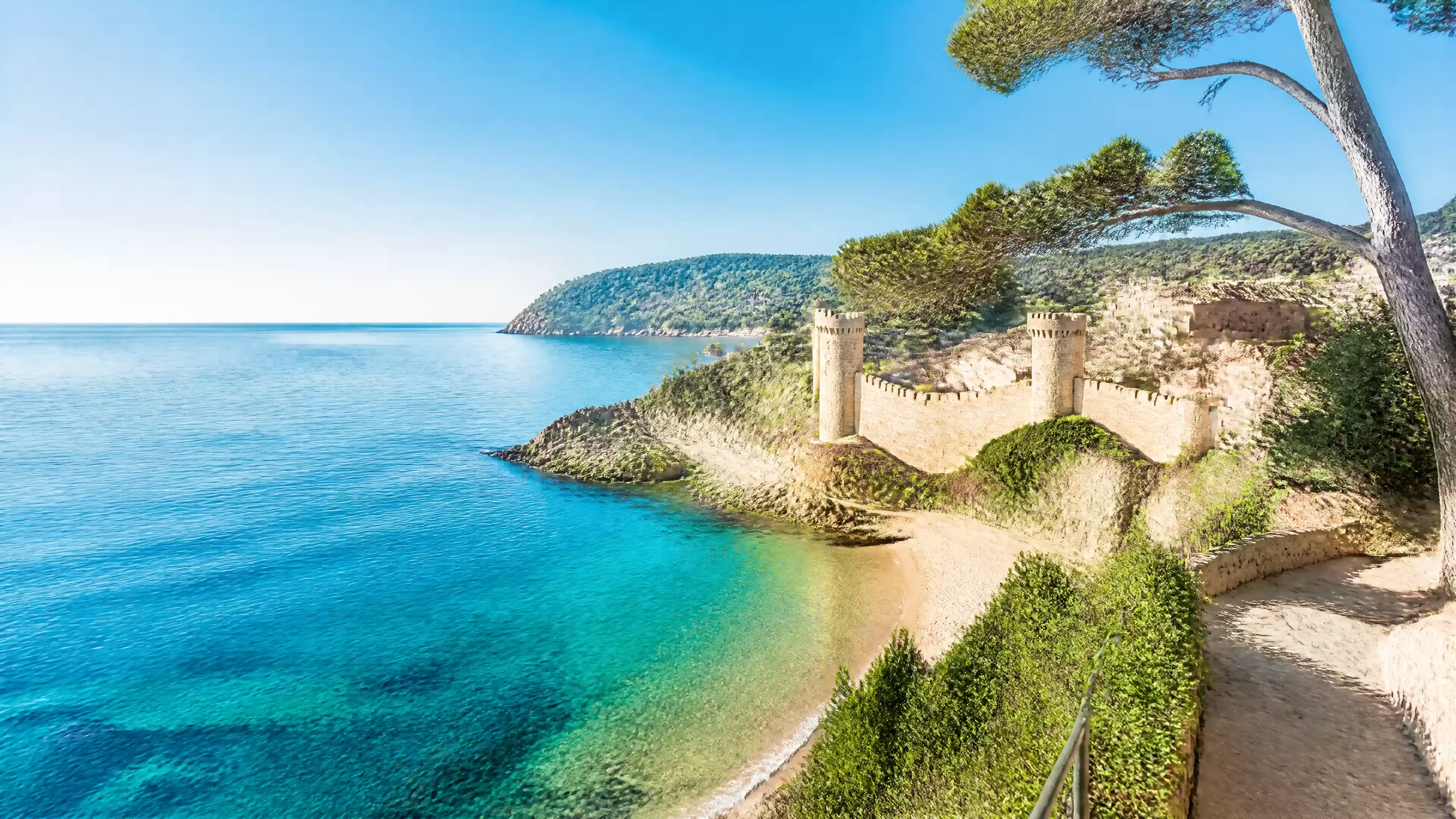
A holiday on the Costa Brava is the coast of Catalonia an hour's drive from Barcelona: gentle beaches, pine-covered cliffs and towns like Lloret de Mar and Tossa. From Almaty, flights go with one or two connections, and the journey takes from twelve hours. The most comfortable time is from May to June and in September: the sea is warm, and hotel prices are lower than at the height of July and August.
Visa and flight from Almaty: how to get to the Spanish coast?
The journey to the Costa Brava from Kazakhstan takes almost a day, and the route is better planned in advance. Below are practical options for the flight and transfer to the resorts.
Schengen for Kazakhstanis: submitting documents in Almaty and processing times
A trip to Spain begins with obtaining a Schengen visa of category C, and residents of Almaty can submit documents at the consulate or visa centre. The package is standard: an application form, photo, insurance, hotel bookings and confirmation of the route. Processing times usually take up to two weeks, but in high season the queue stretches out. It is better to submit documents a month and a half to two months before departure in order to wait calmly for the decision. For a holiday on the Costa Brava, a visa opened for another Schengen country will also do if it is valid. Check the exact requirements and current submission rules on the website of the official authority.
Routes with connections: via Istanbul, Dubai, Frankfurt and Doha
There are no direct flights from Almaty to Barcelona, so tours to Spain from Almaty always include one or two connections. The most convenient is to fly via Istanbul: the connection is short, and there are many flights. Via Dubai and Doha the route is longer, but the connections are comfortable. Frankfurt suits those who want to combine a holiday on the Costa Brava with a stop in Germany. The total travel time including waiting is from twelve to eighteen hours. The time difference with Kazakhstan is small, and acclimatisation is easy. Tickets for the summer are snapped up in advance, so it is worth booking the flight several months ahead.
Transfer from Barcelona to the resorts and car rental on site
From Barcelona airport to the resorts of the coast is from sixty to one hundred kilometres, and the journey takes about an hour. You can get there by a pre-booked transfer, a scheduled bus or a rented car. Hotels on the Costa Brava often offer a meet-and-greet, but this should be arranged in advance. Renting a car gives freedom: a Kazakhstani needs an international driving licence and a bank card for the deposit. Toll sections on the motorways are inexpensive, but parking in coastal towns is full in summer. If the holiday is planned without travelling around, it is more profitable to take a transfer and use commuter trains.
Seasonality and trip budget?
The cost of the trip depends greatly on the month, and the difference between July and September is noticeable. Below is when it is better to go to the Costa Brava and what the budget consists of.
High season, school holidays and shoulder season: the difference in prices
The peak of prices for tours to the Costa Brava falls in July and August, when the coast has hot weather and families with children arrive. During school holidays hotels raise prices almost twofold, and the beaches are full from the morning. May, June and September are the golden mean: the sea is already or still warm, and prices for a holiday on the Costa Brava are noticeably lower. October and April are cheap, but swimming is not always comfortable. In winter the resorts empty out, and many cafes close until spring. For a calm trip without crowds, it is better to choose late spring or early autumn.
How much a day of holiday costs: flight, accommodation, food, excursions
A day of holiday on the Costa Brava consists of accommodation, food and entertainment, and on average it comes out moderate by European standards. The flight is the most expensive part of the trip, and it is better to book it in advance. Prices for tours to the Costa Brava depend on the hotel category and the board type: breakfast is cheaper than half board. Lunch by the menu of the day costs noticeably less than dinner at the same restaurant. Excursions to Barcelona or Girona add expenses, but they can be replaced by independent trips on the commuter train. On the whole, the trip budget is planned based on the season and appetites.
Euro, exchanging tenge and cards of Kazakhstani banks abroad
Payments in Spain are made in euros, and tenge cannot be exchanged on site, so currency is taken along or withdrawn from ATMs. Cards of Kazakhstani banks abroad do not always work: before the trip it is worth checking them and notifying the bank of the departure. ATMs are found everywhere, but the withdrawal fee can be noticeable. Small shops and markets often accept only cash. It is better to keep part of the sum in cash in euros, and pay for large purchases by card. Check the exchange rate and fees with your bank before departure.
Cuisine, language and local customs
The Catalan coast speaks two languages and feeds on Mediterranean cuisine. Understanding local habits simplifies the holiday and saves money.
Catalan dishes, markets and the menu of the day
Spanish cuisine on the coast has a Catalan character: fish, seafood and vegetables from the garden are loved here. It is worth trying paella, suquet de peix — fish soup, and fried squid. Local markets work until lunch and offer fresh products cheaper than supermarkets. The menu of the day is served at lunch on weekdays: several dishes and a drink at a fixed price. Dinner here starts late, so restaurants empty out only towards midnight. Hotels on the Costa Brava often include breakfast, and it is more profitable to have lunch outside the tourist streets.
Spanish, Catalan and where English helps
In Catalonia the official languages are Spanish and Catalan, and locals use both. In tourist areas English is understood almost everywhere: in hotels, restaurants and shops. Outside the resorts it is harder to make yourself understood, so a couple of phrases in Spanish will come in handy. Menus are often duplicated in English, but announcements at stations are sometimes only in Catalan. Signs and directions in the region are also bilingual. Knowing basic words helps at the pharmacy and at the post office, where English is not guaranteed.
Tipping, siesta and dress code in churches
Tipping in Spain is not mandatory, but it is customary to leave small change or round up the bill in a cafe. Siesta is preserved in small towns: shops close for a couple of hours after lunch. Dinner here is late, and restaurants open closer to eight in the evening. In churches and monasteries, covered shoulders and knees are required, and hats are removed. On the beach a swimsuit is appropriate, but in the city it is better to change clothes. Respect for local customs makes a holiday on the Costa Brava more pleasant and peaceful.
How to get around the coast and what to see
The coast is connected by commuter trains and buses, and the sights of Catalonia are nearby. Below are transport and the best day trips.
Commuter trains, buses and ferries between cities
Commuter trains connect the resorts of the coast with Barcelona and with each other, and they run frequently. Tickets are sold in machines at stations, and a multi-zone pass saves money. Buses reach places where trains do not go, but the schedule is less frequent. Ferries connect coastal towns and neighboring islands, and this is a pleasant way to see the shore from the water. A rented car is convenient for long trips, but in summer parking is hard to find. For a holiday on the Costa Brava without a car, commuter trains cover almost all needs.
Day trips: Barcelona, Girona, Figueres, Montserrat
From the resorts it is easy to go for a day to Barcelona: the commuter train takes a little over an hour. Girona with its medieval quarter and colorful houses on the river is worth a separate trip. Figueres is known for the Dali Museum, where lovers of surrealism go. The Montserrat monastery in the mountains impresses with its view and choral singing, but the journey takes a whole day. It is better to plan trips in advance so as not to waste time on transfers. Tours to Spain from Almaty often include such excursions in the program.
Trekking, cycling routes and water sports
The coastal trails of Catalonia stretch along cliffs and bays, and trekking here is accessible even for beginners. Cycling routes are laid along old railway tracks and flat sections. Diving, kayaking and windsurfing are popular on the coast, and schools operate right on the beaches. Equipment is available for rent, and instruction is included in the price. For water sports, it is better to choose the morning, when the wind is weaker. Active holidays on the Costa Brava will diversify beach days and will appeal to older children.
Practical little things and safety
Communication, pharmacies and precautions are what should be thought through before departure. These details affect the peace of mind of the whole trip.
Communication and internet: local SIM cards and roaming
A local SIM card can be bought at a mobile phone shop or at the airport, and it will cost less than roaming. An identity document is required for registration. Roaming of Kazakhstani operators is convenient, but expensive with active internet use. Wi-Fi is available in hotels, cafes and at train stations, but the speed is not always high. For navigation and translation, it is better to have a data reserve. Communication on the coast is stable, but in the mountains the signal disappears.
Pharmacies, medical care and holidays with children
Pharmacies in Spain are marked with a green cross and work according to a schedule, while duty pharmacies are open around the clock. Medical care under insurance is provided in clinics, so a policy is taken without fail. A holiday on the Costa Brava with children is convenient: the beaches are gently sloping, the water is warm, and the infrastructure is developed. Baby food and diapers are sold in supermarkets without problems. A stroller on the cobblestones of old towns is inconvenient; a sling is better. At noon there is little shade on the beach, so an umbrella and a panama hat are essential.
Pickpockets, loss of documents and emergency phone numbers
In tourist places in Barcelona and the resorts there are pickpockets, so the bag is kept in front of you. It is better not to carry valuables and money in one place. If documents are lost, you need to contact the police and get a report. Copies of documents should be kept separately from the originals. Emergency services in Spain are called by a single number, and the operator speaks English. Calmness and attentiveness make a holiday on the Costa Brava safe.
Holidays and festivals: which dates to plan the trip for
Catalonia is rich in holidays, and it is worth planning the dates of the trip for them in advance. In June, the night of Sant Joan takes place with bonfires on the beaches and fireworks. In September, Diada is celebrated with human towers and street festivities. The National Day of Catalonia in September is accompanied by processions and concerts. Local fiestas in resort towns include fairs and sardana. During holidays, hotels become more expensive, so it is better to book a holiday there in advance. Check the calendar of events on the region's tourist websites.
Visa and entry rules change: check with the primary source — the Embassy of the Kingdom of Spain in the Republic of Kazakhstan, https://www.exteriores.gob.es/Embajadas/astana/es/ServiciosConsulares/Paginas/index.aspx. The information on this page was verified on 10.09.2026.
In short
- The coast of Catalonia is an hour from Barcelona: gently sloping beaches, cliffs, colorful towns.
- From Almaty they fly with transfers; the journey takes from twelve to eighteen hours.
- The most comfortable time to go is May, June and September: warm and cheaper.
- The budget depends on the season, hotel category and meal plan.