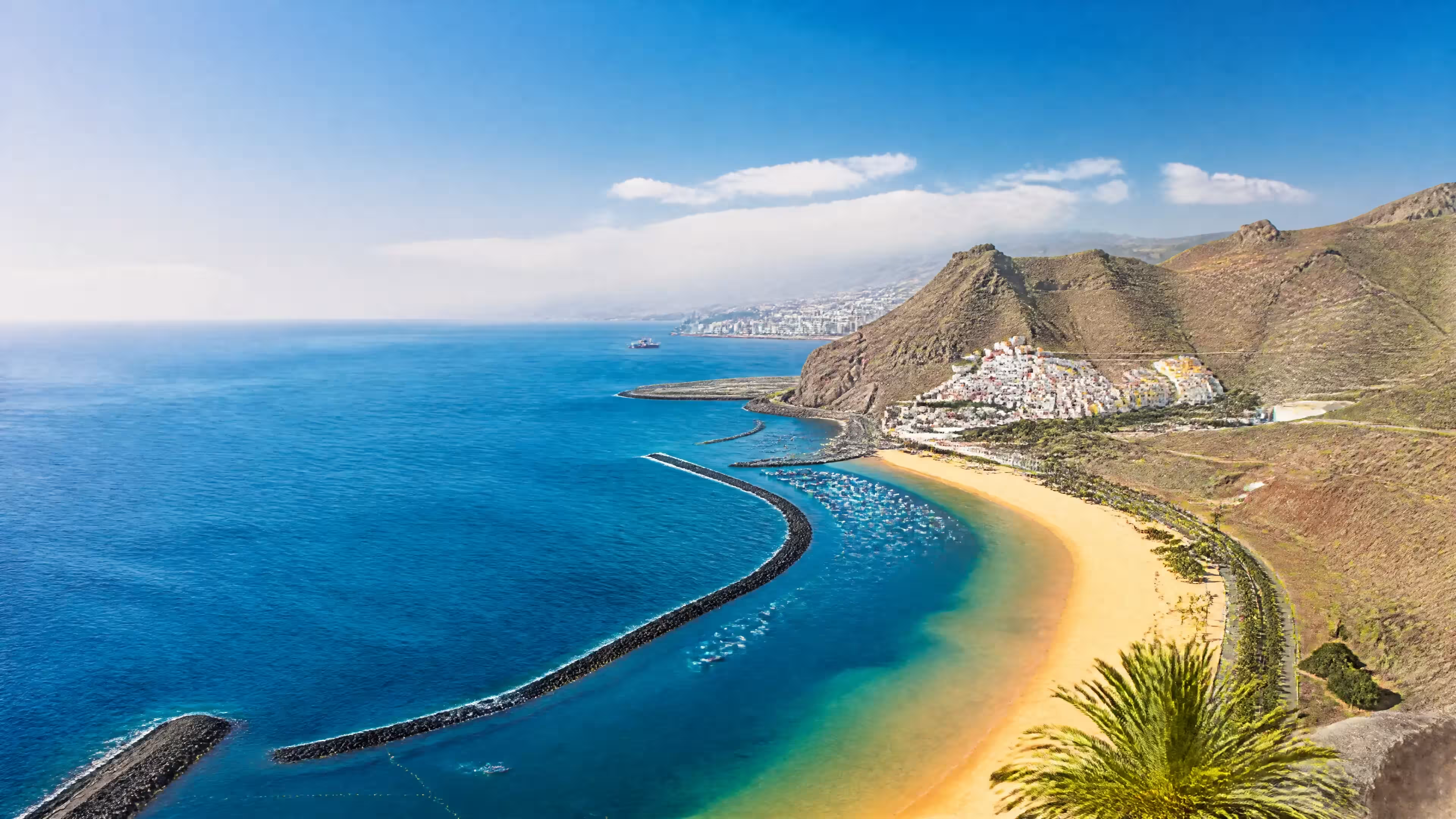
Year-round holidays in Tenerife: the south of the island offers dry warmth and swimmable sea even in winter, while the north offers greenery and clouds. The best time to travel is May and November: the weather is swimmable and prices are lower. There are no direct flights from Almaty; the journey takes about a day with a connection. Plan for a week or more.
How are holidays on the island structured?
Tenerife is the largest of the Canary Islands, and its geography divides tours into two dissimilar directions. The south and north live in different climates, and hotels here are chosen by weather, not by stars.
Southern resorts and northern areas
The south of Tenerife is best suited for beach holidays — the resorts of Las Americas, Costa Adeje and Los Cristianos. Here it is dry and sunny almost all year round, and rain falls on just a few days. The north of the island, including Puerto de la Cruz and the capital Santa Cruz, is greener and cooler, but windier and more often covered by clouds. Tours to the south are taken for stable warmth and calm sea, tours to the north — for local colour, gardens and proximity to the mountains. The Spanish development in Puerto de la Cruz has preserved its historic centre, while the southern resorts grew up specifically for tourists. The temperature difference between the zones in winter reaches several degrees, and it is noticeable in the evening. Hotels in the north are often cheaper, but not everyone and not always finds swimming there comfortable. It is more convenient to plan a holiday in Tenerife by deciding in advance what is more important — the beach or sightseeing.
Beaches with volcanic and light sand
There are two types of sand on the island, and this is immediately visible in hotel photos. The southern beaches are covered with light imported sand from the Sahara, so they look familiar and are suitable for children. The northern and western beaches have preserved volcanic black sand — it heats up more and contrasts beautifully with the water. The best places for swimming in the south are the calm bays of El Duque and Las Vistas. In the north, it is worth remembering the waves and strong current, especially in winter. It is better to go to the beach with children where there are lifeguards and a gentle entry into the water. The local sand does not stick to the skin, but it stains light towels and swimwear. The Spanish habit of swimming late in the evening also works here: the water cools down slowly.
Tours and hotels: what to expect by budget?
Holiday prices depend on the season, hotel category and meal plan. Understanding this range helps you choose a good moment to book.
Seasonal prices and off-season deals
It is cheaper to travel in May and November, when the high season has not yet started or has already ended. Prices for tours to Tenerife in these months are noticeably lower, while the weather remains swimmable. Winter holidays and school breaks are the most expensive period, and it is worth booking them several months in advance. In summer the south is hot, but hotels offer discounts for long stays. Spanish operators often release early booking deals, and this is a real way to save. It is more profitable to plan holidays with children for the off-season: fewer people in pools and queues. Prices for tours to Spain from Almaty consist of the flight and the ground portion, so the connection affects the total more than the hotel category. Flexible departure dates almost always save money.
Booking conditions and what is included in the price
The composition of the tour and payment rules are different for each company, and they need to be clarified before signing. Hotels in Tenerife usually offer breakfast or half board, and the price difference between them is noticeable. All inclusive meals are convenient for families with children who do not want to look for restaurants every evening. Spanish cuisine in hotel buffets is simple, but local dishes are worth trying separately. The cost of transfer to the hotel is often included in the package, but not always. Read the conditions carefully: little things like a deposit for the room affect the trip budget.
The journey from Almaty: routes and connections
There are no direct flights from Almaty to the island, and the route is always built through a major hub. The journey takes almost a day, so it is worth choosing a connection with a margin of time.
Tenerife airports and transfer to the hotel
Tenerife South Airport (TFS) receives most flights and charters, and it is closer to the resorts. Tenerife North (TFN) is located near the capital Santa Cruz and is convenient for those going to Puerto de la Cruz. Transfer to hotels in the south takes about 15–30 minutes, to northern resorts — noticeably longer. A group transfer is cheaper than a private one, but adds time for dropping off tourists. Renting a car at the airport saves waiting if you are ready to get behind the wheel right away. Spanish roads on the island are high-quality, but mountain serpentines require experience. Booking a transfer in advance is calmer, especially with a late arrival. A holiday begins exactly from the moment you reach the hotel without stress.
Visa, insurance and documents for the trip
Applying for permission to travel to Spain takes time, and the appointment at the consulate depends on the season. Medical insurance for Schengen is mandatory, and it is checked at the border. Documents should be prepared in advance, not a week before departure. The Spanish side accepts a standard package, but clarify its requirements in official sources. Keep copies of documents separately from the originals. Tours to Spain from Almaty are more convenient to arrange together with the package of documents so as not to miss deadlines.
Getting around the island and car rental
The island is small, but the terrain is serious, and the mode of transport changes the impression of the trip. The choice between bus and car depends on the route and the number of stops.
TITSA buses between resorts
TITSA bus network connects resorts, the capital and major attractions. The schedule is convenient for trips along the southern coast, but there are fewer services to the mountains. Tickets are bought from the driver or by card, and it is cheaper than a taxi. The bus to Mount Teide takes a long time, but without parking hassles. In high season the cabins fill up, and at rush hour you may not get a seat. Spanish drivers are punctual, but traffic jams in the south happen in the morning. For a family with children, the bus is convenient for short stretches, not for the whole day. Beach holidays with children in this case is built around one or two routes, not the whole map.
Payment, cash and tips
The currency on the island is the euro, and cards from Kazakh banks are not accepted everywhere. Cash is useful for small expenses, buses and market purchases. ATMs are found in resort areas, but the withdrawal fee can be noticeable. Tips in restaurants are usually about 5–10% of the bill if service is not included. In cafes on the promenade, small change is left more readily than in large hotels. The Spanish habit of siesta means that some shops are closed during the day. Keep a small amount of cash in case the terminal does not work. Prices in tourist areas are higher than in the capital, and this is normal.
What to do: sightseeing tours and active holidays
The island offers both calm sightseeing tours and serious activity. The programme should be put together for yourself, rather than taking everything in a row.
Volcano, gorges and boat trips
The main point of attraction is Mount Teide and the national park around it. The ascent to the crater takes half a day, and the weather at the top is noticeably colder than on the coast. Masca Gorge in the west impresses with its cliffs and the village squeezed between them. Loro Park and Siam Park are suitable for a family day with children. Boat trips to whales and dolphins depart from Los Cristianos and Las Americas. The observatory on Teide is interesting for evening tours of the starry sky. Spanish cuisine in the villages along the way is a separate pleasure: mojo, papas arrugadas and local wine. Beach holidays in Tenerife without going into the mountains loses half its meaning.
Trekking, diving and surfing
Trekking in Anaga is a classic of the island, routes go through laurel forests. Diving in the south is suitable for beginners, visibility in the water is good almost all year. Surfing is better on the northern beaches, where the waves are more stable and stronger. Paragliding over the southern coast gives a view of the island from above. Equipment can be rented from local schools, instructors speak English. Spanish insurance for the activity is arranged separately, clarify this in advance. When it is better to go to Tenerife for a specific sport depends on the wind and the season. Beach holidays in Tenerife with children is more often limited to the pool and easy routes.
Visa and entry rules change: check with the primary source — the Embassy of the Kingdom of Spain in the Republic of Kazakhstan, https://www.exteriores.gob.es/Embajadas/astana/es/ServiciosConsulares/Paginas/index.aspx. The information on this page was checked on 10.09.2026.
In short
- The south of Tenerife — sun and light sand, the north — greenery and black volcanic shore.
- The trip budget is determined by the season, hotel category and the chosen meal plan.
- The shoulder season in May and November gives the best prices with swimming weather.
- The route from Almaty goes through Istanbul, Dubai or European hubs.
- The southern airport is closer to the resorts, the transfer takes up to half an hour.