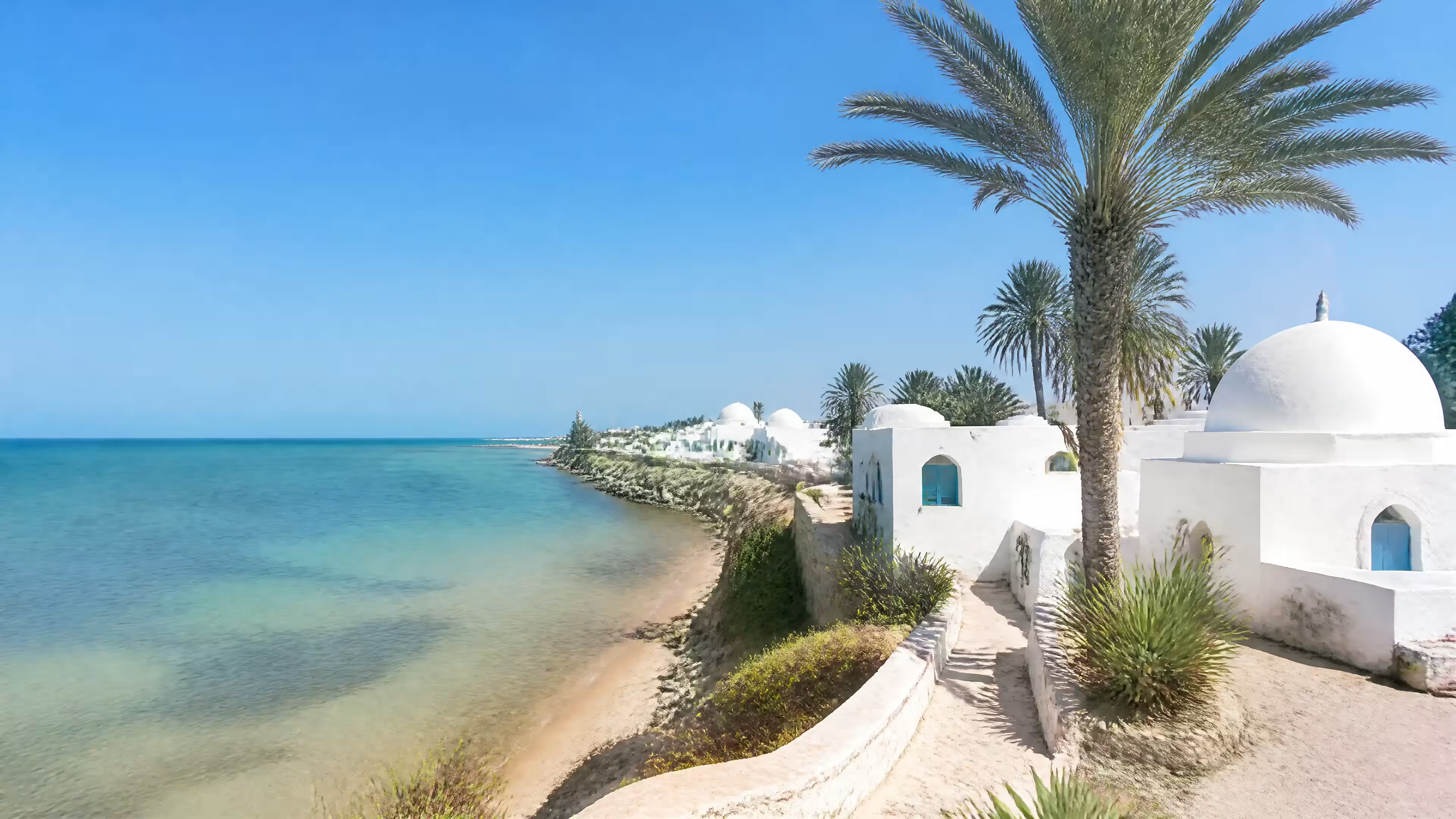
Holidays on Djerba are a warm sea from May to October, a mild winter and a flight from Almaty from ten hours with one transfer. The island is suitable for a calm beach holidays, family trips and inexpensive tours. High season is July and August, the most comfortable is in September and October. You can swim from May, the water warms up to +24 °C.
Preparation for a holiday begins with documents and insurance. Let's break down what to arrange in advance and what is decided already on the spot.
Visa and documents for citizens of Kazakhstan
The island has a simplified procedure for tourists from Kazakhstan, and this is worth finding out before buying tickets. On arrival at Djerba airport, a residence permit is issued if the passport is valid for more than three months from the date of entry. No forms need to be filled out in advance, but it is better to have return tickets and confirmation of hotel booking with you. A border service officer may ask to show them, and having printouts speeds up the procedure. The length of stay is usually limited to the tourist period, and its conditions should be clarified with your tour operator before departure. For a holiday on Djerba this is enough if the trip fits within standard limits. Children also need their own passport, not an entry in a parent's document. Keep copies of documents separately from the originals — on the island this helps.
Insurance and medical care on the island
A medical policy is not required for entry, but for a holiday on Djerba with children and in the hot season it is worth arranging in advance. State clinics on the island are modest in equipment, and serious cases are taken to Tunisia. Private offices in Houmt Souk accept insurance, but coverage needs to be checked before departure. Clarify whether the policy includes dentistry, sunburn and poisoning. Pharmacies on the island are well stocked, but familiar medications may have different names. Take your own set of medicines with a supply and a prescription in case of questions. This way a holiday on Djerba will not be overshadowed by searching for the needed pill in an unfamiliar city.
The road from Almaty: routes and transfers?
There is no direct connection between Almaty and the island, so the route is built through major hubs. We will tell you how long it takes and how to cope with the time zone change.
How long to fly and through which hubs
The road from Almaty to Djerba takes from ten hours including the transfer, and the route is chosen for the convenience of the connection. Most often people fly through Istanbul: Turkish airlines provide a short flight to Tunisia, and then either a local flight or a transfer. The second option is through Dubai, it is convenient for those who want to break up the journey and rest in the Emirates. The third is through Tunis-Carthage: some tourists fly there and go to the sea by ground transport. Djerba airport mainly receives charters and seasonal flights, so in winter the choice of connections is narrower. A connection of three to four hours is considered comfortable, less — risky in case of delay. Tickets for tours to Djerba with a fixed departure date are usually cheaper, but there is no flexibility in them.
Time difference and acclimatization
The time difference with Almaty is 4 hours all year round: Tunisia is on UTC+1, Kazakhstan on UTC+5. Adults usually get used to it within a day, but children cope with the time zone change harder. It is better not to plan the first day on the island densely: let the body adjust. Dinner by local time seems late, and waking up — too early. Shift the routine gradually, by an hour a day, even before departure. On the way back, adaptation is easier because the clocks are moved forward. Plan excursions for the third day, when sleep has already normalized. A holiday on Djerba with children should begin with the beach near the hotel, not with a long trip.
Money, communication and language at the resort
Financial and everyday little things decide how calm the holiday will be. Let's break down the currency, communication and how to explain yourself to the locals.
Dinar, cards and cash: how not to overpay
The currency of the island is the Tunisian dinar, and it cannot be taken out of the country, so exchange exactly for the needs of the trip. The rate is better in banks and exchange offices, not at hotel desks, where the markup is noticeable. Cards are not accepted everywhere: at markets, in taxis and small cafes you need cash. ATMs are available in Houmt Souk and Midoun, but in high season there is sometimes a queue for them. Keep small bills for tips and purchases — they often cannot give change from large ones. Paying directly in euros is unprofitable, it is better to exchange immediately into dinars. Tunisian cuisine at the market will cost less if you pay in cash. Spend the remaining dinars before departure at the airport, exchanging them back will not be possible.
SIM card, internet and language barrier
A local SIM card is issued by passport, and this is cheaper than roaming of Kazakh operators. The official language is Arabic; in the tourist zone French is spoken freely. English is understood worse, so a translator in the phone helps constantly. Download an offline dictionary in advance so as not to depend on the network. Wi-Fi in hotels is available, but the speed in rooms is often lower than in the lobby. For calls home, messengers are more convenient than regular communication. At the market, bargaining with the seller goes with fingers and a calculator, and this is normal. Djerba Tunisia is a place where a couple of French words dispose your interlocutor to you.
Local rules and safety
Respect for local norms makes the holiday calmer. We will tell you about clothing, alcohol and what to put in the first aid kit.
Clothing, alcohol and Ramadan
On the beach a swimsuit is appropriate, but in the city and at the market it is worth covering your shoulders and knees. This is respect for local norms, not a formal requirement. Alcohol is sold in hotels and specialized shops; outside the tourist area it is better not to display alcohol. During Ramadan some cafes are closed during the day, and in the evening life shifts to the night. Keep this in mind when planning excursions and dinners. Tunisian tradition implies modesty in clothing at shrines and in residential neighborhoods. For women traveling outside the resort, a light scarf will come in handy. Photographing people without permission is not worth it, especially women. Holidays on Djerba do not require strict rules, but politeness is valued here.
Water, sun and first aid kit
Tap water must not be drunk; even for brushing your teeth use bottled water. The sun on the island is harsh, so SPF 50 cream, a head covering and a drinking regimen are mandatory. Children and elderly people burn faster; they need shade from noon to three. In the first aid kit put remedies for poisoning, an antipyretic, bandages and an antiseptic. Usual medicines may be called differently, so take a supply for the whole trip. Insect bites in the evening are possible; repellent will not hurt. At the first signs of heatstroke, take the person into the cool and give water. Tunisian heat is easier to tolerate by the sea than in the interior of the island.
Visa and entry rules change: check with the primary source — the Ministry of Foreign Affairs of the Tunisian Republic, https://www.diplomatie.gov.tn/. The information on this page was checked on 10.09.2026.
Cuisine, souvenirs and trip budget
Gastronomy and shopping are a noticeable part of the impressions. Let's break down what to try, what to bring back and how much to set aside for small things.
What to try and what to bring back
The basis of local cuisine is fish and seafood, as well as couscous, brik and spicy harissa sauces. Hotel food is milder, street food is spicier, so try gradually. Brik is a thin envelope of dough with egg and tuna; it is served almost everywhere. Among souvenirs people bring olive oil, dates, Guellala ceramics, carpets and leather goods. Bargaining at the market is customary and expected; the first price is usually inflated twofold. Ceramics are packed carefully, but it is better not to take them in hand luggage. Buy dates by weight, not at the airport, where they are more expensive. Djerba Tunisia is famous for first-press olive oil; it is worth taking home.
Tipping and everyday expenses
Tipping on the island is expected: one or two dinars to a porter, maid and driver are considered the norm. Set these expenses aside in the budget in advance so as not to look for small change in your pockets. Everyday expenses depend on whether you eat at the hotel or in the city. Lunch at a local snack bar costs noticeably less than a restaurant at the hotel. Excursions and transport rental are paid separately; check prices on the spot. Small banknotes will be useful for taxis and purchases at the market. The Tunisian habit of bargaining also applies to drivers' services. Plan a daily limit so as not to go beyond it.
Briefly
- Djerba is an island in Tunisia, where people fly from Almaty with one transfer.
- The best months for a trip are September and October; in winter it is calmer and cheaper.
- Exchange money at banks; cards are not accepted everywhere.
- In the city cover your shoulders and knees, do not display alcohol outside the hotel.