
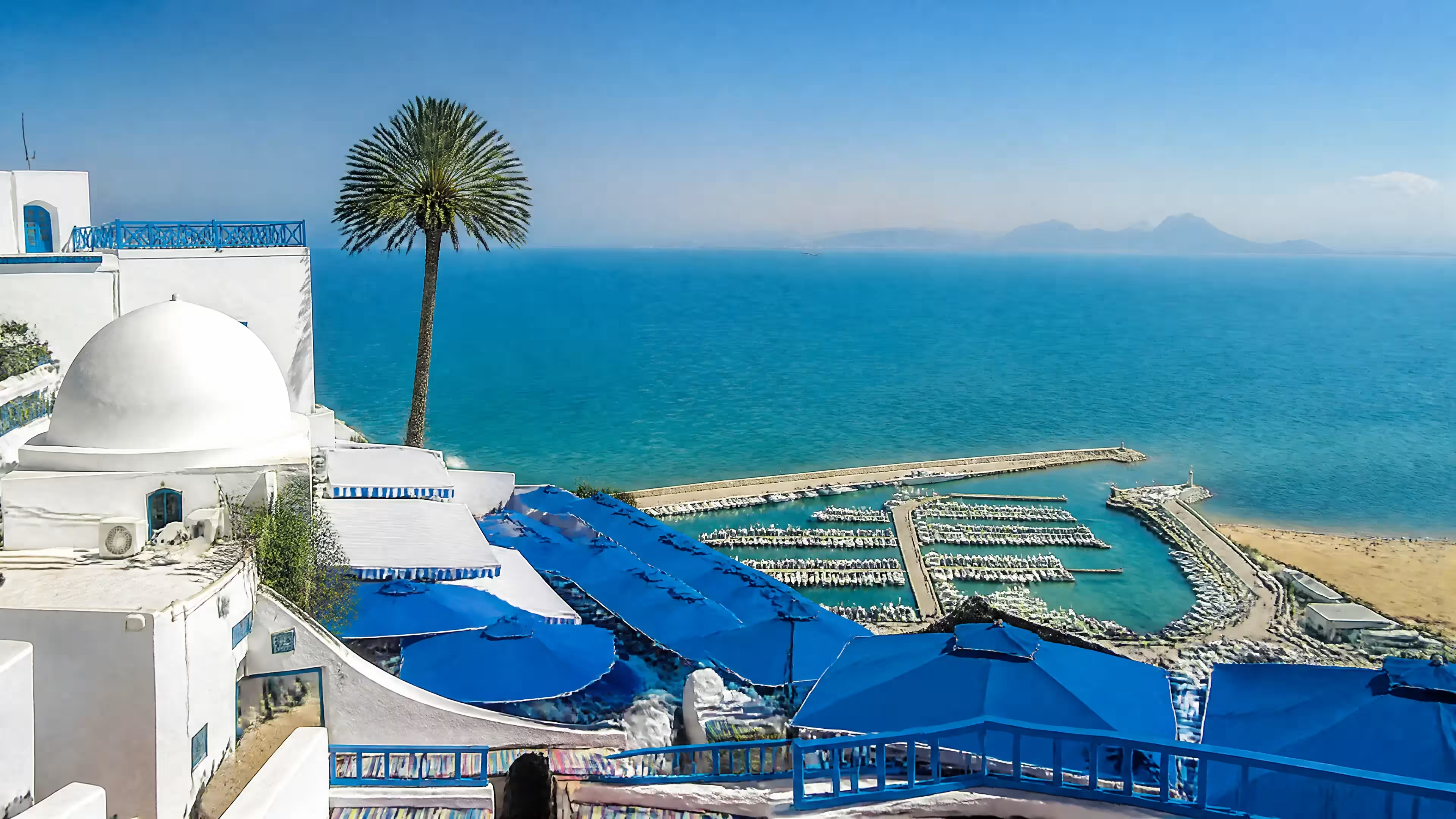
Sightseeing tours to Tunisia from Almaty: prices
Search across tour operator offers: price, dates, hotel and board on one screen.
Price, dates, hotel and board — on one screen.
Tours to Tunisia
Resorts of the country
for 2 adultswith a flight from Almaty


Low-price calendar for tours to Tunisia
The lowest price by month for the chosen destination.
for 2 adultswith a flight from Almaty
Tour collections for Tunisia


How to buy a tour to Tunisia
- 01
Find a tour
Departure city, destination, dates, nights and who is travelling — five fields in one row.
- 02
Choose and book
Compare the price for two, the board and the beach line, then hold your choice with a request.
- 03
Pay
By card, in instalments through a bank, by bank transfer or in cash at the office.
- 04
Get the documents
The contract, the voucher, the insurance policy and the itinerary receipts arrive by e-mail.
Tours to Tunisia: facts for the traveller
Ready to travel?
Leave a request and a manager will suggest options for your budget, dates and party.
Tours to Tunisia: what to know
Sightseeing tours to Tunisia from Almaty are most conveniently planned for spring and autumn: in April, May, October and November the coast has comfortable weather, while inland it is warm without exhausting heat. There are no direct flights, the journey goes with a connection through Istanbul, Dubai or Doha and takes from several hours to a day.
Preparing for the trip
Trips to Tunisia begin long before departure, and the main issue here is paperwork. An entry permit for a citizen of Kazakhstan is arranged in advance; it is not issued upon arrival.
How to arrange an entry permit in advance
An entry permit is arranged before departure, not at the arrival airport. The application is submitted through a consulate or visa center, and it usually takes from several days to two weeks. The package is assembled standard: form, photographs, hotel booking and route confirmation. Sightseeing tours with a ready package of documents are processed faster, because confirmations from the receiving side are already in hand. It is worth submitting documents with a time margin. In high season the consulate is busier, and the wait stretches out. Before submitting, check the current list on the department's website. That way you will not lose a week on sending in a missing certificate.
Requirements for documents and passport validity period
The main requirement of the Tunisian side is the remaining passport validity period. It must be valid for at least six months at the moment of entry, and this rule is checked carefully. If less than half a year remains until expiry, the trip is better postponed until the document is replaced. Such destinations from Almaty are often booked several months in advance, so the passport is checked first of all. The second point is blank pages: at least two are needed. Keep copies separate from the original, and keep a scan on your phone. For children under adulthood a separate package of documents is usually required; check the composition in advance. Everything concerning entry rules should be verified with an official source before submitting.
When is it better to plan a sightseeing trip?
The season in Tunisia decides more than it seems. In summer it is scorching here, in winter the north is damp, while in spring and autumn the country shows its best side.
Weather by season on the coast and inland
It is mildest to explore cities and ancient monuments in April, May, October and November. In these months the coast maintains a comfortable temperature, while inland it is warm during the day, but without exhausting heat. Sightseeing tours in this period are easy to endure, even if the route is long. In summer on the coast the heat is above +35 °C, and sightseeing is better scheduled for morning or evening. In winter the north is cool and rainy, but you can swim in the south, and there are almost no crowds of tourists. Djerba in winter is noticeably warmer than the mainland part. In the shoulder season the weather is changeable, so it is worth adding a spare day to the route.
| Season | Coast | Inland | Who it suits |
|---|---|---|---|
| Spring | Warm, windy | Dry, up to +28 °C | For exploring cities |
| Summer | Above +35 °C | Very hot | For beaches and sea |
| Autumn | Mild, clear | Warm during the day | For excursions |
| Winter | Cool, rains | Warm in the south | For a quiet holiday |
High season, Ramadan and the load on popular programs
High season in Tunisia falls in July and August, as well as the New Year holidays. At this time hotels and popular routes are booked in advance, otherwise there are simply no places left. Sightseeing tours in high season become more expensive, and groups become denser. Ramadan shifts the country's daily rhythm: some cafes and shops operate on a reduced schedule, and programs may start later. For a tourist this is not an obstacle, but the day is worth planning with an eye to local working hours. Djerba and Hammamet during Ramadan are calmer than at the height of summer. If you want silence and moderate prices, choose May or October.
Money, communication and everyday expenses on site
The Tunisian dinar is a closed currency, and this determines the entire financial logic of the trip. Cards are not accepted everywhere here, so cash is needed constantly.
Cash and cards: where each is useful
It is worth exchanging money in small amounts, because taking dinars out of the country is prohibited. Exchange as much as you plan to spend in the coming days. Visa and Mastercard are accepted in hotels and large restaurants, but in markets, in the medina and small cafes cash is needed. Sightseeing tours bought on site are often paid for in cash. There are ATMs in resort areas, but there are few in remote districts. Keep small change at hand: it will be useful for tips and small purchases. Large sums are better not carried around all at once.
| Expense item | Where to pay by card | Where cash is needed |
|---|---|---|
| Hotel | Yes | No |
| Large restaurant | Yes | Sometimes |
| Medina and market | No | Yes |
| Taxi | No | Yes |
| Small cafes | No | Yes |
Tips, bargaining and typical tourist expenses
Tips in Tunisia are expected everywhere: for the guide, driver, maid, waiter. The amounts are small, but it is customary to leave them for almost any service. Bargaining is appropriate in markets and in the medina, but in shops with fixed prices it is inappropriate. Excursions on site are sold at the hotel reception or by street agencies, and prices there differ. Souvenirs — ceramics, olive oil, carpets — are typical purchases, and here bargaining works best of all. Plan expenses with a margin: small expenses on holiday accumulate unnoticed. The main items are food, trips and gifts.
How to get there and how to move between cities?
The journey from Almaty to Tunisia takes almost a day, and within the country it is most convenient to move along the coast. Let us look at how the logistics are arranged.
Connections and travel time from Almaty
There are no direct flights from Almaty to Tunisia, and this is the main thing to consider when planning. Connections usually go through Istanbul, Dubai or Doha, and add from a few hours to a day to the journey. Sightseeing tours with flights through Istanbul are considered the shortest in total time. The time difference with Almaty is 4 hours all year round: Tunisia is on UTC+1, Kazakhstan on UTC+5. A long layover is a good reason to choose a convenient overnight segment and sleep on the way. When transferring, check whether the terminal changes. Baggage sometimes has to be collected and checked in again.
Car rental, taxi and organized transfer
Renting a car gives freedom of movement between cities, but requires an international driving permit. The driving style of local drivers is peculiar, so concentration is needed behind the wheel. Taxis in resort areas are available, but it is better to agree on the price before getting in. Sightseeing tours with an organized transfer save you from these hassles: you are taken from the hotel and back. Hammamet, Sousse, Monastir and Mahdia are connected by convenient roads, and to Djerba they get there by ferry or plane. For short trips around the city, a taxi is enough; for long routes, a transfer is more convenient. If you travel on your own, plan your journeys with a margin of time.
What to consider in behavior and daily life
Tunisia is a country with its own rules of everyday life, and a tourist should know them in advance. This concerns clothing, food and small everyday details.
Clothing, photography rules and visiting religious sites
For visiting mosques and religious sites, dress modestly: covered shoulders and knees are mandatory, women should take a headscarf. Sightseeing tours often include such stops, so suitable clothing is taken along in advance. Photographing military facilities, police officers and some locals without permission is not advisable. In the medina and at markets, people react more calmly to a camera, but asking permission is still appropriate. On beaches and in hotels the dress code is free, while in cities it is better to look modest. Tunisian everyday life is tolerant of tourists, but respect for local customs is appreciated. Sunscreen and a head covering are mandatory in summer.
Cuisine, alcohol and medical insurance
Tunisian cuisine is spicy: the basis of many dishes is harissa, couscous, tagine, brik, as well as fresh fish and olive oil. If you do not like spicy food, ask for it to be cooked without sauce, otherwise the portion will turn out fiery. Alcohol is not sold everywhere: during Ramadan and in areas far from resorts it is harder to find. Pharmacies in resort areas exist, but it is better to bring rare medicines with you. Sightseeing tours into the interior of the country should be planned taking into account a supply of water and a first aid kit. If you have health problems, contact the clinic at the hotel.
Visa and entry rules change: check with the primary source — the Ministry of Foreign Affairs of the Tunisian Republic, https://www.diplomatie.gov.tn/. The information on this page was verified on 14.09.2026.
In brief
- Routes around cities and monuments are best booked for April, May, October or November.
- In summer, sightseeing is scheduled for morning and evening due to heat above +35 °C.
- There are no direct flights from Almaty: they fly with a connection through Istanbul, Dubai or Doha.
- Dinars are exchanged in small amounts; taking them outside the country is prohibited.
- Within the country, transfers between Hammamet, Sousse, Monastir and Mahdia are convenient.
Tours by destination and departure city
Turkey
Tours to Turkey from Almaty Tours to Turkey from Astana Tours to Turkey from Shymkent Tours to Turkey from Kostanay Tours to Turkey from Aktobe Tours to Turkey from AktauEgypt
Tours to Egypt from Almaty Tours to Egypt from Astana Tours to Egypt from Shymkent Tours to Egypt from Kostanay Tours to Egypt from Aktobe Tours to Egypt from AktauUAE
Tours to UAE from Almaty Tours to UAE from Astana Tours to UAE from Shymkent Tours to UAE from Kostanay Tours to UAE from Aktobe Tours to UAE from AktauFrequent questions about tours to Tunisia
There are no direct flights, and the journey with a connection takes from ten hours or more.
Hammamet, Sousse, Monastir, Mahdia and Djerba offer convenient access to the main attractions.
The capital Tunis, Carthage, Sidi Bou Said, El Jem and Kairouan.
In the evening by the sea it can be cool, so a light jacket will not hurt.
Yes, short excursions and the sea nearby make the trip convenient with children.
Couscous, brik, harissa and seafood, as well as olives and dates.
For the main sightseeing tours a week is enough, for the south more is needed.
Yes, morning departures leave the second half of the day by the sea.
Ceramics, olive oil, dates, leather and handmade carpets.
By group transport as part of the tour or by a rented car.
In spring, in April and May, when excursions to the ruins are especially pleasant.
Visa and entry rules change: check with the primary source — the MFA of the Tunisian Republic, https://www.diplomatie.gov.tn/. The information on this page was verified on 14.09.2026.
Reviews of tours to Tunisia
What travellers write afterwards: the hotel, the dates and what is worth knowing in advance.
No data yet
No one has left a review yet. Yours would be the first.
Write a review
The review appears on the site after a moderator checks it.
Destination guide
Short guides: season, hotels, money and documents.

Are international driving permits required
When planning a trip from Almaty, many tourists decide in advance whether an international driving permit is needed. The answer depends on the country and on whether you plan to get behind the wheel.
Read
How to dress when visiting temples
A trip from Almaty to southern countries often includes visiting temples. Many tourists wonder in advance how to dress when visiting temples. Modesty rules apply in mosques, Hindu and Buddhist temples.
Read
Online check-in for the flight
Online check-in opens 24 hours before departure. For flights from Almaty, it is usually available on the airline's website and in its app. The procedure takes a few minutes and saves you from queues at the airport.
Read
Consent for a child's departure
Consent for a child to travel abroad is arranged in advance. A notary in Almaty certifies a power of attorney for the accompanying person. Parents decide who will take the minor on the trip.
Read
Hand luggage rules
Hand luggage is the items a passenger takes into the aircraft cabin. The carriage rules apply to everyone flying from Almaty. Airlines set their own weight and size standards. Carriage of large bags in the cabin is usually not allowed.
Read
Transfer between flights
A transfer between flights is a stop at an intermediate airport, after which the traveler continues the journey on another plane. From Almaty, almost any long route is built through such a hub.
Read