
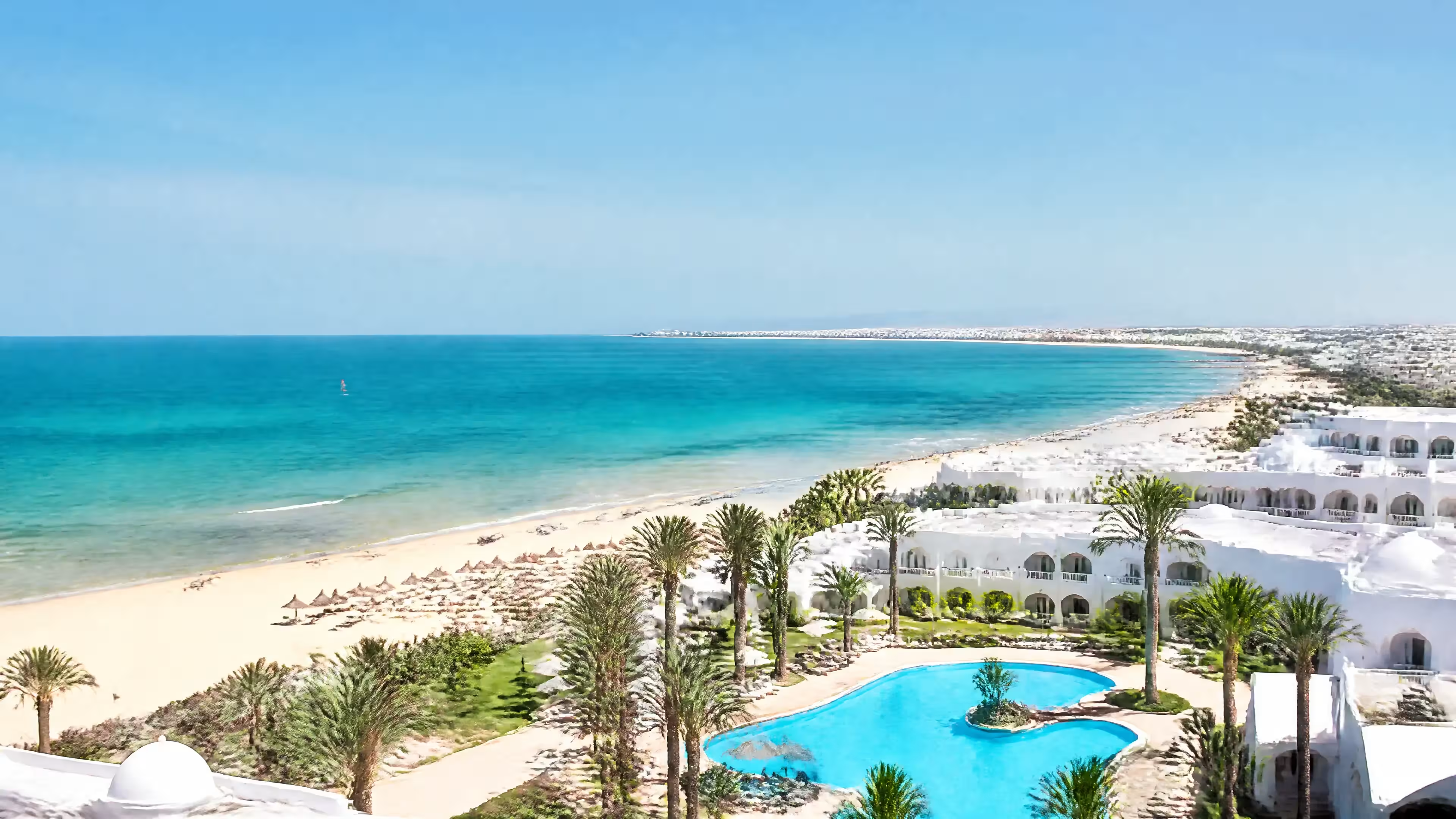
All inclusive in Tunisia from Almaty: prices
Search across tour operator offers: price, dates, hotel and board on one screen.
Price, dates, hotel and board — on one screen.
Tours to Tunisia
Resorts of the country
for 2 adultswith a flight from Almaty


Low-price calendar for tours to Tunisia
The lowest price by month for the chosen destination.
for 2 adultswith a flight from Almaty
Tour collections for Tunisia


How to buy a tour to Tunisia
- 01
Find a tour
Departure city, destination, dates, nights and who is travelling — five fields in one row.
- 02
Choose and book
Compare the price for two, the board and the beach line, then hold your choice with a request.
- 03
Pay
By card, in instalments through a bank, by bank transfer or in cash at the office.
- 04
Get the documents
The contract, the voucher, the insurance policy and the itinerary receipts arrive by e-mail.
Tours to Tunisia: facts for the traveller
Ready to travel?
Leave a request and a manager will suggest options for your budget, dates and party.
Tours to Tunisia: what to know
All inclusive holidays in Tunisia are a package with a flight from Almaty, transfer, accommodation and meals at the hotel. Swimming is comfortable from May to October on the mainland and from April to November on Djerba. The resort fee, tips and excursions are paid separately. The main resorts are Hammamet, Sousse, Monastir, Mahdia and Djerba.
Visa, flight and money: what to consider before departure from Almaty?
Before travelling to Tunisia, it is worth sorting out the formalities, currency and travel time. Below is what is important to know before departure from Almaty.
Arrival processing for citizens of Kazakhstan
Check the entry procedure for citizens of Kazakhstan in advance with a tour operator representative. Direct charters from Almaty fly to Enfidha or Djerba, the journey takes about 7–8 hours. The time difference with Almaty is 4 hours all year round: Tunisia is on UTC+1, Kazakhstan on UTC+5. The return flight is at night, so it is better not to plan anything important on the day of departure. Take cash for the first expenses: ATMs at Enfidha airport work, but the queue after the plane lands can be long. A backup option will also come in handy here — a small exchange at the airport if the ATM does not accept the card.
Dinar, exchange and resort fee
The currency of Tunisia is the Tunisian dinar, and it cannot be taken out of the country. Exchange is done only at banks, exchange offices at hotels and the airport; the rate is approximately the same everywhere, but keep the exchange receipt until departure. The resort fee at hotels in Hammamet, Sousse and Monastir is paid separately from the package. The amount depends on the accommodation category, and it is usually charged at check-out. Cards are accepted in large hotels and shops, but cash is needed in markets and taxis. Small notes will come in handy for tips and purchases from local traders. Do not exchange money with private individuals on the street: the rate there is more tempting, but the notes may turn out to be old or counterfeit. All inclusive holidays in Tunisia do not cancel these everyday little things: dinars for the first day and a cash reserve noticeably simplify the start of the trip.
When to go to the beaches of the Mediterranean Sea and the island
The beach season in Tunisia lasts longer than it seems by the calendar. The choice of month depends on where exactly you are flying.
Season at mainland resorts
Swimming on the mainland is comfortable from late May to October. In Hammamet and Sousse the water warms up by June, and in September it still stays around +25 °C. July and August are the hottest months: the air rises above +35 °C, and it is better to spend midday in the shade or in the pool. In Monastir and Mahdia the winds are slightly stronger, so the heat is easier to bear. The velvet season is late September and October: the sea is warm, and the sun is no longer so aggressive. For excursions to the Sahara, it is better to choose spring or autumn: in summer the desert is too hot. In winter it is cool and rainy here, but short walks along the coast are quite possible.
Swimming features on Djerba
On Djerba the swimming season is longer than on the mainland. The shallow water and warm gulf allow you to enter the water already in April, and the season ends closer to November. The water here warms up faster, and even on windy days swimming remains comfortable. Winds on the island are normal: they bring coolness and make the weather milder than in Hammamet. For families with children, Djerba is convenient thanks to its gentle entry and calm sea. In winter the island is also warm, but few dare to swim. If you are going for the beach outside the high season, Djerba is the most reliable option in the region.
What is included in the package and what will you have to pay for separately?
Even with a paid package, part of the expenses remains with the tourist. Understand in advance what to pay for on the spot.
Tips and drinks outside the restaurant
| Item | Included in all inclusive | Payment on the spot |
|---|---|---|
| Meals in the hotel restaurant | Yes | — |
| Drinks at the pool bar | Usually yes | — |
| Premium cocktails | No | According to the bar menu |
| Bottled water in the room | Often no | According to the hotel price list |
| Tips for staff | No | In dinars |
Tips at all inclusive hotels are not included in the package. They are usually left separately: for maids, waiters, bartenders. Focus on modest amounts in dinars, but without fanaticism. Alcohol is served at hotels, but outside the tourist zone sales are restricted, and it is not available everywhere. Check at the reception what exactly is included in your rate: the lists differ at different hotels. Drinks at the pool bar are usually included, while premium cocktails may be paid. Tunisia offers the all inclusive format in almost every large hotel in Hammamet, Sousse and Djerba, but the set of options at a specific hotel should be checked before booking.
Excursions and car rental
Excursions from Hammamet and Sousse are booked on the spot or with a tour operator representative. Carthage, Sidi Bou Said, a trip to the Sahara and a jeep safari are popular. Prices depend on the programme and the number of participants, so compare offers. Renting a car requires an international licence, and local traffic rules are strict. Fines are high, so without experience of driving abroad it is better to take a car with a driver. For trips around the island on Djerba, a taxi or an organised transfer is enough. If you plan to move around a lot, renting pays off, but only with confident driving.
How to prepare for a trip during Ramadan
Ramadan changes the rhythm of life in Tunisia, and a tourist should take this into account. Hotels are almost unaffected, but the street lives differently.
Opening hours of cafes and shops
During Ramadan, cafes and shops outside hotels operate on a reduced schedule. During the day many places are closed, and they open closer to evening, after iftar. In the tourist zones of Hammamet and Sousse, cafes for tourists still work, but the choice is more modest. Dinner at a restaurant outside the hotel may start late: locals sit down at the table after sunset. Plan souvenir shopping for the evening, when the markets come to life. In Djerba and Monastir the rhythm is calmer than in large cities, but the general logic is the same. If you are going during Ramadan, do not count on the usual daytime schedule of cafes.
Dress code and behaviour outside the hotel
During Ramadan, dress more modestly than you would on the beach. Outside the hotel, women should cover their shoulders and knees, especially in Monastir and Mahdia. Men should not walk the streets without a T-shirt. Do not eat or drink ostentatiously on the street during daylight hours: locals may disapprove. Taking photos of people without permission is not customary, especially during prayer. In the tourist zone the rules are more relaxed, but respect for local traditions is always appropriate. Behave calmly and do not raise your voice in public places.
Communications, first aid kits and souvenirs: practical little things
Small details decide how calm your trip will be. It is worth thinking about communications, medicines and shopping in advance.
Local SIM card and roaming
A local SIM card is issued with a passport at an operator's shop. Roaming with Kazakhstani operators is expensive, so for calls and internet it is more economical to buy a local SIM card. At Enfidha Airport and in major cities there are mobile phone shops, but on the first day there may not be enough time. Wi-Fi in hotels in Hammamet and Sousse is usually available in the lobby, while the signal is weaker in the room. For navigation and messengers, a package of a few gigabytes is enough. If you are going to Djerba, check coverage in advance: on the island it is slightly worse than on the mainland. Charge your phone with a margin: sockets in hotels are standard, but an adapter may be needed.
Medicines and haggling at markets
Take first aid kits and medicines with you: the range in Tunisian pharmacies is limited. Prescription drugs may not match by name, and the usual remedy may simply not be available. Be sure to take what you take constantly, plus a standard set for colds and stomach issues. Medical insurance is not mandatory for entry, but with all inclusive, the coverage of treatment outside the hotel should be clarified in advance. At markets prices are inflated, and haggling is appropriate: bargain boldly, but politely. Cards are not accepted everywhere, so keep cash in dinars with you. It is better to buy souvenirs at the end of the trip, when you already understand the real prices.
| Resort | Swimming season | Feature |
|---|---|---|
| Hammamet | Late May — October | Gentle entry, developed infrastructure |
| Sousse | June — October | Long beach line |
| Monastir | June — October | Stronger winds, easier heat |
| Mahdia | June — October | Calm rhythm, winds |
| Djerba | April — November | The longest season, shallow water |
Visa and entry rules change: check with the primary source — the Ministry of Foreign Affairs of the Tunisian Republic, https://www.diplomatie.gov.tn/. The information on this page was verified on 14.09.2026.
In short
- The package covers the flight, transfer, accommodation and meals at the hotel, but not all expenses on site.
- The resort fee and tips are paid separately and depend on the hotel category.
- The swimming season on the mainland runs from May to October, and on Djerba it lasts longer.
- Think through excursions, communications and medicines in advance, and keep cash in dinars at hand.
- During Ramadan, the schedule of cafes and shops outside hotels shifts to the evening.
Tours by destination and departure city
Turkey
Tours to Turkey from Almaty Tours to Turkey from Astana Tours to Turkey from Shymkent Tours to Turkey from Kostanay Tours to Turkey from Aktobe Tours to Turkey from AktauEgypt
Tours to Egypt from Almaty Tours to Egypt from Astana Tours to Egypt from Shymkent Tours to Egypt from Kostanay Tours to Egypt from Aktobe Tours to Egypt from AktauUAE
Tours to UAE from Almaty Tours to UAE from Astana Tours to UAE from Shymkent Tours to UAE from Kostanay Tours to UAE from Aktobe Tours to UAE from AktauFrequent questions about tours to Tunisia
Optimally from May to October, when the sea is warm and Tunisian hotels operate at full capacity.
Usually meals, local drinks, the pool, the beach and animation, but each hotel's set is its own.
Yes, there is a shallow sea and many hotels with kids' clubs.
Sousse is larger and livelier, Monastir is more compact and quieter.
Yes, if you want a warm sea, lagoons and a calm island rhythm.
There are no direct regular flights; people fly by charter or with a connection.
Cool and windy, swimming is not comfortable for everyone, but it is cheaper.
Yes, dinars will come in handy for markets, cafes and tips.
Medinas, fortresses, ruins of ancient cities and the desert.
No, in Tunisian hotels bottled water is taken.
Mahdia and Monastir are suitable for those who want a calm holiday.
From the airport to Hammamet it is about an hour, to Sousse and Monastir it is longer.
Reviews of tours to Tunisia
What travellers write afterwards: the hotel, the dates and what is worth knowing in advance.
No data yet
No one has left a review yet. Yours would be the first.
Write a review
The review appears on the site after a moderator checks it.
Destination guide
Short guides: season, hotels, money and documents.

Are international driving permits required
When planning a trip from Almaty, many tourists decide in advance whether an international driving permit is needed. The answer depends on the country and on whether you plan to get behind the wheel.
Read
How to dress when visiting temples
A trip from Almaty to southern countries often includes visiting temples. Many tourists wonder in advance how to dress when visiting temples. Modesty rules apply in mosques, Hindu and Buddhist temples.
Read
Online check-in for the flight
Online check-in opens 24 hours before departure. For flights from Almaty, it is usually available on the airline's website and in its app. The procedure takes a few minutes and saves you from queues at the airport.
Read
Consent for a child's departure
Consent for a child to travel abroad is arranged in advance. A notary in Almaty certifies a power of attorney for the accompanying person. Parents decide who will take the minor on the trip.
Read
Hand luggage rules
Hand luggage is the items a passenger takes into the aircraft cabin. The carriage rules apply to everyone flying from Almaty. Airlines set their own weight and size standards. Carriage of large bags in the cabin is usually not allowed.
Read
Transfer between flights
A transfer between flights is a stop at an intermediate airport, after which the traveler continues the journey on another plane. From Almaty, almost any long route is built through such a hub.
Read