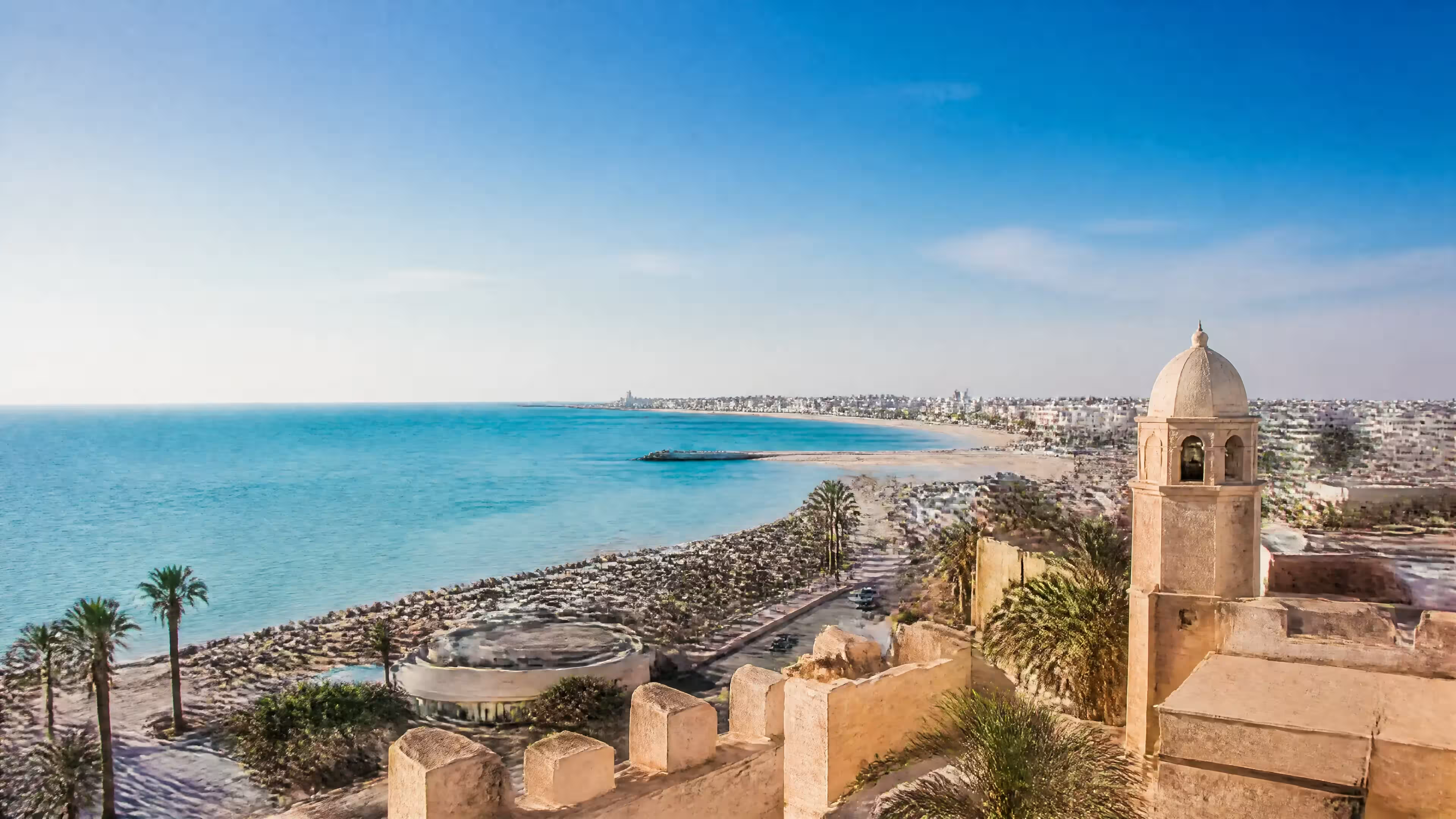
Holidays in Monastir are a calm Mediterranean resort with sandy beaches, mild winters and hot dry summers. The swimming season lasts from May to October, with the peak in July and August. There are no direct flights from Almaty, the journey takes about a day with a stopover in Istanbul, Dubai or Doha. Tours to Monastir are usually booked for 7–10 nights.
Visa, flight and the first day after arrival: what do you need to know?
This section gathers practical preparation for the trip. Here is how entry works, how the route from Kazakhstan is built and what to do in the first hours on site.
What citizens of Kazakhstan need to know for visa-free entry
On arrival in Tunisia a migration card is filled out, and its form is handed out on the plane. The passport must be valid for at least three months from the date of entry, so the term is worth checking at home. Medical insurance is not included in visa-free entry automatically, it is arranged separately, including coverage for hospitalization. Vaccinations for entry from Kazakhstan are not required, but it is worth updating the standard set. In the first day after arrival in Monastir it is useful to immediately check the insurance validity period and save its number in the phone. A Tunisian border guard may ask a question about the purpose of the trip, and a hotel booking answers it best. It is worth keeping a printout of the booking and return tickets at hand.
How the route from Almaty is built and where the stopover takes place
There are no direct flights Almaty — Monastir, and the flight is usually built through Istanbul, Dubai or Doha. The last leg goes to Enfidha or Tunis-Carthage, then the tourist is awaited by a transfer to the hotel. The time difference with Almaty is 4 hours all year round: Tunisia is on UTC+1, Kazakhstan on UTC+5. This is worth taking into account when planning the first day: the body is still living on Almaty time. The journey takes almost a day including the stopover. The first day in Monastir is better not filled with excursions, but giving yourself time to acclimatize.
Money, communications and everyday little things on site: what to consider?
Everyday details decide how calm a holiday in Monastir will turn out. Below is about currency, exchange and communications.
Tunisian dinar: exchange, cash and cards
The currency of Tunisia is the Tunisian dinar, and taking dinars out of the country is prohibited. Exchange in Monastir is better planned for daily expenses, and not for the whole trip at once. Cards are not accepted everywhere: in hotels and large shops yes, in the medina and small cafes cash is more reliable. Tipping in Tunisia is the norm: porters, maids, taxi drivers are given small notes, change is worth keeping in advance. The rate at the hotel is usually less favorable than at a bank or exchanger in the city. Small notes will also come in handy for taxis, where change may not be given. The remaining dinars before departure will have to be spent at the airport.
SIM card, internet and the cost of roaming
A local SIM card in Tunisia is issued by passport, and this is the cheapest way to stay in touch. Roaming of Kazakhstani operators in Tunisia is expensive, so it is turned on only for an emergency. Operators in Monastir offer packages with internet for a week or a month, they are enough for messengers and maps. Wi-Fi in hotels is available, but the speed in rooms is often lower than in the lobby. For calls home, messengers are more convenient than regular communication. Sockets in Tunisia are type C and E with a voltage of 230 V, an adapter is needed, and equipment from Kazakhstan works without a transformer. An adapter is worth buying in advance, it may not be available at the hotel.
How the rhythm of the city is arranged
The daily life of Monastir obeys its own rules. This section is about language, manners and seasonal shifts in the schedule.
Language, tips and rules of behavior outside the beach
The official language of Tunisia is Arabic, in the tourist zone French is widespread, English is understood in hotels and agencies. A few words in French noticeably simplify communication with locals. Clothing outside the beach should be modest: in the medina and mosques covered shoulders and knees, a swimsuit is appropriate only on the hotel grounds. Tunisian cuisine and markets imply bargaining, but without pressure. Tips are given for a service, and not for attention. Photographing people without asking is not worth it, especially women. These little things make a holiday in Monastir calmer and more pleasant for both sides.
Ramadan and seasonal changes in the schedule
Ramadan noticeably changes the rhythm of the city: some cafes are closed during the day, and in the evening life shifts to late hours. Tourists at the hotel are almost not bothered by the restrictions, but on the street it is worth behaving respectfully. A trip during this period gives an unusual experience, if you understand the schedule in advance. Outside Ramadan, the evening rhythm of Monastir is also late: dinner is after sunset, and the embankment comes alive closer to night. In summer the siesta shifts the work of small shops to the morning and evening. In winter the city quiets down earlier, and some establishments work on a reduced schedule. Tours to Monastir in high season are booked in advance, because hotels fill up densely.
Getting around the city and the surroundings
Transport in the region is inexpensive, but with its own peculiarities. Here is about how to move around the city and where to go for a day.
Taxi, trains and car rental
Taxis in Monastir are cheaper than in Europe, but the meter is not always turned on: the price is worth agreeing on before boarding. The railway connects Monastir with Sousse and Tunis, trains are cheap, but the schedule is worth checking on site. Car rental requires an international driver's license, and traffic in Tunisia is left-hand — this is the main surprise for a Kazakhstani driver. For short trips within the city a car is not needed, a taxi is enough. For longer outings it is more convenient to take a car with a driver or go by train. Gasoline is inexpensive, but parking in the center can be a problem. The roads between the resorts are good, but the signs are not always duplicated in Latin script.
What a driver from Kazakhstan should consider
Left-hand traffic is the first thing a driver from Kazakhstan does not get used to right away. At intersections and roundabouts, priority works differently than at home, and it is better to drive the first kilometers at a calm pace. An international driver's license is mandatory; a national one is not enough. Fines on the roads are issued on site, and payment is usually in cash. In the resort area of Monastir, speed limits are lower than on the highway. At night outside the city there is almost no lighting, and pedestrians walk onto the road. A car is worth renting if long trips are planned, rather than drives around the city.
Visa and entry rules change: check with the primary source — the Ministry of Foreign Affairs of the Tunisian Republic, https://www.diplomatie.gov.tn/. The information on this page was verified on 10.09.2026.
Health and safety
A calm vacation in Monastir largely depends on basic preparation. This section is about insurance, medicine, and preventing minor troubles.
Insurance, first aid kits, and medical care
Medical insurance for a trip to Tunisia is arranged separately and must include hospitalization. Pharmacies and clinics in the tourist area operate, but in a serious case they take you to Sousse or Tunis — this is worth considering when choosing coverage. A first aid kit with familiar medications is taken along, because familiar names are not found in local pharmacies. Prescription medications are transported in factory packaging. Sunscreen and insect repellent are useful year-round. For chronic diseases, it is worth finding out in advance where the nearest clinic with the needed specialty is. Tunisian medicine in private clinics is paid, and insurance covers expenses by receipts.
Water, food, and preventing minor troubles
Drinking tap water is not worth it even at the hotel — bottled water is bought, including for brushing teeth. Street food in Tunisia is tasty but unusual, and in the first days it is better not to mix everything at once. Vegetables and fruits are washed with bottled water or peeled. It is better not to take ice in drinks outside the hotel. Acclimatization in the first days causes drowsiness, and it is not worth attributing it to illness. For mild malaise, rest in the shade and more water help. These simple habits remove most minor problems.
Briefly
- A vacation in Monastir will suit those who want a calm sea and inexpensive trips around the surroundings.
- Tours to Monastir are convenient for families with children and for those traveling to Tunisia for the first time.
- Check the passport's validity period and arrange insurance with hospitalization coverage.
- Take an adapter for type C and E sockets and a supply of familiar medications.