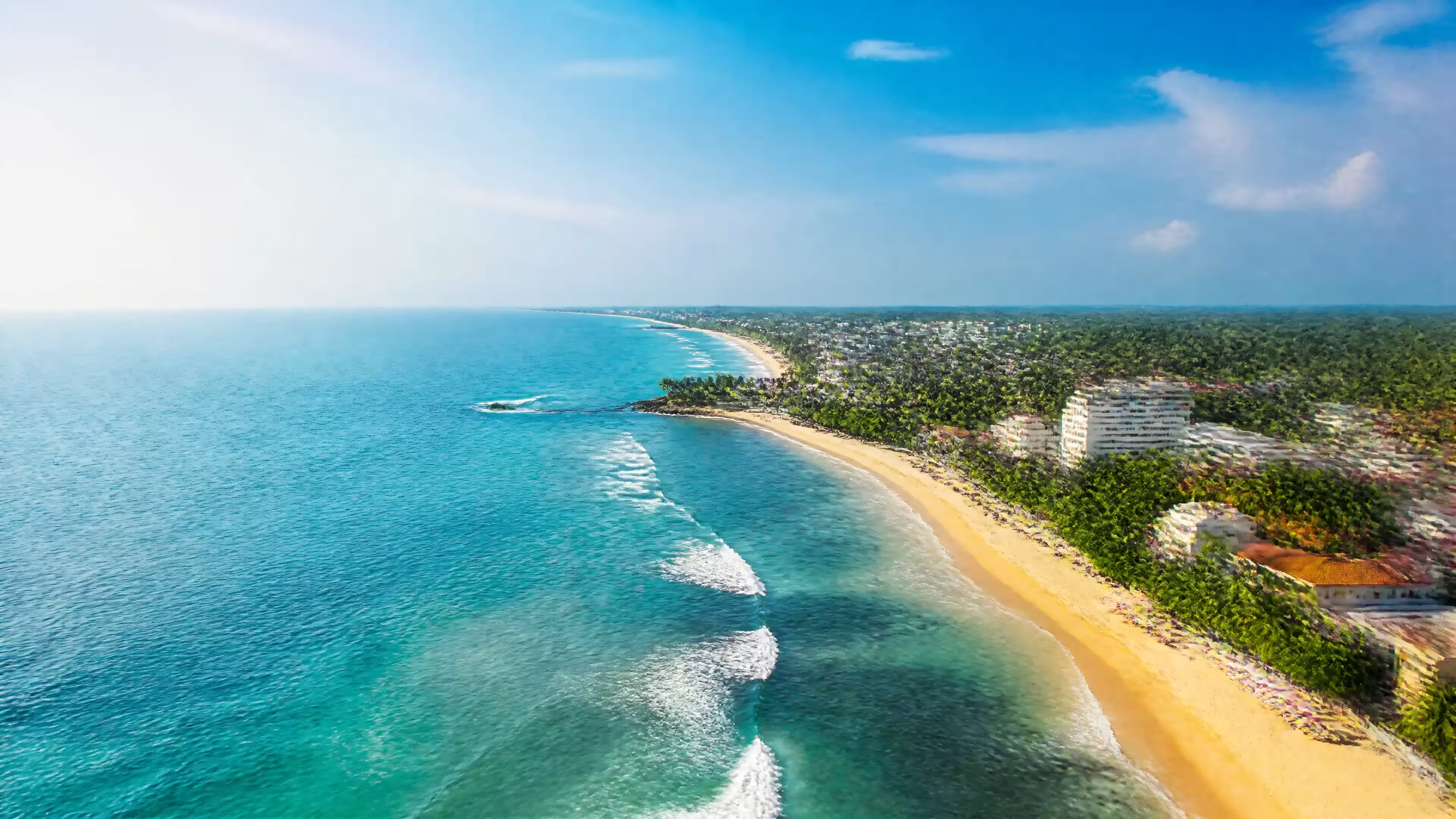
A holiday in Hikkaduwa means a calm sea and clear water by the reefs from November to April, when visibility reaches ten to twenty metres. High season falls on December–February, and accommodation is booked two to three months in advance. The flight from Almaty is with one transfer; there are no direct flights. The shoulder season in May, June and September offers discounts on hotels and guesthouses.
Swimming and snorkelling season in the south-west: when is the water calm and the visibility by the reefs good?
The south-west of the island lives by its own calendar, and a trip to Hikkaduwa depends on it directly. Below is when the water by the reefs is clear and when waves reach the shore.
Calm water and visibility by the reefs
From November to April the sea by Hikkaduwa is calm, and visibility by the reefs stays at ten to twenty metres. In December and January the water warms up to twenty-eight degrees, and snorkelling is possible almost every day. In the morning, before eleven o'clock, the surface is the smoothest, and by midday the wind picks up. The reefs by the "Coral" hotel and by the cape opposite the lagoon are considered the local spots for a mask. The current here is strong in places, so the route should be checked with those who go out to sea daily. The best takeaway for a guest is simple: plan snorkelling for the morning, and leave the beach and walks for after lunch. A trip here in these months gives what people come here for.
Waves, rain and the shoulder season
From May to October the south-west of Sri Lanka has its rainy season, and swimming in Hikkaduwa becomes a matter of chance. The waves come in large, the water near the shore turns murky, and visibility by the reefs drops to a couple of metres. Rain falls most often at night and in the first half of the day, but there can also be prolonged periods. Surfers are happy at this time, but a family holiday in Sri Lanka in Hikkaduwa is better planned for another window. The shoulder season in April and November is a compromise: the water is either still or already warm, and the crowds thin out. Sri Lankan weather is changeable, so the forecast should be checked anew every morning. For a calm sea, choose December, January and February.
When to go and how to book accommodation in the south-west?
Accommodation in Hikkaduwa varies in price several times over depending on the month and the distance from the water. Let us break down when to book in advance and when you can bargain on the spot.
High season and holiday weeks
From mid-December to the end of February Hikkaduwa fills up almost completely, and accommodation is booked two to three months in advance. Catholic Christmas, New Year and the first week of January are the peak, when prices on the beachfront rise noticeably. In these weeks tours to Hikkaduwa are taken in advance, otherwise the only choice left is distant guesthouses. The Sri Lankan New Year in April also gives a surge in domestic tourism. It is worth booking with free cancellation to leave yourself freedom. If the trip falls on the holidays, sort the matter out well in advance.
Shoulder-season discounts and lanes away from the beach
In May, June and September prices for a trip to Hikkaduwa fall, and bargaining is appropriate almost everywhere. A guesthouse in the second or third lane from the beach costs less than the beachfront, and the walk to the sea is five to ten minutes. Owners of small hotels often give way if the guest stays a week or more. Rooms with air conditioning are more expensive, with a fan cheaper, and the difference is noticeable. It is worth looking at accommodation on the spot before paying: photos on websites flatter. This approach saves the budget without losing comfort.
How to prepare for a trip from Almaty
Getting ready for the road from Almaty takes more time than it seems. Below is what to decide before departure and what to take with you.
What to arrange in advance and what to put in the first-aid kit
Permission to enter Sri Lanka for citizens of Kazakhstan is arranged online, before the trip, and the current procedure for submitting it should be checked on the official website of the immigration service. Medical insurance with coverage for activities on the water is a reasonable precaution for a holiday in Hikkaduwa. Doctors advise getting vaccinations against hepatitis A and typhoid fever about a month before departure. There are pharmacies in Hikkaduwa, but the range is limited, so bring personal medicines with a supply. Keep copies of the booking and insurance on your phone and on paper. Calm preparation saves fuss at the airport.
Rupee, cards and cash at the market
The local currency is the Sri Lankan rupee, and it is more profitable to exchange in banks in Colombo than at a hotel at the resort. Cards are accepted by large hotels and some restaurants, but at markets and in tuk-tuks you need cash. Small notes will come in handy for payments on the beach and in small cafes. There are ATMs in Hikkaduwa, but the withdrawal fee is noticeable, so it is better to exchange a large sum at once. The rate at exchangers by the beach is usually worse than the bank's. Keep part of the money separate from the main sum. This arrangement gives freedom on any day of a holiday in Hikkaduwa.
Getting around and day trips
Around Hikkaduwa it is convenient to move over short distances, and the surroundings open up on day trips. Here is what is worth knowing about transport and routes.
Tuk-tuk, scooter rental and a licence
A tuk-tuk is the main transport over short distances, and it is better to agree on the price before getting in. A trip around Hikkaduwa usually takes five to ten minutes, and the cost depends on the time of day. Renting a scooter gives freedom, but requires an international licence or a certified translation of the Kazakhstani one. A helmet is mandatory, and road traffic in Sri Lanka is left-hand, so you need to get used to it. Petrol is sold in small shops along the road. Inspect the scooter before renting and photograph the scratches. For longer trips it is more sensible to take a car with a driver.
Tea plantations and Galle Fort
Tea plantations and Galle Fort are the most popular day trips from Hikkaduwa. Galle is reached in about an hour via the southern expressway, and the old fort looks especially good towards evening. At the plantations near Kandy, they show how Ceylon tea is picked and dried, and fresh harvest is sold right there. The road to the mountains takes longer, so such a trip is planned for a full day. Take water, a hat and a light jacket: it is cooler in the mountains. Return before dark so as not to drive along the winding road at night. A holiday here combines easily with such trips.
Visa and entry rules change: check with the primary source — the Department of Immigration of the Democratic Socialist Republic of Sri Lanka, https://www.eta.gov.lk/slvisa/visainfo/weta.jsp. The information on this page was verified on 10.09.2026.
Local rules and water safety
The Sri Lankan way of life differs from the usual one, and some rules are worth knowing in advance. Below — about food, holidays and safety by the sea.
Spicy dishes, Poya and alcohol
Sri Lankan cuisine is spicy, and for a mild option it is enough to ask for not spicy. Rice and curry is a staple dish worth trying in a local eatery, not only at the hotel. Alcohol is sold in special shops, and on full moon days, which are called Poya, sales are restricted. On such days, do not plan noisy parties: locals spend them quietly. Street food is cheaper than restaurant food, but choose spots with a good flow of people. Do not drink tap water, take bottled water. Respect for local customs makes a holiday here calmer.
Currents, sun and pharmacies
The current off the coast of Hikkaduwa is strong in places, so swim where there are other people. The sun is equatorial, and high-SPF cream is needed even on cloudy days. A hat and a light long-sleeved shirt save you at midday. Drinking regime is important: dehydration here sets in unnoticed. There are pharmacies in Hikkaduwa, but the choice of medicines is limited, so bring a basic kit with you. At the first signs of severe overheating, rest in the shade and drink water. These simple habits preserve energy for the whole vacation.
Briefly
- The sea by the reefs is calm from November to April, visibility reaches twenty metres.
- Snorkelling is best planned for the morning, by lunchtime the wind picks up.
- High season is December–February, accommodation is booked two to three months in advance.
- The shoulder season in May, June and September offers discounts and bargaining on the spot.
- The flight from Almaty goes with one transfer, there are no direct flights.