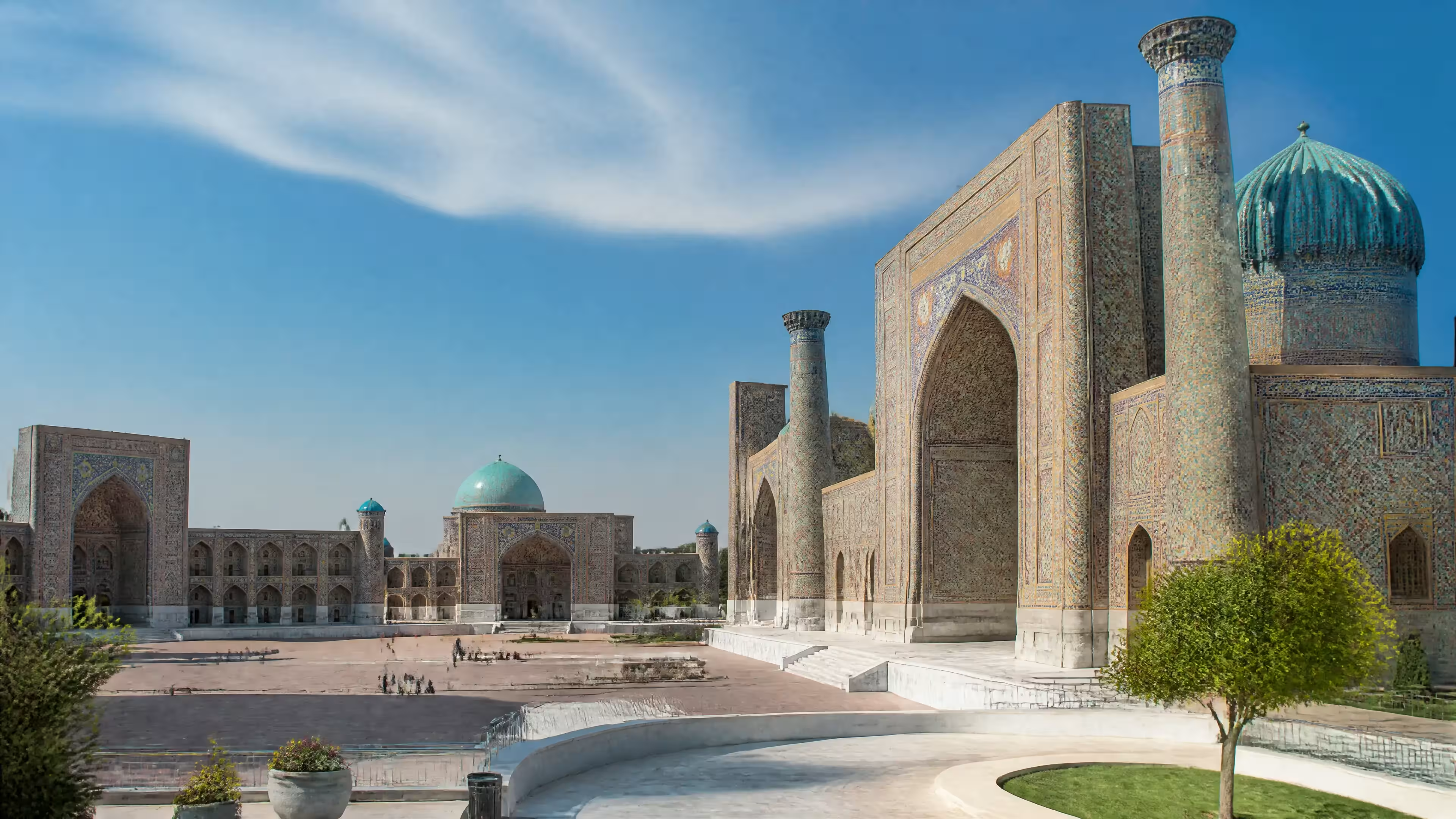
A holiday in Samarkand from Almaty takes about an hour and a half by direct flight, and that time is enough to change the setting to an oriental fairy tale. The best months for a trip are April, May, September and October: mild warmth, greenery and no exhausting heat. In winter the city is quieter and cheaper, in summer sightseeing is moved to the morning and evening.
What to consider when travelling to Samarkand from Kazakhstan
A trip here from Almaty takes less time than it seems. Money, communications and season matter here.
Money: som, exchange and a cash reserve
The currency of Uzbekistan is the Uzbek som, and cash in Samarkand is needed constantly. It is used to pay at bazaars, in taxis and in small cafes, while cards are accepted far from everywhere. Exchanging tenge directly is inconvenient, so it is more practical to bring dollars or rubles. They can be exchanged at banks and exchange offices in the city, the rate is usually better outside the airport. ATMs exist here, but on holidays and late in the evening they may be empty. A cash reserve for a couple of days ahead will save the holiday from unnecessary running around. Small notes will come in handy for taxis and tips. It is better not to carry large sums with you, but to leave them in the hotel safe.
Seasons: when to go and what to expect from the weather
The most comfortable holiday in Samarkand comes together in spring and autumn, when there is no exhausting heat. In April and May the city is drowned in greenery, the nights are still cool, and during the day there are dust winds. In summer the air heats up by noon, so sightseeing is moved to the morning and evening. Autumn gives mild warmth and the best views of the Registan madrasah. In winter it is around zero here, there is sometimes snow and fog, but prices for accommodation are noticeably lower. The Uzbek winter does not prevent walking if you take a warm jacket and waterproof shoes. Plan your trip around your own temperature comfort, not someone else's advice.
How to prepare for a holiday in Samarkand in advance?
Preparing for a trip saves time and money on the spot. Accommodation, communications and a first aid kit are worth thinking through before departure.
Accommodation: guest houses and hotels near the Registan
Accommodation in Samarkand is chosen between guest houses in mahallas and modern hotels near the Registan. A guest house gives a homely atmosphere, breakfast with flatbreads and a close acquaintance with an Uzbek family. A hotel in the centre is more convenient in location, but costs more. In April-May and September-October prices are noticeably higher than in winter. During festivals and national holidays it is worth booking one or two months in advance: there are almost no free places in the centre. When choosing, look not only at the price, but also at the walking distance to the Registan. Rooms with air conditioning are essential for a summer holiday. Check whether breakfast is included and whether there is a transfer.
SIM card, internet and taxi-hailing apps
A local SIM card is issued here with a passport, it takes about fifteen minutes. Operators Uzmobile, Beeline and Ucell sell tourist tariffs with internet right at the airport and in the city centre. Without a local number, taxi aggregator apps do not work, and they are noticeably cheaper than street cars. A taxi inside Samarkand costs little, but with a driver without a meter you bargain before getting in. The internet is enough for maps, a translator and messengers. Take a phone charger with you, the sockets here are ordinary, but an adapter may come in handy. Download an offline map of the city in case of communication disruptions.
Insurance and a first aid kit for the road
Medical insurance with coverage on the territory of Uzbekistan is a reasonable precaution for any holiday. Pharmacies exist in Samarkand, but some familiar medicines are sold under different names. Take with you painkillers, remedies for stomach upset, antipyretics and plasters. In summer add sunburn remedy and rehydration. Bring chronic medications with a supply for the whole trip and in the original packaging. Copies of prescriptions in Latin script will not hurt. Keep the insurance policy in your phone and in printed form.
What is important to know about local rules and safety?
Samarkand is a city with strong traditions, and a tourist should respect them. Clothing, filming and hygiene require attention.
Clothing and behaviour at mosques and mazars
In Samarkand there are many active mosques and mazars, and at the entrance women need a headscarf. Men and women should choose closed clothing down to the knees and shoulders. Shorts and T-shirts are appropriate by the hotel pool, but not in holy places. Shoes are removed where asked, usually at the entrance to the prayer hall. Loud conversations and laughter at mazars are perceived as disrespect. Photographing worshippers is not customary. If you are unsure about the rules, look at the behaviour of locals and repeat it. Uzbek politeness to a guest does not cancel these norms.
Photographing people and paid mausoleums
It is better to photograph people in Samarkand with permission, especially women. A gesture and a smile decide more than words if the language barrier gets in the way. In some mausoleums filming inside is paid or prohibited, signs at the entrance say so. The cost of such filming is small, but you need to pay on the spot. A tripod and a professional camera sometimes require separate permission. Street traders and artisans are usually not against a photo if you have bought something from them. Children on the streets willingly pose, but ask their parents for permission. Respect for people is more important than a successful shot.
Water, food and hygiene at bazaars
It is not worth drinking tap water in Samarkand even for locals. It is safer to buy bottled water, and wash fruit and vegetables with boiled water. Uzbek cuisine in Samarkand differs from the general regional one: local plov, samsa and flatbreads are made according to their own recipes. The portions are large, so order gradually. At bazaars, try food cautiously, especially dairy products and street salads. Hot and freshly prepared food is safer. Wipe your hands with napkins or wash them where there is water with soap. It is better not to take ice in drinks on the street.
What to do in the city besides excursions?
A holiday in Samarkand is not limited to visiting mosques and mausoleums. The city opens up through crafts and bazaar bustle.
Crafts, silk and ceramics in workshops
Samarkand workshops are open to guests and show crafts live. Here they make silk paper, paint ceramics and weave carpets. In the workshop near Registan you can see the whole process from thread to finished scarf. The hosts willingly talk about the technique and let you try it yourself. Prices for items are higher than at the bazaar, but the quality and authorship are obvious. A short pottery lesson takes about an hour and is suitable for a family with children. Uzbek suzani embroidery is sold right where it is embroidered. Buying directly supports the craftsmen and leaves a memory of the trip.
Siab Bazaar: souvenirs and bargaining
Siab Bazaar is the best place in Samarkand for souvenirs and getting to know local life. Here they bargain, and prices are noticeably lower than in the shops near the main attractions. Start at half the named sum and do not rush to agree. Spices, dried fruits, nuts and flatbreads are bought right here. Uzbek ceramics, chased metalwork and fabrics are also abundant. Come in the morning, when the counters are full and the sellers are more agreeable. Bargaining here is part of communication, not a conflict. Small-denomination cash will simplify payment.
How tours to Samarkand are organized: booking and payment
Tours to Samarkand are put together in advance so as not to solve everyday issues on the spot. The organizer takes on documents, accommodation and logistics.
Visa and entry rules change: check with the primary source — the MFA of the Republic of Uzbekistan, https://gov.uz/en/mfa/activity_page/o-zbekiston-respublikasi-vizasi. The information on this page was verified on 10.09.2026.
In short
- There is no time difference with Almaty: Uzbekistan, like Kazakhstan, is on UTC+5 all year round.
- Cash sums will be useful at bazaars, in taxis and small cafes.
- Accommodation near Registan is booked one to two months before high season.
- A local SIM card is issued by passport; without it, taxi apps do not work.
- Medical insurance with coverage in Uzbekistan is a reasonable precaution.